
Toilet transfer safety is the planning of how a person lowers onto a toilet, rises from it, and turns in the space around it. Each of those moves depends on seat height, a stable hand support, and clear floor room. The stakes are measurable: more than one out of four older people falls each year1. This guide is written for proactive older adults and for the families helping them plan. It covers the whole topic, from seat height and grab points to space, transfer method, and when to ask an occupational therapist.
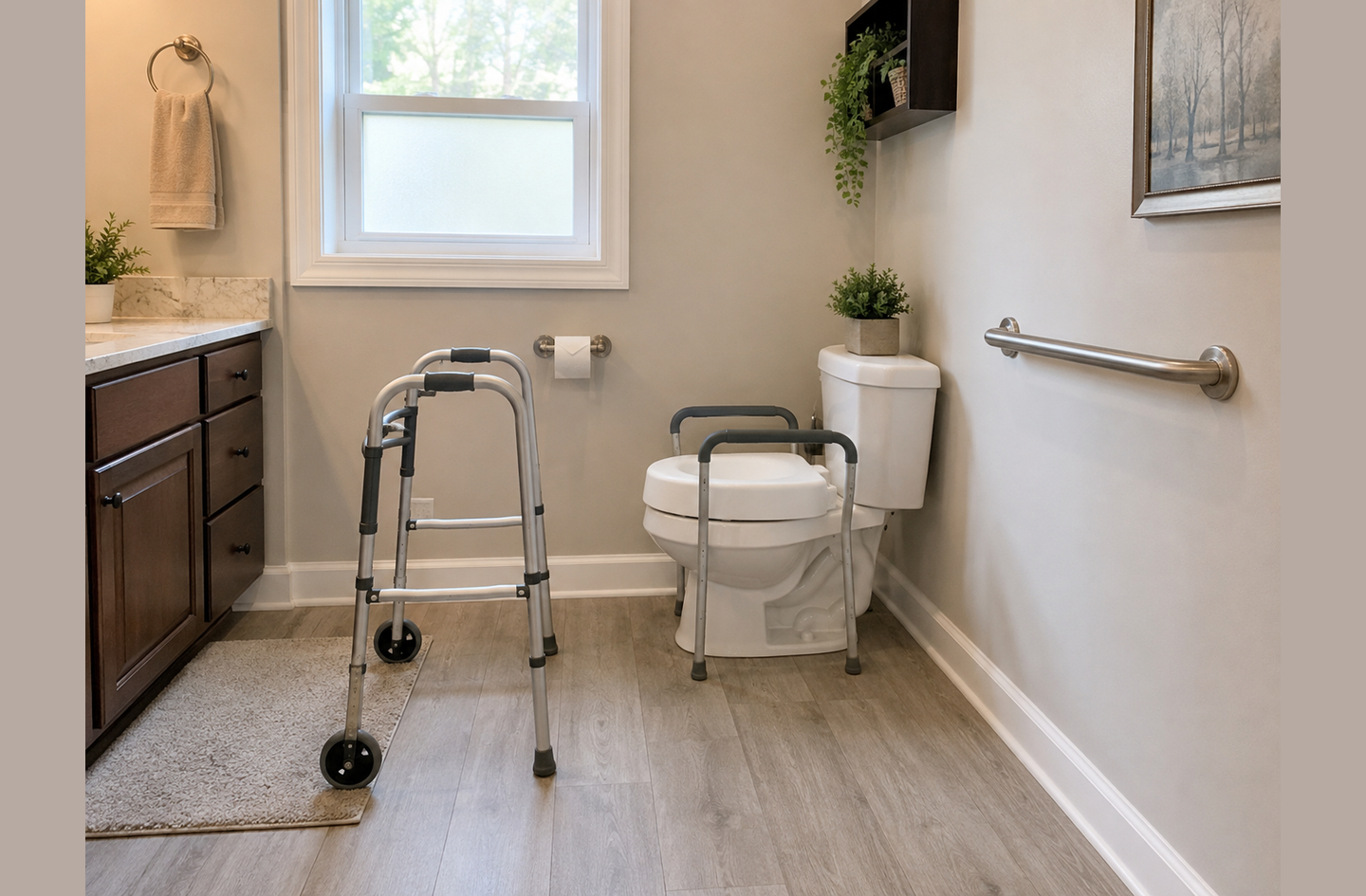
Quick Answer
What is Toilet Transfer Safety?
Toilet transfer safety is the match between a person’s sit-to-stand ability and the toilet setup: seat height, hand support, clear space, and transfer method. The ADA Standards set a seat height of 17 to 19 inches for accessible public toilets2, a useful reference rather than a home prescription.
Why it matters:
A transfer happens several times a day, so small mismatches add up to cumulative load.
Key Takeaways
- In 2008, an estimated 234,094 nonfatal bathroom injuries were treated in U.S. emergency departments, and 81.1% were caused by falls3.
- Injuries on or near the toilet rose from 4.1 per 100,000 people aged 15 to 24 to 266.6 per 100,000 at age 85 and older3.
- In a trial of 310 older adults, whole-home hazard removal produced a 38% reduction in the rate of falling5.
- A toilet transfer works as a system of five parts: seat height, hand support, space and route, transfer method, and knowing when to escalate.
- The most common misconception is that more seat height is always better, when foot contact and arm support decide whether a rise feels controlled.
Toilet Transfer Safety in 30 Seconds
| If you are… | Do this |
|---|---|
| Rising from the toilet in several tries | Measure seat height first, then add arm support before adding more height. |
| Using a walker | Clear a straight approach, park the walker within reach, and push up from fixed supports. |
| Using a wheelchair | Map the transfer side and clear floor space before choosing any bar or frame. |
| Renting or avoiding drilling | Compare a toilet-mounted frame or a tension pole with a landlord-approved wall bar. |
| Recovering from hip or knee surgery | Get seat height and movement precautions from the care team, then fit equipment to them. |
| Helping a parent with transfers | Watch one full transfer, note each hesitation point, and ask an OT before any lifting. |
What Is Toilet Transfer Safety?
Toilet transfer safety is the planning discipline that matches a toilet setup to the way a specific person sits down, stands up, and turns. It covers the seat, the supports around it, the floor and approach, and the movement method. The goal is a transfer that feels controlled every time, not one that depends on a lucky grab.
Sit-to-stand is the movement of rising from a seated position to standing, and its reverse is controlled lowering. Both phases load the knees and hips most at the lowest point, which is why seat height changes effort so much. Hand support shares that load with the arms. Firm foot contact gives the legs a stable base to push from.
The topic includes raised toilet seats, comfort-height toilets, toilet safety frames, wall grab bars, transfer poles, floor surfaces, and lighting on the night route. It also includes the space a walker, wheelchair, or helper needs. It excludes medical treatment, personal therapy plans, and structural design for a specific wall. Those decisions belong with an occupational therapist, a physician, or a licensed contractor.
Public accessibility rules supply a reference geometry. The ADA Standards call for a toilet seat 17 to 19 inches high, measured to the top of the seat. The toilet centerline sits 16 to 18 inches from the side wall2. Those numbers describe public facilities. A home plan starts from the person and then uses the standard as a cross-check.
Why Toilet Transfer Safety Matters
Toilet transfer safety matters because the bathroom packs hard movements into a small room with hard surfaces. A CDC analysis estimated that 234,094 nonfatal bathroom injuries were treated in U.S. emergency departments in 20083. The same report found that injury rates near the toilet climbed steeply with age, reaching 266.6 per 100,000 people aged 85 and older3.
The wider fall picture explains the stakes without any need for fear. Each year there are about 4.5 million emergency department visits due to falls among older people1. In 2023, the unintentional fall death rate for adults 65 and older was 69.9 per 100,0004.
The encouraging part is that the home itself can change the odds. A randomized trial of home hazard removal enrolled 310 older adults living in their own homes5. Its authors, Stark and colleagues, reported a clear result:
There was a 38% reduction in the rate of falling in the intervention group compared with the control group
That trial tested a whole-home program, not toilet equipment alone. It still shows that changing the setup, not only the person, can reduce avoidable risk. Three gaps account for most toilet transfer friction:
- Height mismatch: a seat that is too low forces deep knee and hip bending at the hardest point of the rise.
- Support gaps: towel bars, sink edges, and walkers get used as handholds they were never built to be.
- Space conflicts: a door, vanity, or frame blocks the turn, the wheelchair approach, or the helper.
The Five-Part Toilet Transfer Safety Framework
The Five-Part Toilet Transfer Safety Framework splits every transfer into five checks: height, support, space, method, and escalation. The parts were grouped from the friction points people describe at the toilet, reduced to the smallest set that still covers the topic. Each part can be checked alone, but a change to one is rechecked against the others.
Seat Height and Vertical Travel
Seat height sets how far the body must travel and how deeply the knees and hips bend at the start of a rise. Height is measured from the finished floor to the top of the seat. The working check is simple: feet flat on the floor and knees near hip level. A raised toilet seat is a removable riser that clamps or locks onto the bowl to add height without replacing the fixture. A comfort-height toilet adds height permanently. Weight capacity, bowl shape, bidet hardware, and post-surgery precautions all shape which option fits.
More height is not automatically better: once the feet lose firm floor contact, the rise trades an effort problem for a balance problem.
Deeper read: how to measure toilet seat height for easier transfers.
Deeper read: choosing a raised toilet seat for lower-effort transfers.
Deeper read: comfort height toilet vs raised toilet seat.
Deeper read: comfort height vs standard height toilets for transfers.
Deeper read: installing a raised toilet seat with stability checks.
Deeper read: raised toilet seat weight limits and side loading.
Deeper read: bidet compatibility with raised toilet seats.
Deeper read: raised toilet seats after knee or hip surgery.
Hand Support and Push-Off Points
Hand support lets the arms share the work of rising and lowering, and it gives a fixed point to steady the turn. A toilet safety frame is a set of armrests that mounts to the toilet or stands on the floor around it, placing a handhold on each side. Wall grab bars carry load through framing or blocking behind the wall, so their strength depends on anchoring as much as on the bar. The ADA reference places grab bars 33 to 36 inches high, with a side bar at least 42 inches long2. Floor-to-ceiling poles and seat-mounted handles fill gaps where no wall sits in the right place.
The best support is the one the hand reaches at the moment of greatest effort, which tends to be low and close rather than high on a far wall.
Deeper read: raised toilet seat vs toilet safety frame.
Deeper read: choosing a stable toilet safety rail.
Deeper read: toilet safety frame vs grab bars.
Deeper read: fixed vs swing-away grab bars for toilet transfers.
Deeper read: floor-to-ceiling toilet safety poles.
Deeper read: raised toilet seats with handles.
Space, Floor, and the Route
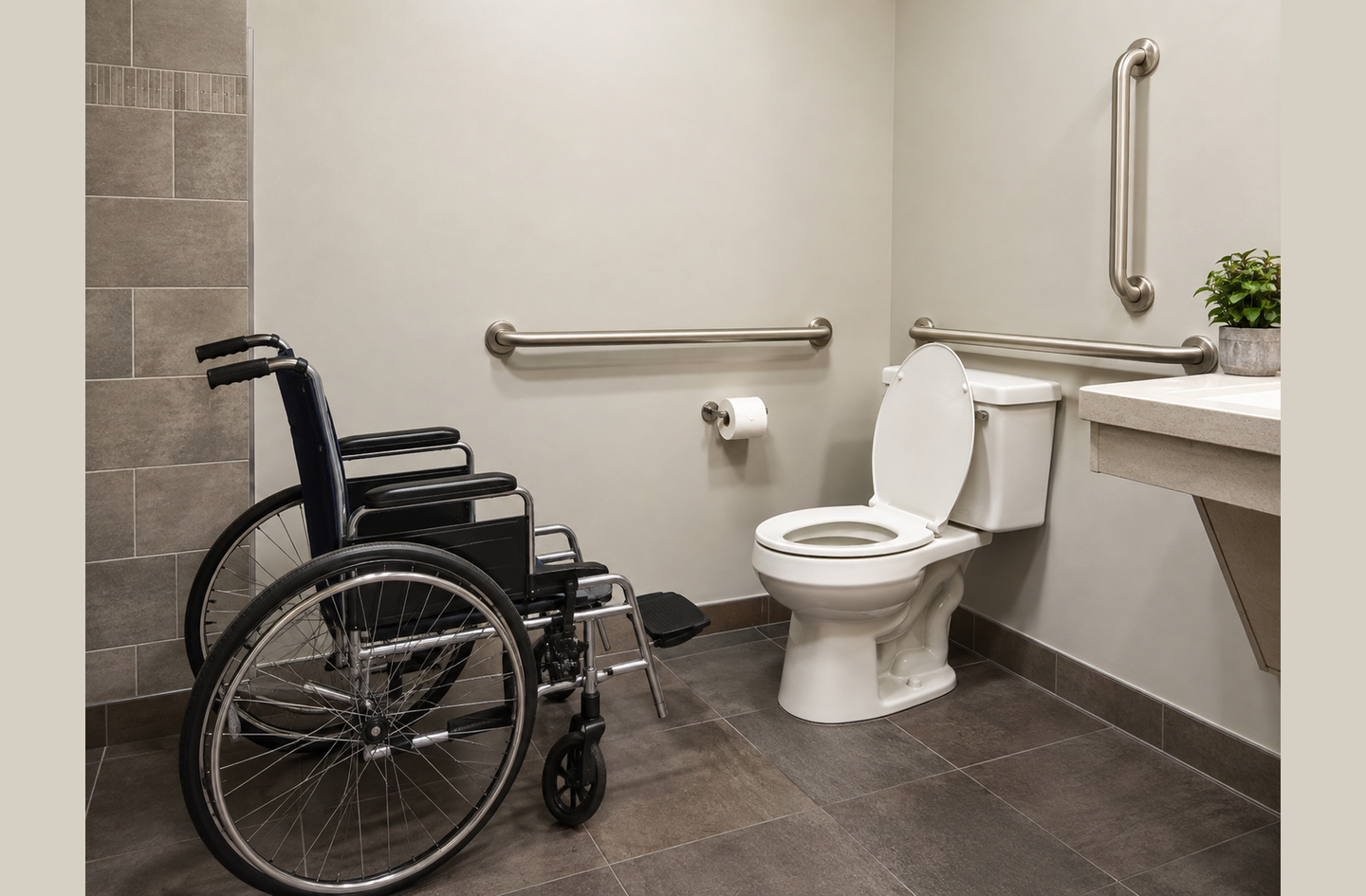
Clear floor space is the open area beside and in front of the toilet where feet, a mobility aid, or a helper can stand without obstruction. The ADA reference for an accessible toilet is a clearance at least 60 inches wide and 56 inches deep2. Few home bathrooms match that, so the plan decides which side the transfer uses and what can move out of the way. The floor counts too, since a curled mat edge or wet tile can undo a well-chosen seat. At night, the route from bed to toilet needs low-glare light and visible edges.
A small bathroom is a sequencing problem before it is a remodeling problem: decide the transfer side first, then fit equipment around it.
Deeper read: wheelchair toilet clearance.
Deeper read: wheelchair toilet transfers in small bathrooms.
Deeper read: bathroom rugs and traction near the toilet.
Deeper read: lighting and routes for nighttime toilet trips.
Transfer Method: Walker, Wheelchair, Board, or Helper
Transfer method is the movement pattern itself, and it changes what the setup must provide. A walker user approaches, turns in small steps, and sits, so the walker stays parked within reach instead of serving as a push-off point. A wheelchair user needs the chair angled close, brakes locked, and footrests clear. A transfer board is a smooth plank that bridges the gap between a wheelchair seat and the toilet for a seated slide. When a helper assists, body mechanics, cueing, and a gait belt matter more than any single fixture.
Equipment should be chosen after the method is known, because a frame that helps a walker user can block a wheelchair side transfer.
Deeper read: toilet transfers with a walker.
Deeper read: wheelchair-to-toilet transfer setup.
Deeper read: transfer boards for toilet transfers.
Deeper read: caregiver body mechanics, cueing, and gait belts.
Knowing When to Escalate
Escalation is the point where added height and handholds no longer meet the demand of the transfer. A bedside commode shortens the distance at night, or replaces the trip when the walk is the real problem. A powered toilet lift seat raises and lowers the person mechanically when the sit-to-stand itself has become too hard. Repeated failed rises, new falls or near-falls, a new mobility aid, or helper strain are signals to bring in an occupational therapist.
Escalating early is not a sign of failure; it is the cheapest point to correct a setup, while the person can still test options and choose.
Deeper read: raised toilet seat vs bedside commode.
Deeper read: powered toilet lift seats.
Deeper read: when to ask an occupational therapist about toilet transfers.
How to Choose the Right Toilet Transfer Safety Setup
The most important criterion is the person’s actual transfer, observed once from start to finish, not the product category. Watching where the person grips, hesitates, or drops into the seat shows which part of the framework is failing.
- Observe one full transfer. Note foot position, where the hands go, and whether the person lands hard or rises in several tries.
- Measure the seat. Accurate numbers start with toilet seat height for easier transfers, measured from the finished floor and compared with seated knee height.
- Name what is missing. The choice between a raised toilet seat and a toilet safety frame turns on whether the gap is height, support, or both.
- Check space and approach. Walk the route with the walker, wheelchair, or helper, and note door swing and vanity edges.
- Confirm anchoring and fit. Wall bars need solid backing. Clamp-on seats need a bowl match and a no-rock check after installation.
- Retest and recheck. Repeat the transfer with the new setup, then recheck fasteners and fit on a regular schedule.
Some findings call for a professional review rather than a purchase. A wall with unknown framing needs a licensed contractor before any bar goes up. A transfer that needs lifting, or one bound by post-surgery precautions, needs an occupational therapist.
Compare All Toilet Transfer Safety Options
Toilet transfer safety options differ in which part of the transfer they change, how they attach, and how much floor space they take.
| Criteria | Raised toilet seat | Toilet safety frame | Wall grab bar | Floor-to-ceiling pole | Commode or lift seat |
|---|---|---|---|---|---|
| Main job | Reduces vertical travel | Adds armrests on both sides | Fixed handhold in the wall | Vertical handhold where no wall fits | Replaces the trip or powers the rise |
| Attachment | Clamps or locks onto the bowl | Bolts to the toilet or stands on the floor | Anchored into framing or blocking | Tension fit between floor and ceiling | Freestanding; lift seat needs power |
| Footprint | Within the bowl outline | Adds width on both sides | Wall only | One pole beside the toilet | Largest; needs open floor |
| Reversible | Yes | Yes | Leaves fastener holes | Yes, if the ceiling is sound | Yes |
| ADA reference | Seat 17 to 19 in high | No ADA equivalent | Bar 33 to 36 in high | No ADA equivalent | No ADA equivalent |
| Best fit | Low seat, steady feet | Needs a push from both hands | Long-term plan, sound walls | Awkward wall layout | Night urgency or very hard rises |
Choose a raised toilet seat if: the main problem is the depth of the rise and the feet still rest flat at the new height.
Choose a toilet safety frame if: the person rises better with a push from both hands and the room has width to spare.
Choose a wall grab bar if: the wall can be anchored and a permanent handhold fits the transfer side.
Choose a floor-to-ceiling pole if: no wall sits where the hand needs support during the turn.
Choose a commode or lift seat if: the walk or the rise itself has outgrown height and handholds.
Deeper read: raised toilet seat vs toilet safety frame.
Common Mistakes
Mistake 1: Adding Maximum Height by Default
Why it is a mistake: Extra height shortens the rise, but a seat set too high can leave the feet light on the floor or dangling. The legs then lose their stable base, and the person slides forward to land. That adds a balance problem at the exact moment of sitting. The ADA range of 17 to 19 inches is a reference for public toilets, not a target for every body2.
What to do instead: Measure the current seat and check that the feet rest flat at the proposed height. Add only the height the transfer needs, and pair moderate height with arm support before adding more.
Read more: how to choose a raised toilet seat.
Mistake 2: Using a Towel Bar, Sink, or Walker as a Grab Point
Why it is a mistake: Towel bars and sink edges are not built or anchored to carry body weight, and a walker can roll or tip when pushed sideways. These handholds feel firm under a light touch but can let go under the sudden, angled pull of a stumble. In the CDC bathroom injury analysis, 81.1% of injuries were caused by falls3.
What to do instead: Provide a purpose-built support where the hand naturally reaches during the rise. Keep the walker parked within reach for the walk out, not under the hands for the push.
Read more: toilet safety frame vs grab bars.
Mistake 3: Choosing Equipment Before Checking Space
Why it is a mistake: A frame with fixed arms can narrow the seat, block a wheelchair side transfer, or crowd a helper out of position. A door that swings into the toilet zone can trap the user. The ADA reference clearance of 60 by 56 inches shows how much room an accessible transfer is planned around2, and few home bathrooms have it.
What to do instead: Measure side space, front space, door swing, and vanity edges first. Then choose removable, swing-away, or narrow supports that keep the transfer side open.
Read more: planning transfers in small bathrooms.
Mistake 4: Setting Up Once and Never Rechecking
Why it is a mistake: Clamps loosen, bolts creep, and seats shift as a riser or frame is loaded several times a day. Needs change too, after surgery, with a new walker, or as strength varies. A setup that fit well in spring can rock or feel too low by winter.
What to do instead: Recheck fasteners and rocking on a regular schedule. Retest the whole transfer after any change in health, mobility aid, or helper, and ask an occupational therapist when rises repeatedly fail.
Read more: raised toilet seat stability checks.
Best Toilet Transfer Safety Setup by Use Case
Toilet transfer safety setups work best when matched to one transfer pattern. Four common profiles cover a wide range of homes.
Best for Independent Walkers Planning Ahead
An older adult who still stands without help, but notices more effort on low seats, gains most from measurement and modest changes. A raised seat or comfort-height toilet that keeps the feet flat, paired with one well-anchored grab bar on the natural reaching side, lowers effort without making the room look clinical. This is the stage where observation, not renovation, does the most good.
Deeper read: comfort height toilet vs raised toilet seat.
Best for Walker Users
A walker user needs a clear, straight approach and a turn made in small steps. Supports belong where the hands go after letting go of the walker, which points to frame arms or a bar beside the seat. The walker stays parked within reach and is never used to pull up. Night trips add lighting and route planning on top of the transfer itself.
Deeper read: toilet transfers with a walker.
Best for Wheelchair Users
A wheelchair transfer is most often a side transfer, so the open side of the toilet matters as much as its height. The chair angles close to the seat, brakes lock, and footrests swing clear before the move. Swing-away or flip-up supports keep the transfer side open, while a transfer board can bridge a height difference. Board use depends on the person, so an OT or PT should select it and train the technique.
Deeper read: wheelchair-to-toilet transfer setup.
Best for Recovery After Surgery
Temporary needs after hip or knee surgery follow the care team’s movement precautions, not a generic seat height. The surgeon, OT, or PT sets the limits on bending and how long they last. The home plan then fits a removable raised seat and arm support to those limits, checks walker clearance, and removes the equipment once it is no longer needed.
Deeper read: raised toilet seats after knee or hip surgery.
Frequently Asked Questions
What is the right toilet seat height for older adults?
No single toilet seat height suits every older adult. The ADA Standards set 17 to 19 inches, measured from the floor to the top of the seat, for accessible public toilets2. That range is a planning reference, not a home prescription. The better test is personal: feet flat on the floor, knees near hip height, and a rise that starts without rocking. Taller people and anyone recovering from surgery can need a different height, set with an occupational therapist.
Is a raised toilet seat or a toilet safety frame better?
A raised toilet seat and a toilet safety frame solve different problems. The seat reduces vertical travel, while the frame adds handholds for pushing up and lowering down. Many transfers need both functions, but combining them means checking that the frame fits around the riser and the arms sit at a usable height. The ADA reference for grab bar height, 33 to 36 inches to the top of the gripping surface, is one helpful comparison point2.
Where should grab bars go around a toilet?
Grab bars around a toilet belong where the hand reaches during the rise and the turn, on the side wall and behind the toilet. The ADA reference calls for a side bar at least 42 inches long and a rear bar at least 36 inches long2. CDC guidance on bathroom injuries recommends installing grab bars next to toilets3. Every bar needs solid anchoring into framing or blocking, which a licensed contractor should confirm before use.
When should an occupational therapist assess toilet transfers?
An occupational therapist should assess toilet transfers after repeated failed rises, a new fall or near-fall, surgery, a new mobility aid, or any transfer that needs lifting. The stakes are real: falls among older people lead to about 4.5 million emergency department visits each year1. An OT watches the actual movement in the actual bathroom, then recommends equipment and technique. No general guide can replace that individual assessment.
How This Guide Was Built
The methodology behind this guide combines public accessibility standards, federal injury and fall statistics, and peer-reviewed research on home hazard removal. Every figure links to the page that states it, and each source was checked for its exact supporting sentence before publication. The five-part framework was derived by mapping every planned and published toilet transfer guide in this cluster to the physical job it does. The guide was drafted with AI assistance under the editorial responsibility of Oded Feigin, founder and lead author of Home Age Fit, on October 3, 2026. It is revised whenever a cited standard or statistic changes.
What This Hub Does Not Cover
- Shower and tub transfers involve wet surfaces and different supports, so they belong to bathroom shower planning rather than this hub.
- Medical guidance after surgery, including movement precautions and how long they last, comes from the surgeon, OT, or PT.
- Structural decisions about walls, ceilings, and blocking for grab bars or poles need a licensed contractor.
- Patient lifts and mechanical hoists for people who cannot bear weight are a clinical equipment decision for a therapy team.
References
- Centers for Disease Control and Prevention – Older Adult Falls Data and Facts
- U.S. Access Board – Guide to the ADA Accessibility Standards, Chapter 6: Toilet Rooms
- CDC Morbidity and Mortality Weekly Report – Nonfatal Bathroom Injuries Among Persons Aged 15 Years and Older, United States, 2008
- National Center for Health Statistics – Data Brief No. 532, Deaths From Unintentional Falls Among Older Adults
- Stark et al., JAMA Network Open – Home Hazard Removal to Reduce Falls Among Community-Dwelling Older Adults, randomized clinical trial
Next Read
Toilet transfer safety comes down to matching height, support, space, and method to one person’s actual transfer, then rechecking as needs change. Physics, not popularity, should decide the equipment. Hand support is where many setups start, so the stability of the frame or rail is a natural next decision.
Choose a stable toilet safety frame for sit-to-stand support