
The geometry of a toilet transfer matters more than most people expect. Each time someone lowers onto or rises from a toilet, the body shifts its center of mass forward, loads the knees and hips, and depends on arm push-off to complete the movement. A toilet safety rail, placed well, reduces that load significantly. Our overview on Toilet Transfer Safety covers the full transfer picture; this article focuses specifically on how toilet-mounted and floor-standing rail designs compare across the dimensions that determine whether a frame actually supports you. In 2008, an estimated 234,094 Americans received emergency care for nonfatal bathroom injuries1.
Quick Answer
What matters most when choosing between toilet-mounted and floor-standing toilet safety rails?
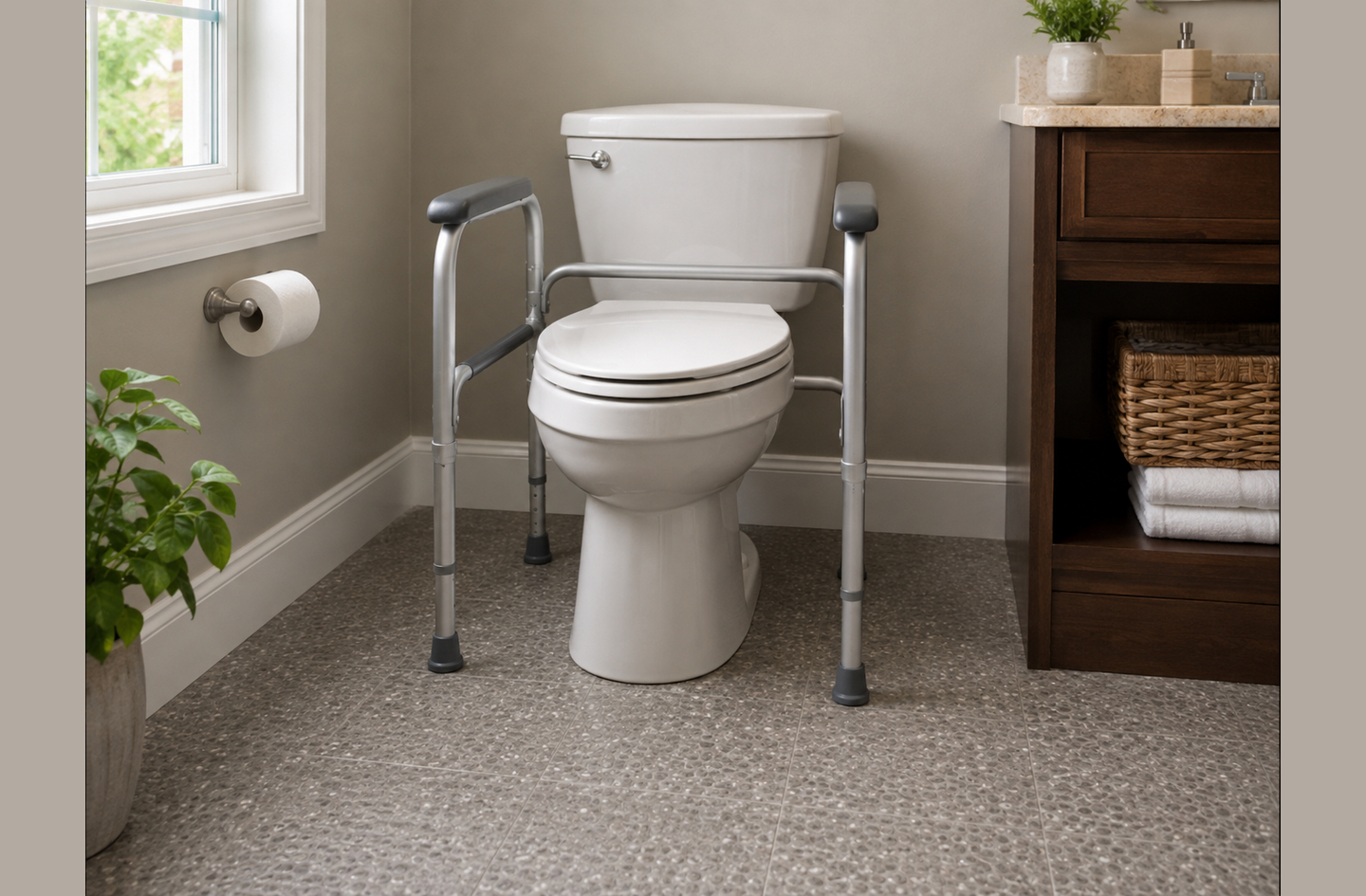
Floor-standing frames are structurally independent from the toilet, anchoring their load directly to the bathroom floor. That makes them more stable laterally and less sensitive to variations in bowl shape or mounting hardware. Toilet-mounted frames are easier to install and remove but transfer their load through the toilet’s bolt points. For sit-to-stand support with meaningful weight bearing, the floor-standing geometry is more reliable. Among adults 85 and older, toilet transfers account for nearly 37% of all bathroom emergency department visits1, which makes the structural choice worth getting right.
Key Takeaways
- Toilet-mounted frames clamp to the toilet’s mounting bolts and may flex on oval bowls or worn hardware; floor-standing frames anchor to the bathroom floor and are structurally independent from the toilet fixture.
- Floor-standing frames typically span 18 to 22 inches between armrests and adjust from 28 to 34 inches in height; toilet-mounted frames cover a similar height range but draw their stability from the toilet’s own anchor points, which limits how much lateral force they absorb.
- Adding a raised toilet seat to a toilet-mounted frame changes the effective arm height by 2 to 4 inches and can conflict with the riser’s own mounting hardware; a floor-standing frame maintains its calibrated arm position regardless of what sits on the toilet bowl.
Toilet Safety Rails: Mounted vs Floor-Standing Frame Compared
These two designs share the same goal: give you something firm to push against when sitting down and standing up from the toilet. They differ in where that structural load goes, how much each tolerates variation in body size and toilet shape, and what trade-offs they ask you to accept in exchange for their respective strengths.
| Factor | Toilet-Mounted Frame | Floor-Standing Frame |
|---|---|---|
| Structural anchor | Toilet mounting bolts | Bathroom floor (4 to 6 legs) |
| Lateral stability | Moderate; depends on bowl fit | Higher; floor-independent |
| Width between armrests | 17 to 20 inches (typical) | 18 to 22 inches (typical) |
| Height adjustment range | 28 to 34 inches above floor | 28 to 34 inches above floor |
| Effect of raised seat | Raises arms relative to frame; may conflict with riser hardware | No effect; frame stays calibrated to its own leg setting |
| Typical weight rating | 250 to 300 lb | 250 to 400 lb |
| Oval bowl compatibility | Variable; confirm bowl dimensions before purchase | Generally compatible; legs adjust to floor position |
| Floor clearance needed | Minimal; clamps directly to toilet | Legs extend 4 to 8 inches beyond bowl edge on each side |
| Installation | Low effort; tool-free on most models | Low to moderate; legs require leveling on uneven floors |
| Best suited for | Space-limited bathrooms, renters, lighter users | Higher weight bearing, lateral instability, raised seat combinations |
Lateral Stability: Which Design Holds Steadier?
Floor-standing frames hold steadier under lateral force because their load path reaches the floor directly, without passing through the toilet fixture. That distinction matters most when the force applied during a transfer is not purely vertical – which is most of the time.
When you push against a toilet safety rail to stand, the force is rarely straight down. It arcs forward and outward as you shift your weight from seated to standing. A toilet-mounted frame transmits that lateral component through the bowl’s mounting bolts, through the toilet base, and into the floor via the wax ring and subfloor connection. That is a longer, less direct structural path than a floor-standing frame’s legs, which contact the floor at multiple points surrounding the bowl.
Research on bilateral grab bars during toilet transfers found that properly positioned arm supports reduce peak extension moments at the hip, knee, and ankle – decreasing the muscle effort required to complete the movement4. The mechanism works regardless of frame type. The question is whether the frame holds its position while those forces are applied. A floor-standing frame with rubber-tipped legs on a non-slip surface moves less under lateral load. A toilet-mounted frame’s clamping mechanism performs best on round bowls where the clamp geometry fits flush; oval bowls introduce a small gap in the clamping contact that reduces rigidity under side force.
This does not make toilet-mounted frames structurally inadequate. Most perform well within their rated capacity. The point is that their stability depends on a confirmed fit between the frame’s clamping geometry and the specific bowl shape. Manufacturers list bowl dimension ranges for this reason. Confirming that match before purchase is not optional – it is the primary structural check for that frame type.
“Participants who had a grab bar were 75.8% more likely to recover their balance during the task than those who did not have a grab bar.”3
Levine, Montgomery, and Novak, researchers, Human Factors (Sage Journals, 2023)
The balance-recovery benefit of any support point is substantial. Frame type determines how reliably that support point stays in position under the exact forces a specific person applies in a specific bathroom.
Verdict: Floor-standing frames win on lateral stability because they anchor to the floor independently. Toilet-mounted frames are competitive when the bowl fit is confirmed and lateral transfer forces are moderate.
Rail Width and Transfer Clearance
Rail width determines whether you can place your hands close enough to your body to generate effective push-off leverage. The right width is the one that matches your shoulder width and transfer direction – wider is not inherently better.
Toilet-mounted frames typically position their armrests 17 to 20 inches apart. Floor-standing frames span 18 to 22 inches, and some models offer width adjustment between those bounds. For a standard sit-to-stand transfer – both feet on the floor, leaning slightly forward to shift weight, then pressing through both arms to rise – an armrest span of 18 to 20 inches serves most adults well. Arms set too far apart reduce the mechanical advantage of elbow extension. Arms set too close together leave insufficient space to complete a sideways transfer from a wheelchair or shower bench.
Transfer clearance is the related dimension: how much open space the frame leaves on either side of the toilet for foot positioning, for a caregiver’s stance, or for maneuvering a walker into place beside the bowl. Floor-standing frames extend their legs outward from the bowl, narrowing the floor area on two sides. That trade-off is real and is covered in more detail in the floor space section below.
Some floor-standing models offer swing-away armrests that fold down or to the side to open a lateral transfer path. This is useful for wheelchair-to-toilet transfers where one rail needs to clear completely. Toilet-mounted frames rarely offer this feature. If a lateral transfer is part of the daily routine, the floor-standing design’s configuration options make it the more practical starting point.
For walker users who approach the toilet at an angle, the arm on the approach side carries more load during the lowering phase. Some floor-standing frames allow independent height adjustment of left and right arms, which lets you compensate for an asymmetric approach or for differences in right-versus-left arm strength. That flexibility is not available on standard toilet-mounted models.
Verdict: Both design types cover a similar width range. Floor-standing frames offer more configuration options (swing-away arms, independent height adjustment) but require more floor clearance to achieve them.
Height Adjustability and Arm Position
Both frame types adjust within a similar range, typically 28 to 34 inches from the floor to the top of the armrest pad. The ADA standard for toilet seat height is 17 to 19 inches above the finished floor5. Effective push-off usually requires an armrest positioned 8 to 12 inches above the seated height, which places the target armrest range at roughly 25 to 31 inches for a standard-height toilet.
The mechanism for both types is the same in principle: pin-and-hole or twist-lock leg adjustment, moving in 1-inch increments on most consumer models. The critical difference is the reference plane each design uses.
A floor-standing frame adjusts its arm height relative to the bathroom floor. Whatever height you set the legs to, that is the arm height you get, regardless of what the toilet sits at. A toilet-mounted frame adjusts relative to the toilet’s mounting point. The toilet’s own height becomes part of the equation, and any deviation from standard toilet height shifts the frame’s arm position accordingly.
For a standard 15-inch toilet bowl with a seat bringing total seated height to 17 or 18 inches, this difference is small. It becomes more noticeable in older homes with non-standard toilet heights, in bathrooms where a comfort-height toilet (17 to 19 inches to the rim, before seat) changes the reference point, or when a raised seat is installed on top. The floor-standing frame’s clean floor-to-arm reference simplifies the setup in any of those situations.
ADA wall-mounted grab bar standards specify placement between 33 and 36 inches above the finished floor5. Home-use safety frames are not required to meet wall-bar ADA specifications, but this height range is worth noting for users who need a higher push-off point. People with limited hip mobility who cannot lean far forward at the start of a stand benefit from a higher arm position, which allows them to begin the push-off phase earlier in the movement arc.
Verdict: Adjustable height range is comparable. Floor-standing frames use the floor as their reference, which makes calibration more straightforward when toilet height varies or a raised seat is in the picture.
Compatibility With a Raised Toilet Seat
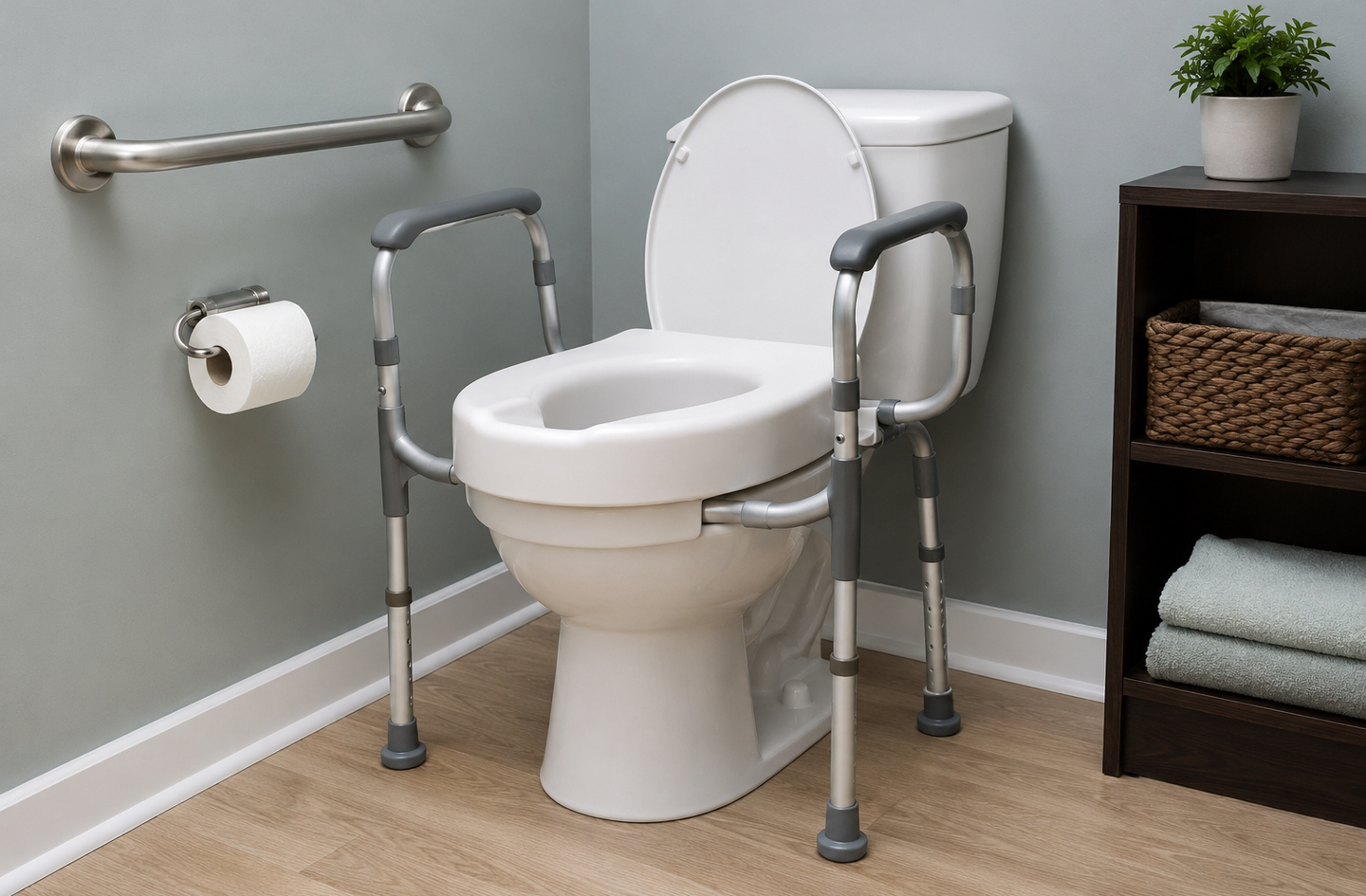
Adding a raised toilet seat to a toilet-mounted frame changes the arm height geometry and often conflicts with the riser’s mounting hardware. Adding one alongside a floor-standing frame requires only a simple height recalibration of the frame legs.
A raised toilet seat typically adds 2 to 4 inches to seated height. For users whose knees or hips resist deep flexion, that elevation meaningfully reduces the range of motion needed to stand. A 2016 study found that raising seat height reduced anterior-posterior sway during sit-to-stand from 235.93 mm to 181.63 mm6, a 23% reduction in postural instability. The researchers concluded that adjusting seat height and angle to suit each individual is likely to reduce fall risk during toilet transfers.
The mechanical complication arises when both a raised seat and a toilet-mounted frame are planned. Many toilet-mounted frames clamp to the toilet bowl’s bolt holes – the same mounting hardware that a locking raised seat also uses. In most configurations, only one of these devices occupies those bolt points at a time. You choose the frame or the raised seat, not both simultaneously, unless the raised seat is designed to sit inside the frame’s clamping area rather than sharing the same attachment points.
Combination units address this by integrating the raised seat and the armrests into one assembly. The riser and rails arrive as a single piece that clamps to the bowl together. These solve the mounting conflict, but they fix the arm height relative to the riser height. The geometry of the combined unit is determined by the manufacturer, not by the individual’s seated position. For users who need a specific arm height independent of how much the seat is raised, that constraint limits fit.
Floor-standing frames remove this conflict entirely. The frame stands on its own legs; the raised seat sits on the toilet bowl; the two pieces share no hardware. You raise the frame’s legs to match the new seated height that the riser creates. That is a single-step recalibration, not a product compatibility puzzle.
A 2025 study comparing interventions for older adults performing toilet sit-to-stand found that standard seat height combined with grab bar support reduced transfer difficulty and improved postural stability; raised seats with grab bars also performed well7. The geometry of pairing any raised seat with bilateral arm support consistently outperformed either intervention alone, across the study’s test conditions.
Verdict: If a raised seat is part of the plan now or in the future, a floor-standing frame is the more flexible choice. Toilet-mounted frames create mounting conflicts with most raised seat hardware, and combination units trade those conflicts for reduced arm-height adjustability.
Weight Ratings and Structural Security
Most toilet safety frames carry rated capacities between 250 and 400 pounds. ADA grab bar standards require the supporting structure to withstand a force of 250 pounds applied at any point on the bar, fastener, mounting device, or supporting structure5. Consumer-grade safety frames generally meet or exceed that threshold, but the path that load takes from the frame to the floor differs significantly between the two designs.
A toilet-mounted frame transmits load through the bowl, through the toilet’s wax ring seal, and into the floor via the mounting bolt assembly. That connection was engineered to support a person sitting on the toilet under primarily vertical load. It was not designed with the expectation of repeated lateral force cycles from daily arm-assisted transfers over years of use. The weight rating on a toilet-mounted frame reflects the manufacturer’s tested static capacity under controlled conditions, not necessarily the long-term performance of the toilet’s own mounting hardware under multi-directional load.
A floor-standing frame distributes its load across four to six rubber-footed legs that press directly on the bathroom floor. That contact spreads the transfer force across a wider area and removes the toilet fixture as a structural intermediary. For users who bear substantial weight on the arms during transfers – particularly those with limited lower-body strength who rely heavily on arm push-off – the floor-standing load path is more direct and remains more consistent over time.
The weight rating number on the product label is the right starting point. The more useful question is: under the specific transfer pattern of the person who will use this frame daily, which design maintains its geometry more reliably over months of use? For moderate-weight users performing standard vertical sit-to-stand transfers with confirmed bowl fit, both designs operate well within their rated specs. For heavier users or anyone whose transfer involves significant lateral force, the floor-standing design’s direct load path is worth the additional floor footprint.
Verdict: Both designs meet the ADA grab bar force benchmark of 250 pounds at any point. Floor-standing frames offer a more direct structural path to the floor, which becomes more important for heavier users or transfers with a meaningful lateral component.
Floor Space, Footprint, and Foot Placement
A toilet-mounted frame adds no legs to the bathroom floor. The frame occupies only the sides of the toilet itself, leaving the floor around the bowl clear. That is a genuine advantage in small bathrooms where a walker or rollator needs to park beside the toilet, or where a caregiver needs to stand close to assist.
Floor-standing frames place four to six legs on the bathroom floor, typically positioned to the front and sides of the bowl. Those legs extend 4 to 8 inches outward from the bowl edge on each side and to the front. In a narrow bathroom where the toilet sits close to a wall or vanity, front legs can interfere with the approach path. In a bathroom where the toilet shares a side wall with the shower, a side leg on that wall side may obstruct the walker’s parking position.
Foot placement during the transfer approach is a related concern. When you move toward the toilet to sit, you need a clear path to position your feet roughly shoulder-width apart and slightly in front of the toilet centerline. Front legs on a floor-standing frame can interrupt this foot position if the frame is set with its front legs too far forward. Most frames allow some adjustment of the forward leg position. Testing this before the legs are fully tightened saves a second disassembly.
For users who approach the toilet forward-facing (the standard approach), the front clearance between the two front legs matters most. For users who approach from the side for a lateral transfer, the side clearance matters more. Neither frame type is universally better on floor footprint. The right choice depends on bathroom dimensions, approach direction, and whether a mobility aid needs to park beside the toilet during the transfer.
Verdict: Toilet-mounted frames win on floor space by leaving the bathroom floor clear. Floor-standing frames need 4 to 8 inches of clearance on each side, which can interfere with approach paths and walker parking in smaller bathrooms.
Who Should Choose Which Frame?
The right frame is determined by the specific combination of transfer direction, body weight, bathroom layout, and whether a raised seat is part of the plan. Each scenario below points to one design based on the physics of the transfer, not on price or popularity. Falls remain a significant health concern for older adults, with an estimated 3 million emergency department visits among adults 65 and older in 2021 alone2.
You need bilateral support for a standard sit-to-stand transfer and your bathroom is large enough for a floor-standing frame
Choose a floor-standing frame. The direct load path to the floor gives you more consistent lateral stability, and the frame’s arm height remains calibrated regardless of toilet hardware or seat additions. If there is enough floor clearance for the legs – typically 8 inches on each side of the toilet, plus a clear front approach path – the floor-standing design addresses the sit-to-stand mechanics more cleanly.
Your bathroom is small and floor space is limited
Choose a toilet-mounted frame, with the bowl compatibility check done before purchase. In a narrow bathroom where the toilet shares a side wall or sits close to a vanity, the floor-standing frame’s legs will interfere with the approach path or block the walker’s parking position. A toilet-mounted frame that fits the bowl geometry well provides meaningful arm support while leaving the floor clear. Confirm the oval or round bowl designation on your toilet before ordering.
You plan to use a raised toilet seat at the same time
Choose a floor-standing frame. The mounting hardware conflict between a locking raised seat and a toilet-mounted frame makes the combination unreliable in most configurations. A floor-standing frame’s legs adjust independently of the toilet bowl. Set the arm height to match the seated height with the riser in place, and both pieces work without competing for the same hardware.
You or the person you are helping weighs more than 300 pounds, or the transfer involves significant lateral force
Choose a floor-standing frame. The higher weight ratings available on floor-standing models (often 350 to 400 lb) and the more direct load path to the floor make them the engineering-informed choice for higher-force transfers. Toilet-mounted frames at 250 to 300 lb may be within rated capacity, but the toilet fixture itself becomes a load-bearing element under lateral force, and that path is less robust over time for repeated high-force use.
The bathroom is a rental, or the installation needs to be reversible without any permanent change
Choose a toilet-mounted frame. Most models install without tools by clamping to the bowl’s existing bolts. They remove just as quickly. Floor-standing frames also require no permanent installation, but they are heavier and less practical to move frequently if the bathroom is shared or the arrangement changes.
For decisions about the specific home and specific person – particularly where medical history, balance conditions, or structural bathroom limitations are factors – consulting an occupational therapist is the most reliable path. These frames are planning tools and support devices; an OT can evaluate the full transfer routine in the actual space.
Frequently Asked Questions
How do I know if a toilet-mounted frame fits my toilet bowl?
Toilet bowls come in two primary shapes: round (about 16.5 inches from seat bolts to front rim) and elongated (about 18 to 18.5 inches). Most toilet-mounted frames list which shapes they accommodate. Measure from your toilet’s seat mounting bolts to the front rim and compare against the frame’s stated compatibility range. A frame that fits a round bowl will rock on an elongated one and vice versa, which reduces lateral stability significantly1.
What is the correct armrest height for toilet safety rails?
The ADA standard for toilet seat height is 17 to 19 inches above the finished floor5. For effective push-off, armrests typically sit 8 to 12 inches above your seated toilet height, placing them roughly at 25 to 31 inches from the floor for a standard toilet. Set the frame at a height where your elbows are at or slightly above 90 degrees when seated, so you can press straight down through your forearms to initiate the stand.
Are toilet safety frames effective at reducing fall risk?
Research supports the use of arm support during toilet transfers. A 2025 study found that toilet seat height combined with grab bar support reduced sit-to-stand difficulty and improved postural stability in older adults7. A 2023 study found that grab bar presence made participants 75.8% more likely to recover balance during a hazardous transfer task3. These findings are directionally consistent but come from small study samples, so they support the case for arm support rather than quantifying a specific risk reduction for a given individual.
Can a floor-standing toilet safety frame work with a bidet seat?
Yes, in most cases. A floor-standing frame’s legs stand independently of the toilet bowl hardware, so a bidet seat that clamps to the bowl’s bolt holes does not conflict with the frame. The arm height may need recalibration if the bidet seat adds thickness that raises the seated height. Toilet-mounted frames are less compatible with bidet seats because both compete for the same bowl mounting hardware.
Do adjustable toilet safety rails require professional installation?
Most consumer-grade toilet safety frames, both mounted and floor-standing types, are designed for tool-free or minimal-tool assembly and do not require professional installation. That said, verifying that the frame sits level, that legs are fully tightened, and that the bowl fit (for toilet-mounted types) is confirmed before full-weight use is the owner’s responsibility. An occupational therapist can assess whether the selected frame matches the specific person’s transfer pattern and bathroom layout.
Limitations and Edge Cases
- This comparison covers the standard floor-standing and toilet-mounted safety frame designs. Wall-mounted fold-down grab bars (which require studs or blocking and are not portable) address a different structural scenario and are not evaluated here.
- Biomechanical research cited draws from small sample populations, some healthy adults and some older women specifically. Findings are directionally consistent with the engineering reasoning but may not generalize equally to all body types, balance conditions, or transfer patterns.
- Bathroom-specific injury data cited is from 2008 CDC analysis, the most granular government dataset available for bathroom injury by cause and age group. Overall fall trends through 2021 are drawn from a separate NCOA/CDC source for current scale context.
References
- CDC Morbidity and Mortality Weekly Report – Nonfatal Bathroom Injuries Among Persons Aged 15 Years, Vol. 60, No. 22, June 10, 2011 (reporting 2008 injury data).
- National Council on Aging (NCOA) – Get the Facts on Falls Prevention, citing CDC 2021 data, page current 2024.
- Human Factors (Sage Journals) – Levine, Montgomery, and Novak, “Grab Bar Use Influences Fall Hazard During Bathtub Exit,” 2023.
- Disability and Rehabilitation: Assistive Technology – Effects of bilateral swing-away grab bars on biomechanics of toilet transfers, PubMed PMID 29522366, published online February 2018.
- U.S. Access Board – Chapter 6: Toilet Rooms, 2010 ADA Standards for Accessible Design, Sections 604.4 and 604.5.
- Journal of Physical Therapy Science (PMC) – Effects of changing angle and height of toilet seat on sit-to-stand, PMC5091059, published 2016.
- Medicine (Wolters Kluwer) – Impact of seat height and grab bars on postural stability during toilet sit-to-stand in older females, PubMed PMID 40101044, published 2025.
Conclusion
The choice between a toilet-mounted frame and a floor-standing frame comes down to the geometry of the transfer, the bathroom’s dimensions, and whether a raised seat is part of the plan. Floor-standing frames offer a more direct structural load path and maintain their calibration independently of the toilet, making them the engineering-informed default for higher-weight users, lateral transfers, and raised seat combinations. Toilet-mounted frames earn their place in space-limited bathrooms and reversible installations where a confirmed bowl fit keeps the stability trade-off acceptable.
For the broader context of toilet transfer planning – seat height, approach clearance, floor surfaces, and lighting – see the overview in Toilet Transfer Safety for how each of these pieces fits the wider picture.