
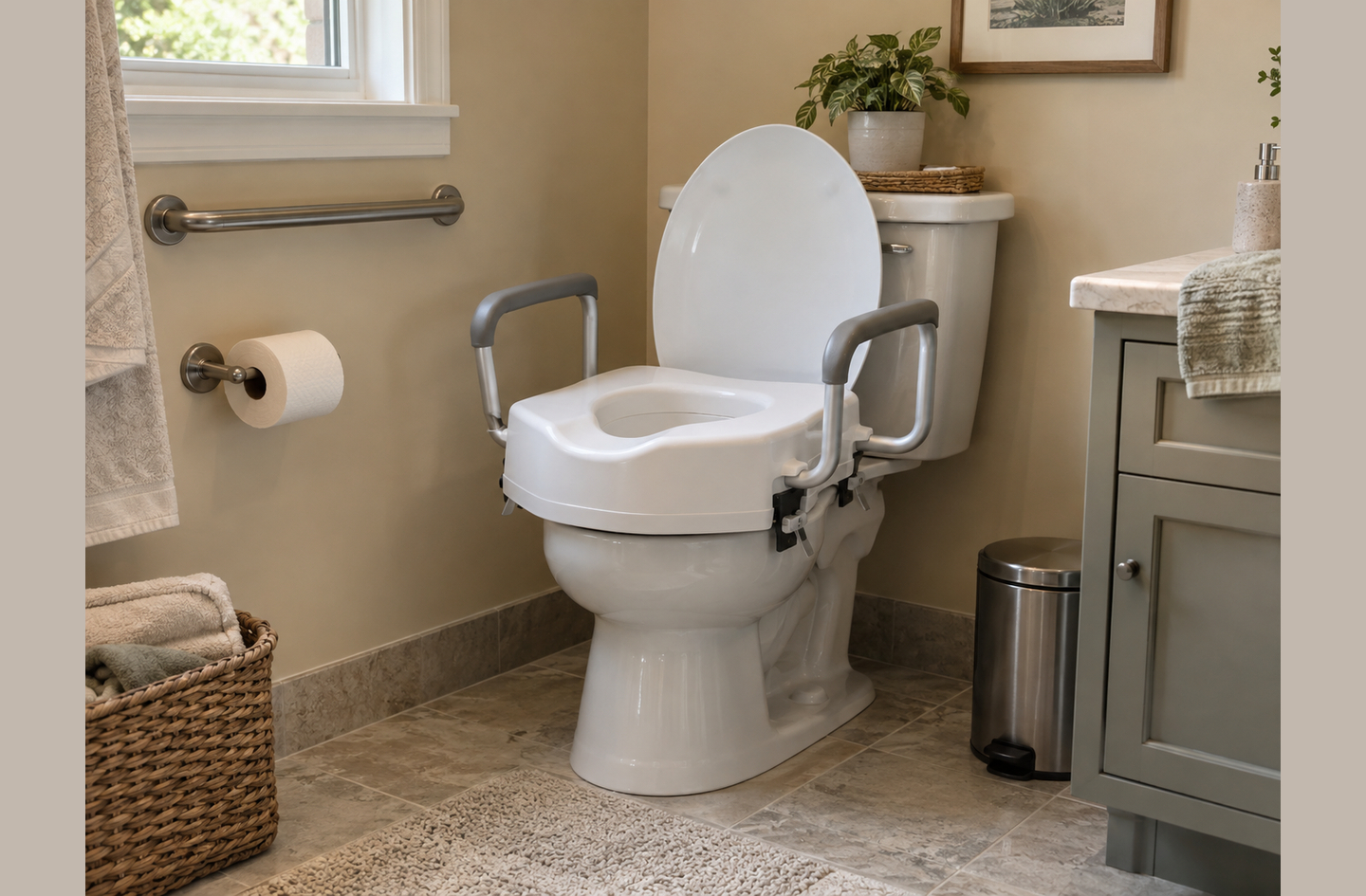
A standard residential toilet seat sits 15 to 16 inches above the floor.1 For the broader planning framework on toilet transfers, see the overview in toilet transfer safety. A raised toilet seat with handles addresses two problems at once: the riser reduces the joint travel required on every sit-to-stand, and the integrated arms provide a push-off point when leg and hip muscle force is lowest. Whether those arms help or limit you depends entirely on your transfer path, your bathroom clearance, and whether a side approach is part of the routine.
Quick Answer
When do the handles on a raised toilet seat help, and when do they get in the way?
Integrated arms improve push-off force and controlled lowering for a standard front-facing transfer. They become a liability when a wheelchair side transfer requires open clearance next to the toilet, when the bathroom has less than 18 inches of clear floor space on the transfer side, or when a caregiver needs lateral access. A 2-inch riser reaches the ADA-accessible minimum of 17 inches1; removable arms let you keep the height benefit while restoring the clearance when you need it.
Key Takeaways
- Integrated arms reduce the peak hip joint moment during sit-to-stand by roughly 35%, which is meaningful for post-surgical recovery and daily fatigue management.2
- The ADA accessible toilet height range is 17 to 19 inches; a 2-inch riser on a standard 15-inch toilet reaches the minimum, a 4-inch riser reaches the maximum.1
- Arms typically add 2 to 4 inches of total width beyond the toilet bowl on each side, which matters most when wheelchair approach or close side-transfer clearance is required.
Fixed Arms vs. Removable Arms: Quick Comparison
The core question in this article is not simply “do handles help?” The question is “under what conditions do they help, and what do they cost you on the other side?” This table maps the key trade-offs. Each row is explained in detail below.
| Feature | Fixed Arms | Removable Arms |
|---|---|---|
| Best for | Dedicated front-approach stand-up support | Users who need push-off support and open lateral clearance at different times |
| Wheelchair side transfer | Not compatible: arms block lateral slide onto seat | Compatible when arms are detached |
| Inside usable width | Fixed at model spec (17 to 20 inches between pads on most models) | Same with arms on; fully open when arms removed |
| Handle height | Fixed on most models; adjustable on some | Adjustable on most models |
| Caregiver side access | Limited: arms restrict a close lateral approach | Full access when arms removed |
| Stability with arms on | High: bracket or bolt attachment to toilet seat | High with arms locked in; seat-only stability when removed |
| Weight rating | 250 to 300 lb per ANSI Z124 standard6 | 250 to 300 lb per ANSI Z124 standard6 |
| Verdict | Right for single-mode front transfers | Right for mixed-use or shared bathrooms |
The verdict depends less on the arms themselves and more on whether the transfer path ever requires open lateral space. If it does now or will in the future, removable arms preserve that option without giving up the push-off benefit.
When Arms Improve a Transfer
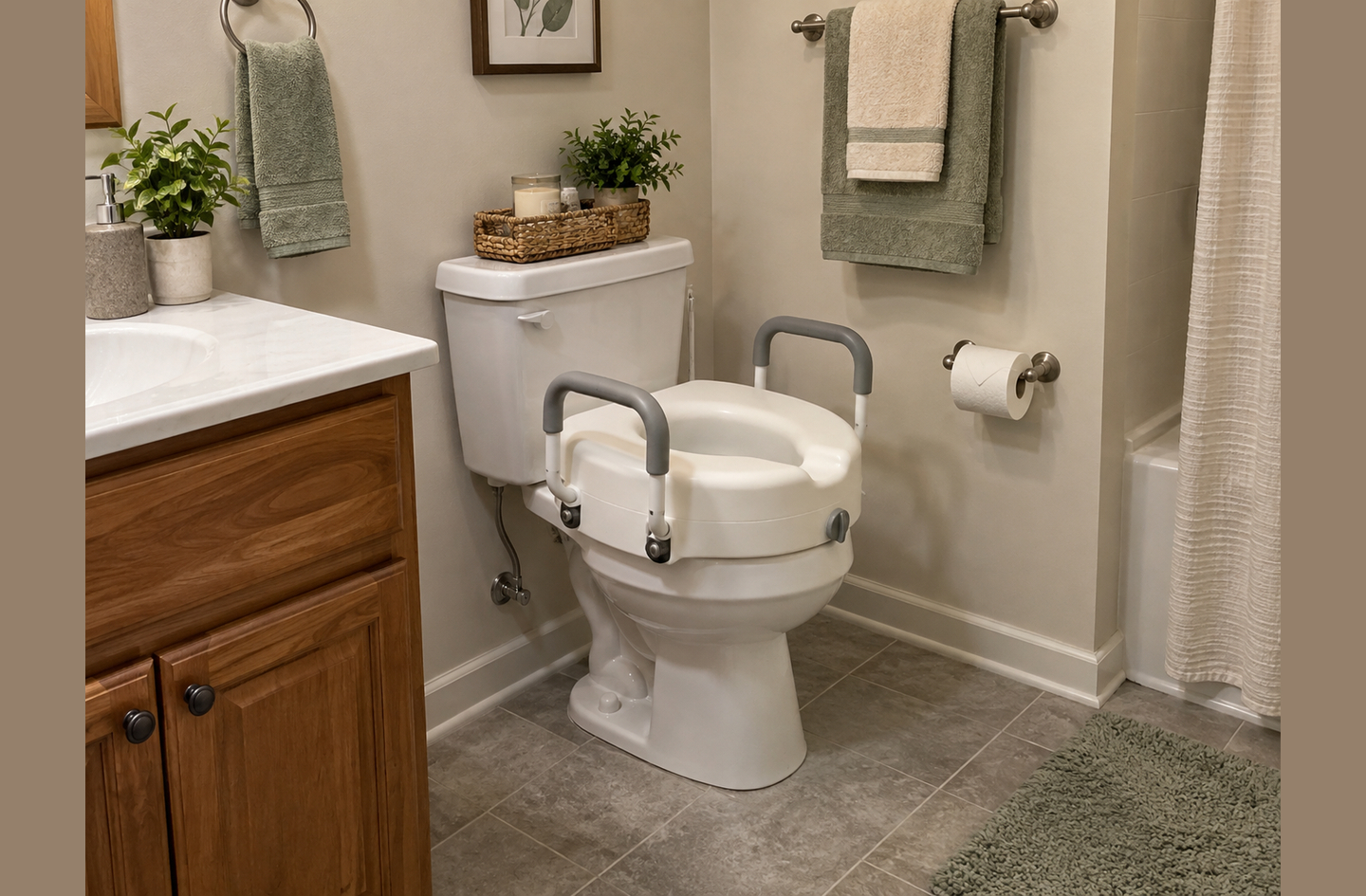
A raised toilet seat with handles is a removable aid placed over an existing toilet to add seat height and provide two lateral push-off points. Peer-reviewed biomechanics research shows the push-off benefit is real and measurable. In a study comparing assisted and unassisted sit-to-stand transfers, the peak hip joint moment dropped by roughly 35% when participants used a lifting-assisted seat device compared to an unassisted transfer.2 That reduction comes from shifting some of the joint load onto the arms, so the hips and knees absorb less force at the moment when their leverage is worst.
“The peak hip joint moment decreased by around 35% when using the lifting-seat device compared to the nonassisted seat.”2
Derek J. Rutherford, School of Physiotherapy, Dalhousie University, as cited in Lou SZ et al., Healthcare (Basel), 20212
Push-off at the moment muscle force is lowest
Standing from a seated position follows a predictable force curve. Muscle demand peaks near the bottom of the movement, when the hips are maximally flexed and the knee extensors must generate force against the longest moment arm. Arms on the toilet seat let you press down and forward at exactly that point, reducing the load the legs must carry alone. For adults with knee arthritis, post-operative weakness, or fatigue-related strength variability, this matters daily, not just in recovery.
The arms work best when they are positioned at roughly elbow height while seated. Too high, and the push becomes a pull. Too low, and the arms give no mechanical advantage. Most adjustable models offer a 3 to 5 inch height range for the arm brackets, which covers the common range of seated elbow heights for adults between 5 feet and 6 feet 2 inches tall.
Controlled lowering on the way down
The return trip (sitting down) is where many falls happen. Lowering toward a seat requires eccentric muscle contraction, the same muscles fighting gravity rather than propelling against it, and eccentric fatigue accumulates faster than concentric. Arms let you distribute the descent load across the upper body, slowing the drop and reducing the impact force at landing.
A wider grip also improves lateral stability during the controlled descent. Someone whose balance is uncertain during standing tasks benefits from having a fixed point on each side that prevents sideways drift before the seat is fully contacted. This is the mechanical case for arms on a front-approach transfer, and it holds regardless of whether the seat height alone would have been enough.
Post-hip-replacement height requirements
Hip flexion angle refers to the bend at the hip joint during sitting, measured in degrees from full extension. After a posterior-approach total hip replacement, orthopedic protocols typically restrict this to 90 degrees or less for the first 6 to 12 weeks post-surgery. A low toilet seat forces the hip past 90 degrees at the bottom of the descent, which is exactly the position the precaution exists to avoid.
Studies of clinical practice found that 95% of UK health trusts routinely prescribe raised toilet seats after hip replacement as a standard discharge item.5 The ADA accessible toilet height of 17 to 19 inches places the hip at or near 90 degrees for most adults; a 2-inch riser on a standard 15-inch seat reaches the 17-inch minimum.1 For the comparison with a permanent comfort-height toilet as an alternative to a riser, see comfort height vs. standard toilet.
Arms add the most value after hip surgery precisely when transfers are most hazardous: during the first weeks when the joint is weakest and the hip angle restriction is strictest.
When Arms Get in the Way
Arms on a raised toilet seat add mechanical advantage in one direction: forward and down. In lateral movement, the same arms become fixed obstacles. Bathroom falls are not rare: the most recently published CDC analysis found an estimated 234,094 nonfatal bathroom injuries treated in U.S. emergency departments in a single year, with 81.1% caused by falls.4 The three conditions below describe when the clearance cost of arms outweighs the push-off benefit.
Wheelchair side transfers and lateral approach
A side transfer is a lateral movement from a wheelchair or mobility aid directly onto an adjacent surface without standing first. The person slides sideways from the chair to the toilet seat, or uses a transfer board bridging the gap. This movement requires the toilet surface to be unobstructed from the side: no armrest blocking the sliding path, no raised edge preventing the board from bridging cleanly.
The ADA standard for accessible toilet rooms places the toilet centerline 16 to 18 inches from the side wall, and requires a 60-inch wide clear floor space beside the toilet to allow wheelchair positioning.1 When a raised seat with fixed arms is installed, the arms extend outward from the bowl on each side, reducing the open lateral surface the transfer depends on. In a standard residential bathroom, there is rarely 60 inches of clear space anyway. Arms in that context make a constrained transfer corridor narrower still.
If a wheelchair side transfer is part of the current routine or is anticipated in the near future, fixed arms are incompatible with the transfer path. Removable arms restore the open side when needed, and the height benefit remains when the arms are reinstalled for front-approach use. For situations where wall placement limits where any lateral support goes, see toilet floor-to-ceiling poles as an alternative lateral support option.
Bathroom clearance and total toilet width
Raised toilet seats with integrated arms typically extend the total unit width to 20 to 22 inches across, compared to a standard elongated toilet bowl of approximately 14 to 14.5 inches. The arms add roughly 2 to 4 inches to each side beyond the bowl edge. In a tight bathroom where the toilet sits close to a wall, a bathtub, or a vanity, those extra inches reduce the clear floor space on the transfer side below a usable threshold.
The practical test: measure the distance from the toilet centerline to the nearest obstacle on the open (non-wall) side. ADA requires 16 to 18 inches from the centerline to the wall; the open side typically has more room, but narrow residential bathrooms often have a cabinet, a door swing, or a linen closet within 20 inches. When arms reduce that clearance to less than 15 inches of clear space beside the seat surface, a person of average width will feel pinched during lateral movement and a caregiver standing beside the toilet will have no working space.
Width is the dimension most buyers overlook when ordering online, and arms are the single largest width variable under user control on a raised toilet seat.
Caregiver access during assisted transfers
Two-person transfers, and even one-person assisted transfers where the caregiver stands beside the toilet, require open lateral access. A caregiver placing hands on the hips or torso of a seated person to help with standing or repositioning needs to be able to stand 6 to 12 inches from the toilet seat surface. Fixed arms at elbow height block exactly that position.
This matters more than it first appears. The most recent CDC analysis found that 45.2% of all inpatient falls in a monitored hospital setting were related to toileting activities.3 The same dynamics apply at home. When a caregiver cannot get into a useful position because arms are in the way, the quality of the assist drops, and the fall risk rises. Removable arms solve this directly: the caregiver removes the arms before the assisted transfer, then reinstalls them for unassisted transfers at other times of day.
Raised Toilet Seat With Handles: Removable vs. Fixed Arms Compared
Understanding the conditions above is useful, but the decision still requires measuring three things in your specific bathroom. This section covers what to look for and what the numbers mean.
Inside usable width and your body width
Inside width on a raised toilet seat with handles refers to the usable distance between the two arm pads at the widest point of the seating surface. This measurement determines whether a user of a given hip width will sit centrally on the seat without the arms pressing against the thighs during the descent, which is both uncomfortable and destabilizing.
Most adults have a seated hip width between 15 and 19 inches. The arms on a raised seat typically set the inside dimension between 17 and 20 inches, with adjustable padding positions offering roughly 1.5 to 2 inches of adjustment range. Before buying, measure your seated hip width with a soft tape measure across the widest point of the hips in a seated position. If your hip width is within 2 inches of the model’s stated inside width, move to a wider model or a removable-arm design before the transfer test, not after.
Handle height and your push-off geometry
The handle height determines whether the arms function as push-off aids or merely as lateral boundaries. Arms set too high relative to the seated elbow position require you to push upward as well as forward, reducing the mechanical advantage. Arms set at or just below seated elbow height produce a clean horizontal push that converts directly into upward body motion.
Measure your seated elbow height: sit on a flat surface at your current toilet seat height, place your forearms parallel to the floor, and measure from floor to elbow. Aim for arm pads within one to two inches of this measurement. On a riser-only model (no height adjustment for the arms), the arm height is fixed relative to the riser height, so a 4-inch riser produces a handle height 4 inches higher than the same model on a standard seat. Check the manufacturer’s stated arm-pad-to-floor height at the riser height you plan to use, not at the default configuration shown in the product image.
Attachment mechanism and stability under lateral load
Most raised toilet seats attach via a locking mechanism that clamps under the existing toilet seat bolts or beneath the rim of the bowl. The seat must not rock side-to-side under load, and the arms must not flex when downward and lateral force is applied during a transfer. Both failure modes are most visible when the attachment hardware is worn, when the toilet bowl has an unusual rim profile, or when a model is used at a weight at the upper end of its rated capacity.
The ANSI Z124 standard for plastic toilet seats requires a static load test of 300 pounds and drop testing for seat and bracket integrity.6 Models meeting this standard are tested for the load, but not always for the lateral torque a push-off transfer applies. Before committing to a model, check the reviews specifically for rocking or lateral movement under load, not just for comfort. For frame-and-rail alternatives where floor anchoring or free-standing stability replaces the bowl attachment, see toilet safety rails.
Reading Your Bathroom Before You Buy
Three measurements taken in 10 minutes will answer the configuration question more reliably than any product comparison. These are the dimensions no product listing shows you, and the ones where most mismatches occur.
The three measurements
First, measure the clear floor space on the transfer side: from the toilet centerline outward to the nearest fixed obstacle (wall, bathtub, cabinet). Write down this number. Anything under 20 inches on the open side will feel tight with arms installed; anything under 15 inches makes a lateral assist difficult regardless of arm design.
Second, measure the current seat height from floor to top of seat. This tells you what riser height you need to reach your target final height. A 17-inch final height (the ADA minimum for accessible toilets) requires a 2-inch riser on a standard 15-inch seat. An 18-inch final height requires a 3-inch riser. A 4-inch riser reaches 19 inches, the ADA maximum for accessible toilet height.1
Third, measure the toilet centerline-to-wall distance on the side where the wheelchair or walker approaches. ADA sets this at 16 to 18 inches from the wall, but residential toilets are often closer to the wall. If the toilet sits less than 16 inches from the wall on the transfer side, arms on the wall side are not relevant; the constraint is the toilet placement itself, not the riser.
When neither configuration fits cleanly
Some bathrooms present conditions where a raised seat with any arm configuration is not the best solution. A toilet flush against a side wall with minimal clearance for a wheelchair approach, for example, solves the height problem but leaves the lateral access problem untouched regardless of arm style.
In those cases, the decision belongs with an occupational therapist or accessibility specialist who evaluates the specific bathroom layout and the specific person’s transfer routine. The framework here describes the general conditions and measurements. A specific home and a specific person require in-person evaluation for a safe and appropriate solution.
Who Should Choose Which Configuration
The comparison above produces four clear reader profiles. Check which one matches the actual transfer situation, not just the current one.
Front-approach transfer, independent user
You walk to the toilet, turn, and lower yourself with a front-facing approach. You stand the same way. A fixed-arm raised seat works well here. The arms give you push-off leverage at the bottom of the movement and controlled resistance on the way down. Choose a model with arm height within 1 inch of your seated elbow height and an inside width at least 2 inches wider than your seated hip width. The height benefit and the push-off benefit both apply without any clearance cost in this scenario.
Wheelchair user, side transfer approach
You position your wheelchair beside the toilet and slide laterally onto the seat, or use a transfer board. Fixed arms are incompatible with this transfer path. A raised seat without arms, or a removable-arm model with the arms detached, keeps the lateral surface open. The height benefit still applies; the clearance cost does not. Confirm the final seat height aligns with the wheelchair seat height before purchase, as a height mismatch creates a transfer angle that introduces its own strain.
Mixed-use or shared bathroom
The toilet is used by more than one person, or by the same person in different ways at different times (front approach when independent, assisted transfer when a caregiver helps). Removable arms are the right choice here. The arms come off in seconds for an assisted transfer or for another user who needs open access, then reinstall for independent use. Fixed-arm models create a single-configuration lock that shared bathrooms rarely support cleanly.
Post-surgical recovery with anticipated long-term change
You are recovering from hip replacement or knee surgery and need a raised seat with arms now, but your transfer needs will change as strength returns. A removable-arm model hedges against that transition: at peak recovery, both arms are in place for maximum assist. As strength and confidence return, one arm or both arms come off as the transfer evolves. A fixed-arm model chosen for the recovery period stays fixed even when the person no longer needs it.
Frequently Asked Questions
Can I use a raised toilet seat with handles for a wheelchair side transfer?
Fixed arms block the lateral sliding path a side transfer requires. A removable-arm model with the arms detached keeps the height benefit while opening the lateral surface. ADA accessible toilet rooms require 60 inches of clear floor space beside the toilet for wheelchair positioning.1 Most residential bathrooms fall short of this, so checking the clear space on the transfer side matters before choosing any configuration.
What riser height is recommended after hip replacement?
Clinical data shows that 95% of UK health trusts routinely prescribe a raised toilet seat after total hip replacement to keep the hip at or above the 90-degree flexion limit.5 A 2-inch riser on a standard 15-inch seat reaches 17 inches, the ADA accessible minimum. A 3 to 4 inch riser reaches 18 to 19 inches, the typical target range. Your occupational therapist or surgical team will set the specific height target for your recovery.
How much width do the arms add to the total toilet footprint?
A standard elongated toilet bowl is approximately 14 to 14.5 inches wide. Raised seats with integrated arms extend the total unit width to 20 to 22 inches across on most models, adding 3 to 4 inches beyond the bowl rim on each side. Measure the toilet centerline to the nearest obstacle on the open transfer side before purchasing and allow at least 15 inches of clear space from the outer arm edge to any adjacent object.
What is the difference between a raised toilet seat with handles and a toilet safety rail?
A raised toilet seat with handles attaches to the toilet bowl and adds both seat height and two fixed push-off points. A toilet safety rail provides lateral support and push-off without necessarily raising the seat height, and floor-standing frames do not depend on the bowl for stability. For comparing these two approaches, see the article on toilet safety rails.
Are raised toilet seats with handles weight-tested?
Most residential models are tested to the ANSI Z124 standard, which requires passing a 300-pound static load test and drop tests for bracket integrity.6 Check the specific model’s rated capacity before purchase. Users near the upper capacity limit should also confirm the attachment clamps firmly to the toilet rim without any lateral rocking after each cleaning or reinstallation.
Limitations and Edge Cases
- The riser height calculations here assume a standard 15-inch residential toilet seat. Comfort-height toilets (17 to 19 inches from the factory) already meet the ADA minimum; see comfort height vs. standard toilet for the tradeoffs of a permanent height change.
- The 300-pound ANSI Z124 figure is the static load test specification, not a user weight guarantee for every model. Always check the model’s own rated capacity.
- Residential bathroom clearance and wheelchair transfer compatibility require in-person evaluation by an occupational therapist or accessibility specialist for a specific home and a specific person.
References
Methodology: every figure below comes from an independent published source and links to the page carrying it; this article was reviewed for factual accuracy against the verbatim supporting evidence at the time of publication.
- U.S. Access Board – Chapter 6 Toilet Rooms: ADA Standards Section 604, Water Closet Location and Clearances, 2010 (evergreen).
- PubMed Central – Lou SZ, You JY, Tsai YC, Chen YC, “Effects of Different Assistive Seats on Ability of Elderly in Sit-To-Stand and Back-To-Sit Movements,” Healthcare (Basel), 2021.
- PubMed – Tzeng HM, Yin CY, “Understanding the Prevalence of Inpatient Falls Associated With Toileting in Adult Acute-Care Settings,” Medsurg Nursing, Vol. 21 No. 6, 2012.
- JAMA – Nonfatal Bathroom Injuries Among Persons Aged 15 Years and Older, United States, 2008. Reprint of CDC MMWR, June 10, 2011, Vol. 60.
- PubMed Central – Poultsides LA et al., “A Nationwide Survey of UK Orthopaedic Surgeons and Healthcare Professionals on Hip Replacement Precautions,” BMC Musculoskeletal Disorders, 2016.
- Kohler Assist – Weight and Load Bearing Limit for Toilet Seats (ANSI Z124 Plastic Toilet Seat Test Requirements), current.
Conclusion
The arms on a raised toilet seat are a leverage tool, not a default feature. When the transfer is front-facing and push-off support is the main need, integrated arms reduce joint load at the hardest moment of the movement. When the transfer is lateral, the bathroom is narrow, or a caregiver needs side access, those same arms block the path. Measuring the three key dimensions (transfer clearance, target seat height, toilet centerline-to-obstacle distance) before buying determines which configuration fits the actual transfer routine, not just the easiest one.
For the broader planning framework on toilet transfers, see the overview in toilet transfer safety.