Slip-resistant flooring describes any surface or surface layer that reduces the likelihood of a foot losing traction, especially in wet conditions or during direction changes. In homes designed for aging in place, it spans hard flooring materials, shower surfaces, portable mats, and the transitions connecting them. Over 14 million older adults in the U.S. fall each year,1 and floor surfaces interact with footwear, lighting, fatigue, and threshold heights in ways a single product label rarely captures. This complete guide maps all five layers of the topic and routes to deeper guides on each.
Quick Answer
What is slip-resistant flooring?
Slip-resistant flooring refers to surfaces or surface layers whose texture, drainage, and material composition reduce traction loss in wet or dry conditions. The primary measurement standard for wet-area traction in the U.S. is DCOF (Dynamic Coefficient of Friction). ANSI A326.3 sets a minimum DCOF of 0.42 for level interior wet surfaces.2
Why it matters:
Falls are the leading cause of fatal and nonfatal injuries among adults 65 and older.1 Floor surfaces, mat placement, and transition heights all interact. Understanding those interactions produces safer-feeling outcomes than relying on a single product rating.
Key Takeaways
- Over 14 million older adults fall each year in the U.S.; floor surfaces, transitions, and portable mats appear frequently as contributing factors.1
- ANSI A326.3 defines a minimum DCOF of 0.42 for level interior wet areas; the appropriate threshold varies by use classification (level floor, ramp, step edge).2
- Portable mats add traction but create risk when their backing does not match the floor surface, their edges curl, or they retain moisture beneath them.
- Shower floor traction depends on tile texture, grout-joint frequency, floor slope, and drainage together, not on any single metric.
- ADA Standards specify that floor-level changes greater than 1/2 inch must be ramped; even 1/4 inch vertical changes can catch a walker tip or wheelchair wheel.3
Slip-Resistant Flooring in 30 Seconds
| If you are… | Do this |
|---|---|
| Choosing tile for a wet bathroom floor | Check verified DCOF of 0.42 or higher, look for textured or matte finish, and consider grout-joint frequency alongside tile size |
| Adding a bath mat or shower mat | Test the backing on the actual floor surface in a wet condition; verify edges stay flat before depending on the mat |
| Using a walker or wheelchair daily | Prioritize firm, seam-free surfaces and transitions under 1/4 inch along the full route |
| Dealing with a floor that feels slick after cleaning | Strip and rinse with a pH-neutral cleaner; most slick-after-mopping problems are detergent film, not the floor material |
| Planning a bathroom renovation | Map the full surface route, including thresholds, before selecting any tile or flooring product |
What Is Slip-Resistant Flooring?
Slip-resistant flooring describes any floor surface, or layer placed on a surface, that reduces traction loss in wet, contaminated, or directionally demanding conditions. The category spans hard surface materials (tile, vinyl, rubber), textured finishes applied at manufacture, portable layers added to existing floors (bath mats, shower mats, rug pads, anti-slip strips), and treatments applied to existing surfaces (chemical etching, anti-slip coatings).
Wet traction is the central measure. A floor that performs well under dry conditions may behave very differently when water, soap film, or tracked-in moisture is present. The dynamic coefficient of friction (DCOF) measures horizontal friction while the surface is wet. It is a single-variable measurement taken under controlled conditions; it does not account for footwear, lighting, the person’s gait, fatigue, or the presence of contamination beyond the test medium.
The field also covers surface continuity: the transitions between flooring materials, threshold heights at doorways, grout joint placement, and the slope of a shower floor toward its drain. These factors affect how a foot or wheeled device moves through a space, and they interact with the friction properties of the surface itself.
What this topic does not include: structural subfloor systems, waterproof membrane installation, or load-bearing assessments. Those require a licensed professional evaluation specific to the building.
Why Slip-Resistant Flooring Matters
Of those 14 million annual falls, roughly 9 million result in injuries,1 and they are the leading cause of fatal and nonfatal injuries in this age group. The age-adjusted fall death rate reached 78.4 per 100,000 older adults in 2024, a 21 percent increase from 64.7 per 100,000 in 2018.1 Falls are also a common cause of hip fractures and other serious injuries among older adults.4 Floor surfaces interact with footwear, lighting, fatigue, and physical condition to determine available traction at any moment.
Three zones where floor decisions have outsized consequences:
- The shower and wet bathroom floor: bare feet, standing water, soap, and directional changes on entry and exit create the highest-demand traction conditions in most homes.
- Transitions between flooring zones: threshold height mismatches, loose trim, and material edges interrupt walking and rolling routes and catch walker tips and wheelchair wheels.
- Portable mats and rugs: a mat that moves, curls, or retains moisture beneath it introduces a variable surface on top of the floor system already in place, adding rather than reducing risk.
Each of these zones is addressable. None requires a full home renovation to improve. The most productive approach is observation before intervention: walk the routes used most, identify where hesitation, gripping, or uneven footing occurs, and then address those specific points.
The 5-Part Slip-Resistant Flooring Framework
Slip-resistant flooring decisions break into five layers that interact with each other. A gap in any one layer can offset the value of the others.
Layer 1: Flooring Material
The installed surface determines baseline friction and the maintenance required to sustain it. Tile provides a hard, water-shedding surface whose traction depends almost entirely on finish and texture, not on whether it is ceramic or porcelain. Polished or glazed finishes perform poorly in wet conditions regardless of material type; matte and textured finishes retain wet-area performance significantly better. Vinyl flooring, including luxury vinyl plank and tile formats, offers a softer underfoot feel and is available with textured surfaces for wet-area use, though seam edges need attention during installation. Rubber provides inherent cushioning and grip but adds rolling resistance that matters for walker and wheelchair users. Low-pile carpet provides good barefoot traction on dry surfaces but is not appropriate in wet zones, and its rolling resistance requires evaluation for any user with wheeled mobility.
Deeper read: how to compare bathroom flooring options by wet traction, maintenance, and mobility compatibility.
Deeper read: matte vs polished tile in wet areas: which finish gives better footing.
Deeper read: vinyl vs tile bathroom flooring for aging in place.
Deeper read: vinyl flooring for seniors: texture, wet grip, seams, and surface continuity.
Deeper read: rubber flooring for seniors: grip, cushioning, cleaning, and mobility trade-offs.
Deeper read: porcelain vs ceramic tile: slip resistance depends on more than material type.
Deeper read: low-pile carpet for seniors: when it helps and when it adds friction.
Layer 2: Shower and Wet-Zone Surfaces
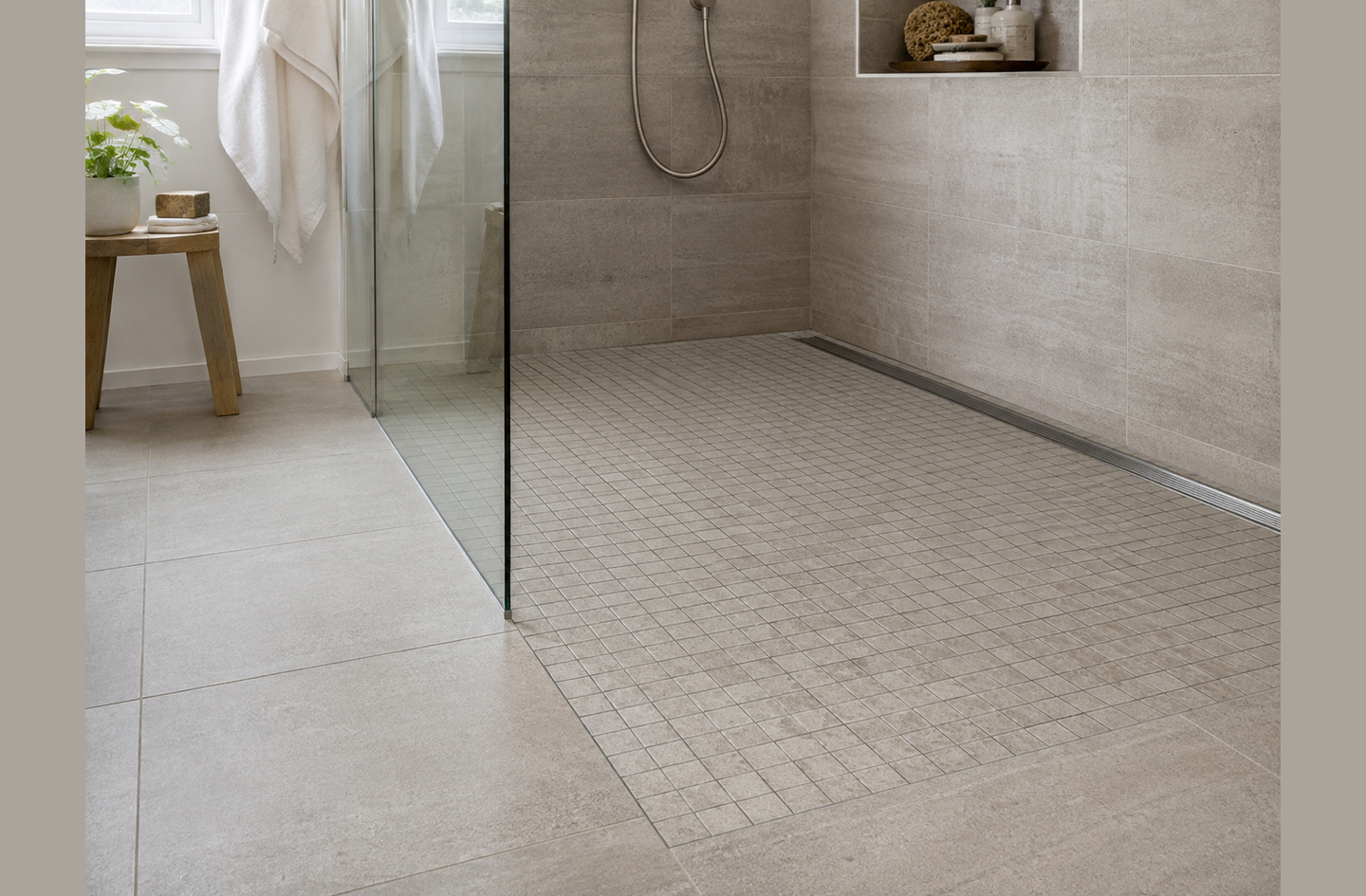
The shower floor is the highest-friction-demand surface in most homes. The combination of bare feet, standing water, soap film, directional changes on entry and exit, and a confined space produces conditions no single tile rating can fully predict. Traction on a shower floor depends on texture, grout-joint frequency, floor slope toward the drain, and the drainage capacity of the drain itself. Small-format tiles (1-inch to 2-inch mosaics) create more grout-line contact per square foot, which improves both drainage paths and texture area underfoot. Larger-format tiles reduce grout maintenance but require precise slope planning so water drains away from standing zones rather than pooling beneath the foot.
When tile replacement is not possible, adhesive anti-slip strips or removable shower mats provide overlay options. Suction-cup mats require a smooth, uncracked tile surface with tight grout joints. On textured, pebbled, or refinished surfaces, suction seals fail, and mat designs without suction-cup mechanisms are needed instead.
Deeper read: non-slip shower floor tile: how texture, size, grout lines, and drainage affect traction.
Deeper read: small vs large shower floor tile: how tile size changes grip and drainage.
Deeper read: non-slip shower mats for seniors: suction, texture, drainage, and coverage.
Deeper read: non-slip bath mat for tiled shower floors: when suction cups will and won’t work.
Deeper read: shower mats for textured or refinished floors: alternatives when suction cups cannot seal.
Deeper read: anti-slip strips vs shower mats: which traction approach fits the surface.
Layer 3: Mats, Rugs, and Portable Traction
Portable traction layers are placed on existing hard flooring and include bath mats, step-out mats, bathroom rugs, rug pads, and in-tub traction mats. Each type has a different design purpose: in-tub mats address traction on the wet bathtub floor; step-out mats provide a stable landing zone at the tub or shower exit; bathroom rugs cover a larger dry-zone area near the vanity. Using the wrong type in a location adds a moving surface without providing the traction or absorbency the location actually needs.
Performance depends on backing compatibility with the specific floor finish: rubber backing grips tile but slides more on polished porcelain or vinyl. Mat weight, pile height, edge profile, and drainage interact with the floor surface and the person’s foot pattern. A mat that stays flat on Day 1 may curl at edges by Week 4 if the backing weakens. Grip loss, hardened suction cups, cracked backing, curled edges, and persistent odor all signal a mat that is no longer performing its function and should be replaced.
Deeper read: anti-slip bathroom rugs: how fit, edge profile, weight, and backing affect stability.
Deeper read: how to keep a bathroom rug from sliding on tile or vinyl.
Deeper read: mold-resistant bath mats: drainage, drying, materials, and cleaning trade-offs.
Deeper read: when to replace a bath mat: grip loss, cracked backing, curling, and persistent odor.
Deeper read: non-slip rug pads: how to match the pad to tile, wood, or vinyl.
Deeper read: bath mat vs bath rug: which belongs inside, outside, or away from the wet zone.
Deeper read: how to wash a non-slip bath mat without damaging the backing.
Deeper read: how to choose a non-slip bath mat by grip, fit, drainage, and backing.
Deeper read: are area rugs a fall risk? when to remove, secure, or reposition them.
Deeper read: why bath mat suction cups stop sticking and what to check before replacing the mat.
Layer 4: Slip-Resistance Ratings, Testing, and Treatments
Traction performance can be measured and often improved on existing surfaces. DCOF, measured under ANSI A326.3, is the primary wet-area traction standard in the U.S. The minimum threshold of 0.42 applies to level interior wet surfaces;2 ramps and step edges carry different thresholds in the same standard. The NFSI B101 standards establish parallel protocols that distinguish between static and dynamic friction on pedestrian surfaces.5 A tile meeting 0.42 for a level context is not automatically appropriate for a ramp or curbed shower threshold: the use classification the manufacturer applied should match the actual installation.
For existing floors, three approaches exist: thoroughly clean the surface to rule out detergent film or wax as the cause, apply a chemical etching treatment or anti-slip coating to alter surface texture, or add adhesive traction strips to specific standing zones. Each changes appearance and cleaning demands.
Deeper read: DCOF tile ratings explained: how to read slip-resistance data for wet floors.
Deeper read: how to make tile floors less slippery without replacing them.
Deeper read: anti-slip coatings for tile: when a surface treatment makes sense.
Deeper read: how to test floor slip resistance at home and when a lab rating matters more.
Deeper read: why a floor feels slippery after mopping: residue, wax, moisture, and grip.
Layer 5: Surface Continuity and Mobility Routes
A bathroom floor can have excellent wet traction, a well-fitted mat, and clean grout, and still present risk if the entry threshold is 3/4 inch higher than the adjacent room’s floor. Surface continuity describes how consistently the floor performs across an entire movement route. ADA Standards for Accessible Design specify that floor-level changes greater than 1/4 inch must be beveled, and changes greater than 1/2 inch must be ramped,3 because those dimensions reliably catch a forward stride and interrupt a wheelchair wheel. Height mismatches, loose trim, and material edges all interrupt walking and rolling paths in ways the floor surface itself cannot compensate for.
For walker and wheelchair users, rolling effort runs alongside traction as a daily concern. A surface with significant texture that maximizes barefoot grip in wet conditions may add rolling resistance that increases upper-body effort over the course of a full day’s movement. Balancing traction with low rolling drag along routes used multiple times daily reduces cumulative fatigue as much as trip risk.
Deeper read: floor transition strips and thresholds: what to evaluate for walkers and wheeled mobility.
Deeper read: flooring for walkers and wheelchairs: grip, rolling effort, and surface continuity.
How to Choose Slip-Resistant Flooring
Starting with a product category before the use case produces a mismatch. This decision order works better:
- Map the route first. Identify every zone where traction is a daily concern: the shower floor, the bathroom step-out area, the hallway, the transitions between rooms. Each has different demands. The shower floor sees water and soap every day. A bedroom hallway in socks on a dry morning is a different condition entirely.
- Assess the current surface before replacing it. Is the floor slick because of the material, the finish, cleaning product residue, or surface wear? Stripping residue is a different solution than replacing tile. Testing the surface with and without cleaning-product removal helps isolate the actual cause.
- Look for verified DCOF data, not just a label. For any tile going into a wet-area installation, request the DCOF figure and confirm it was measured under ANSI A326.3 for the applicable use classification. A minimum of 0.422 for a level wet interior surface is the published threshold. A tile with no published DCOF figure is an unknown, not a verified choice.
- Evaluate portable layers on the actual floor surface. A mat’s backing compatibility with the specific floor finish determines whether it grips or slides. Testing on the actual surface under wet conditions, before depending on the mat, is more informative than any product rating.
- Measure and address transitions. Height differences above 1/4 inch warrant attention, particularly for walker and wheelchair users. Differences above 1/2 inch require a ramped or beveled transition that meets ADA specifications,3 not just a strip of trim.
- Balance grip and rolling effort for the specific user. High-texture surfaces that maximize barefoot traction in wet conditions may add rolling resistance that increases daily fatigue for anyone using wheeled mobility. The right floor for a barefoot-shower-focused use case differs from the right floor for a daily wheelchair route.
An occupational therapist can evaluate the full interaction between a specific person’s mobility, balance, and footwear with the home’s actual surfaces. That evaluation produces person-specific recommendations that a general guide cannot replicate.
Compare All Slip-Resistant Flooring Types
| Criteria | Textured Tile | Vinyl (LVP/LVT) | Rubber | Low-Pile Carpet | Bath Mat Layer |
|---|---|---|---|---|---|
| Wet traction | High (matte/textured); low (polished or glazed) | Moderate to high, depending on surface texture | High | Good when dry; not suitable for wet zones | Variable; backing-surface compatibility determines actual grip |
| Barefoot feel | Hard, cool underfoot | Slightly warmer and softer than tile | Cushioned, firm | Soft, cushioned | Textile surface; pile height and density vary |
| Rolling effort | Low on smooth grout field | Low | Moderate; increases with texture depth | High | Moderate to high; depends on pile height and mat firmness |
| Seam and edge risk | Low; grout joints are small; threshold edges matter more | Seam edges require careful installation and inspection | Sheet rubber minimizes seams; cut edges need securing | Edge curling risk if laid loose or improperly secured | Edge curling; mat shift on contact |
| Maintenance demand | Grout cleaning required; grout sealing recommended | Low; avoid abrasive or solvent-based cleaners | Low to moderate; compatible cleaner required | Regular vacuuming; keep dry | Machine wash regularly; replace on grip or backing failure |
| Best-fit situation | Shower floors, wet bathroom field | Bathroom dry field, kitchen, hallways | Laundry areas, some bathrooms; where cushioning matters | Bedroom, living areas; not wet zones | Step-out zone, entry transition padding |
Choose textured tile if: the area sees regular water and grout maintenance is feasible.
Choose vinyl if: softer underfoot feel, quieter surface, or faster installation without structural changes is the priority.
Choose rubber if: cushioning and impact absorption matter alongside grip, and rolling resistance for the specific user is acceptable.
Choose low-pile carpet if: the room is dry, grip on socks matters more than wet traction, and rolling resistance is not a concern for the primary user.
Add a mat layer if: the installed floor is appropriate for the space overall but the step-out zone or transition area needs portable traction supplementation.
Common Mistakes
Mistake 1: Treating “Non-Slip” as a Standardized Label
Why it is a mistake: Manufacturers apply “non-slip” and “anti-slip” labels without a consistent measurement standard. One tile may carry a verified DCOF rating tested under ANSI A326.3;2 another may have been assessed informally or not at all. The label communicates marketing intent, not a measured traction level.
What to do instead: Request the published DCOF figure and the specific use classification the manufacturer applied it to. A wet-area rating of 0.42 or higher2 for level interior wet surfaces under ANSI A326.3 is the measurable threshold. A label is not.
Read more: DCOF tile ratings explained: how to read slip-resistance data for wet floors.
Mistake 2: Testing a Bath Mat on the Wrong Surface
Why it is a mistake: A rubber-backed mat that grips firmly on matte ceramic tile may slide on polished porcelain or on a textured vinyl surface. Many bath mats are evaluated by manufacturers on smooth surfaces; performance on the specific home floor, especially if it is worn, coated, or refinished, may be different.
What to do instead: Place the mat on the actual floor surface in a wet condition and check that the edges stay flat. A mat that bunches at a corner or shifts on the first week of use is not a reliable safety layer for that surface.
Read more: how to keep a bathroom rug from sliding on tile or vinyl.
Mistake 3: Replacing the Floor When the Issue Is Residue
Why it is a mistake: A floor that was adequate and now feels slick is often carrying detergent film, wax, or accumulated cleaning product that reduces friction without changing the tile itself. Replacing the tile addresses the wrong variable and does not solve the maintenance issue.
What to do instead: Strip and rinse with a pH-neutral cleaner and no additive. If traction returns, the cleaning routine was the cause. If traction does not return after thorough stripping, the surface may need treatment or replacement.
Read more: why a floor feels slippery after mopping: residue, wax, moisture, and grip.
Mistake 4: Improving the Shower Floor Without Addressing the Entry
Why it is a mistake: A well-textured shower floor with adequate drainage is undermined by a curbed entry. The moment of highest risk in many shower routines is the step over the threshold on exit, when the foot is wet and attention is shifting to a towel or support point.
What to do instead: Treat the shower floor and the entry transition as part of the same project. A curbless entry with a beveled or ramped threshold that meets ADA height specifications addresses entry risk alongside floor surface, rather than solving one while leaving the other unchanged.
Read more: floor transition strips and thresholds: what to check for walkers and wheeled mobility.
Mistake 5: Using One Mat Type for Every Bathroom Zone
Why it is a mistake: In-tub traction mats, step-out mats, and decorative bathroom rugs have different design purposes, backing materials, drainage properties, and absorbency levels. Placing an absorbent textile rug inside the shower, or a thin suction-cup mat as a step-out pad on a dry floor, puts a mat in a role its construction does not support.
What to do instead: Match each zone to the right mat type. The shower or tub floor needs a drainage-optimized mat for submersion. The step-out zone needs an absorbent mat that stays flat and dries fully between uses. Any dry-zone rug needs backing compatible with the floor finish.
Read more: bath mat vs bath rug: which type belongs inside, outside, or away from the wet zone.
Best Slip-Resistant Flooring by Use Case
Best for Shower Floor Traction
Small-format mosaic tile (1-inch to 2-inch squares) creates the most grout-line contact per square foot, maximizing both drainage paths and textured surface area under bare feet. For showers where tile replacement is not possible, adhesive anti-slip strips address traction in specific standing and stepping zones without requiring full floor work, provided the tile surface is smooth enough to hold adhesion.
Deeper read: non-slip shower floor tile: how texture, size, grout lines, and drainage interact.
Best for Bathroom Floor Outside the Shower
Matte or textured tile with a verified DCOF of 0.42 or higher is the primary option for wet-area bathroom floors. For renters or those avoiding renovation, a well-fitted step-out mat with backing compatible with the existing floor surface can supplement an adequate but not excellent floor, with the understanding that the mat requires regular condition checks and replacement when grip declines.
Deeper read: how to choose a non-slip bath mat by grip, fit, drainage, and backing.
Best for Walker and Wheelchair Users
Firm, continuous, low-seam hard flooring with minimal rolling resistance and transitions under 1/4 inch throughout the route is the priority. Tile and vinyl with smooth grout fields outperform carpet or deep-textured rubber for rolling. Traction and rolling drag must be balanced: a surface excellent for barefoot shower use may add fatigue as a daily travel surface for a manual wheelchair.
Deeper read: flooring for walkers and wheelchairs: grip, rolling effort, and surface continuity.
Best When the Existing Floor Feels Slick
Strip and rinse with a pH-neutral cleaner first to rule out detergent film as the cause. If traction returns, the surface is performing correctly and the cleaning routine is the issue. If traction does not return, chemical anti-slip treatment or targeted traction strips may improve the surface without full replacement.
Deeper read: how to make tile floors less slippery without replacing them.
Best for a Planned Bathroom Renovation
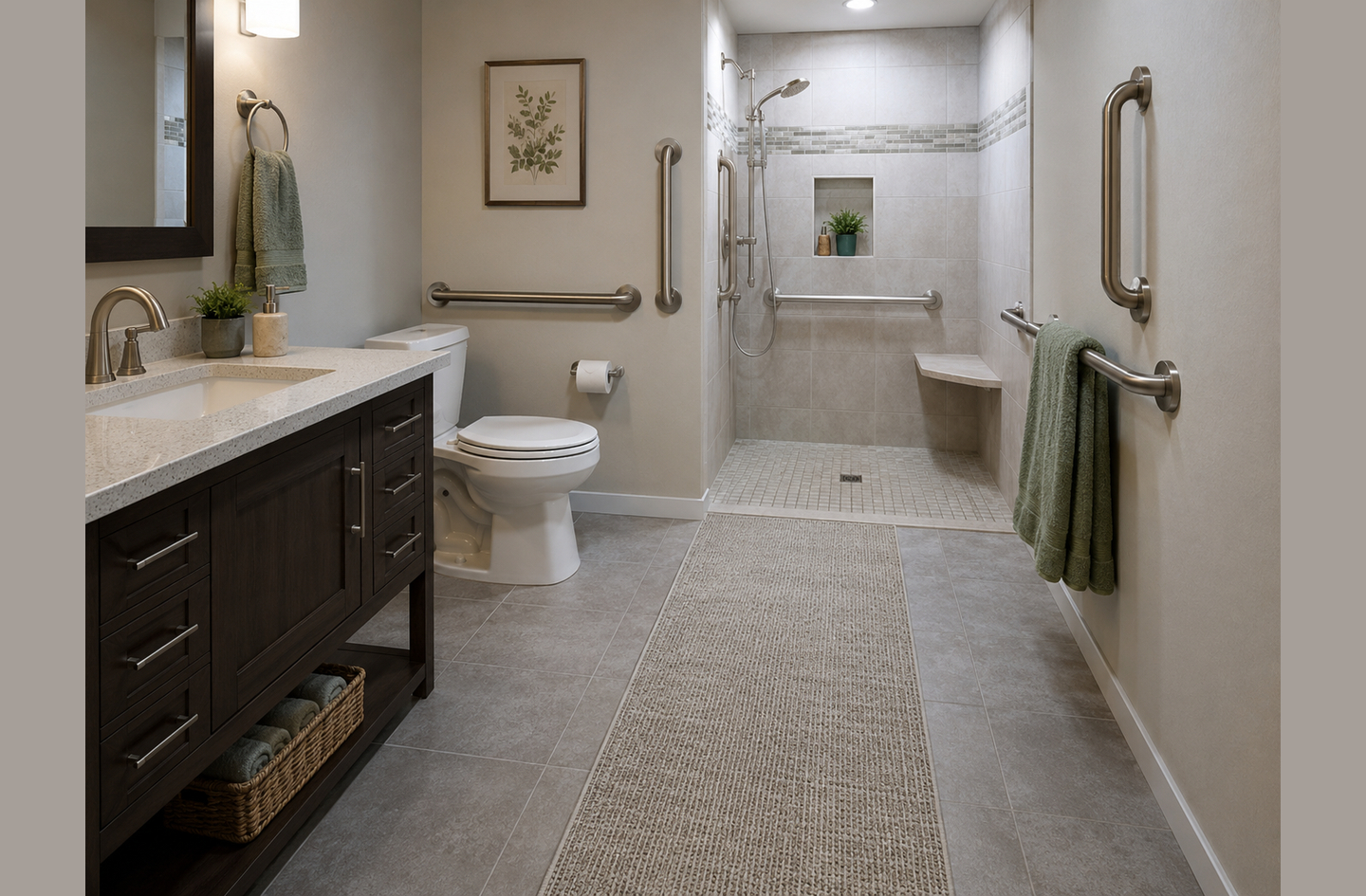
Treat the floor, transitions, and shower entry as one system. A curbless shower with a linear drain, textured mosaic tile on the shower floor, matte large-format tile on the main field, and a beveled entry threshold handles traction, drainage, and accessibility in one coordinated set of decisions rather than isolated fixes.
Deeper read: non-slip bathroom flooring: how to compare tile, vinyl, and other options for a renovation.
Frequently Asked Questions
What DCOF score do I need for a bathroom floor?
ANSI A326.3 sets a minimum DCOF of 0.42 for level interior wet surfaces.2 That threshold applies specifically to level, wet, interior pedestrian use. Ramps, step edges, and other configurations have separate thresholds. A tile rated 0.42 for a level context is not automatically appropriate for a sloped shower floor or a threshold edge.
Do bath mats actually make bathroom floors safer?
A properly fitted mat with backing compatible with the floor surface, flat edges, and regular maintenance can reduce traction risk at a step-out zone. An ill-fitting mat with backing that slides on the actual floor surface, or one with curled edges or degraded suction, introduces a moving surface that adds risk rather than reduces it. Fit and compatibility matter more than the non-slip label.
How do I know when a non-slip mat needs replacing?
Replace a bath mat when it slides on the floor surface it was intended to grip, when suction cups no longer form a seal, when the backing has hardened, cracked, or begun peeling, when edges curl on contact with feet, or when odor persists after thorough washing. A mat showing any of these signs is no longer performing its intended function, regardless of how new it looks.
Is porcelain tile more slip-resistant than ceramic?
Not inherently. Wet traction depends on the surface finish and texture, not on whether the tile is porcelain or ceramic. A polished porcelain tile performs poorly in wet conditions. A matte ceramic tile performs much better. Comparing tiles of the same finish category (both matte, both textured) reveals very little traction difference between the two material types. The finish is the relevant variable.
Can a slippery tile floor be improved without full replacement?
Often yes. Start by ruling out cleaning residue as the cause: strip and rinse with a pH-neutral cleaner and test again. If traction remains inadequate, chemical anti-slip treatments or etching products applied to the existing tile surface can increase friction. Adhesive traction strips cover specific standing zones. Each approach changes surface appearance and cleaning demands, so understand the trade-offs before treating.
What This Hub Does Not Cover
- Structural subfloor assessment or waterproof membrane installation: those decisions require a licensed contractor evaluation specific to the building and the substrate.
- Person-specific mobility assessments: an occupational therapist can evaluate how a specific individual’s gait, balance, footwear, and daily routine interact with specific floor surfaces in the actual home.
- Code compliance certification: general guidance on ADA thresholds and DCOF standards is educational; code compliance for a specific renovation requires a licensed professional review for the jurisdiction.
- Commercial or institutional flooring: slip-resistance standards for commercial wet areas carry different use classifications than residential contexts and are outside this hub’s scope.
References
- Centers for Disease Control and Prevention (CDC) – Older Adult Falls Data and Statistics, including annual fall counts, injury totals, and age-adjusted fall death rates.
- Tile Council of North America (TCNA) – ANSI A326.3 Standard Test Method for Measuring Dynamic Coefficient of Friction of Hard Surface Flooring Materials, including DCOF threshold values and use classifications for wet interior surfaces.
- U.S. Access Board – ADA Standards for Accessible Design, Section 303 Changes in Level, specifying maximum vertical change heights and requirements for beveling and ramping.
- National Institute on Aging (NIA) – Falls and Falls Prevention in older adults, covering risk factors, injury consequences, and fall-related health outcomes including hip fractures.
- National Floor Safety Institute (NFSI) – ANSI/NFSI B101 series of floor safety standards, covering measurement protocols for both static and dynamic coefficient of friction on pedestrian surfaces.
Next Read
Slip-resistant flooring works as a system: installed surface, portable layers, and transitions each play a role. A highly rated tile in the shower does not eliminate risk at the step-out zone or the threshold to the hallway. Evaluating all three layers together, before any renovation decision is made, produces better outcomes than addressing one layer at a time after a problem appears.