
Anti slip bathroom rugs often carry a “non-slip” label that tells you almost nothing about whether the rug will stay flat. What determines stability is backing material, pile weight, edge profile, and how well the rug contacts the specific floor under it. The CDC reports an estimated 234,094 nonfatal bathroom injuries treated in U.S. emergency departments each year among people aged 15 and older, with falls accounting for 81.1 percent of those incidents.1 For context on how surface traction fits into home safety planning, see the overview in slip-resistant flooring overview. This article compares the physical properties that separate a rug that grips from one that slides.
Quick Answer
What actually keeps an anti-slip bathroom rug in place?
Backing material and floor contact decide stability, not the label. Natural rubber and nitrile rubber grip more consistently on wet ceramic and vinyl than latex foam. Pile weight above 2,200 grams per square meter reduces sliding better than lighter construction. A beveled edge keeps the rug flat as the backing ages. Size the rug to cover the full exit zone, not just a decorative patch of floor.
Key Takeaways
- The National Floor Safety Institute defines high traction as a wet TCOF of 0.6 or above; backing materials reaching that threshold can reduce wet-slip risk by 50 to 90 percent.4
- Approximately 37,991 adults aged 65 and older are treated in U.S. emergency departments each year for falls associated with rugs and carpets, with bathrooms accounting for 35.7 percent of home locations.3
- Natural rubber, nitrile rubber, and PVC grid backings outperform latex foam on smooth ceramic and luxury vinyl tile because they maintain surface contact under damp conditions.
- A beveled or tapered edge profile keeps the rug flat against the floor; a thick squared edge becomes a trip hazard when the corner curls or the backing softens over time.
- Loose throw rugs without nonslip backing were found in nearly 78 percent of older adult homes surveyed; an average of more than 11 rugs per home lacked any grip backing at all.3
Backing Compared: What Each Type Delivers at a Glance
The table below compares the four most common bathroom rug backing types across key stability properties. Values reflect typical performance on smooth ceramic tile and luxury vinyl tile under damp conditions. Individual products vary; manufacturer test data takes precedence.
| Property | Natural Rubber | Latex Foam | PVC Grid / Coated Mesh | Woven / Tufted (No Coating) |
|---|---|---|---|---|
| Wet grip on ceramic tile | Strong | Moderate | Strong | Weak to none |
| Wet grip on luxury vinyl tile | Strong | Moderate | Good-to-strong | Weak to none |
| Washability | Good (cold or warm cycle) | Moderate (degrades with heat) | Good | Varies by pile material |
| Edge flatness over time | Good | Poor (corners curl as foam compresses) | Moderate | Varies |
| Drying speed after washing | Moderate | Slow | Fast | Quick |
| Latex allergy risk | None | Yes | None | Latex-free |
| Typical usable lifespan | 3-5 years | 1-3 years | 3-5 years | Varies; pad-dependent |
| Best setting | Wet bathroom exit zone | Dry areas or short-term use | Wet bathroom exit zone | Dry areas with separate non-slip pad |
Anti Slip Bathroom Rugs: How Each Backing Type Grips Your Floor
The backing is the only part of the rug touching the floor. Its material and stiffness determine whether friction is strong enough to resist movement. A “non-slip” or “non-skid” label on the packaging does not specify backing type, floor compatibility, or whether grip holds after repeated washings. Understanding what each backing type actually does removes that uncertainty.
Natural Rubber Backing
Natural rubber provides high surface friction because its molecular structure conforms slightly to the micro-texture of a floor surface under the weight of the rug. On wet ceramic tile or porcelain, rubber maintains that contact even when the floor beneath it is damp. This is the primary reason rubber outperforms foam backings in bathrooms: water on the tile surface does not break the friction bond the way it does with less conforming materials.
One practical limitation is color transfer. Natural rubber can deposit yellow or brown staining onto light-colored luxury vinyl or vinyl plank flooring over time, particularly in bathrooms where moisture increases adhesion between the backing and the floor. Manufacturers sometimes treat rubber to reduce this, but checking the product’s floor-compatibility guidance before installing on light vinyl is worth doing. On ceramic, porcelain, and darker vinyl, color transfer is rarely a problem.
Washing matters too. Machine-washing in cold or warm water is fine for most rubber-backed rugs. Hot water and tumble drying on high heat degrade rubber faster, hardening it and reducing the flexibility that makes it grip. A rubber backing that has stiffened is no longer conforming to the floor surface and is losing its advantage over time.
Latex Foam Backing
Latex foam is the most common budget bathroom rug backing because it is inexpensive to manufacture and feels soft underfoot. It provides acceptable initial grip on dry or lightly damp tile. The problem is durability. Latex foam is an open-cell structure that traps moisture and takes longer to dry between uses. In a bathroom where the rug gets wet daily, the foam gradually breaks down, losing density and grip. Most latex-backed rugs show meaningful grip loss within 12-18 months under regular bathroom use.
A second concern is latex allergy. Latex sensitization affects a meaningful portion of the population, and prolonged skin contact with a latex backing in a warm, humid environment can trigger reactions in sensitized individuals. For households with a known latex sensitivity, rubber or PVC alternatives are the practical choice.
Latex foam also performs poorly on edge flatness over time. As the foam compresses in the center under body weight but retains its thickness at the edges, corners lift. A lifted corner on a bathroom rug is a trip hazard, not a minor aesthetic issue. This is one of the most common failure modes in bathroom rugs: the rug grips adequately underfoot but the edge catches a toe on the way out of the shower.
PVC Grid and Coated Mesh Backing
PVC grid backings use a rigid or semi-rigid lattice structure rather than a solid sheet. The open grid allows water and air to pass through, which keeps the backing drier than foam and reduces the adhesion failure that happens when moisture accumulates between the rug and the floor. On ceramic tile and most vinyl surfaces, a PVC grid backing provides grip comparable to natural rubber and often outlasts latex foam by a wide margin in terms of both grip retention and physical integrity.
The trade-off is flexibility. A firmer PVC grid does not conform as tightly to floor micro-texture as rubber does. On floors with slight surface irregularities, such as handmade tile or stone with variable texture depth, rubber tends to grip more consistently. On smooth, flat factory tile or vinyl, PVC grid performs well.
One note for luxury vinyl plank and sheet vinyl owners: some PVC backings can react chemically with vinyl flooring plasticizers over time, causing the flooring surface to soften or discolor. This is not universal, but verifying the manufacturer’s floor-compatibility statement before using a PVC-backed rug on luxury vinyl is the right precaution.
Woven, Tufted, and Memory-Foam Backings
Woven or tufted rugs with no backing treatment (jute, cotton canvas, or bare fabric backing) offer essentially no grip on smooth bathroom floors. The textured weave does not create meaningful friction against slick tile or vinyl. These rugs belong in dry areas with low-risk placement, or under a separate non-slip rug pad sized to match the rug’s footprint.
Memory-foam-backed rugs are comfortable underfoot but do not function as an anti-slip surface. Memory foam conforms to your foot, not to the floor. The backing is typically smooth and provides minimal friction against tile or vinyl. Again, a correctly sized non-slip pad under the rug is what creates stability, not the foam itself.
If you want to keep a woven or memory-foam rug in the bathroom, a correctly sized non-slip pad makes it functional. The pad must match the rug footprint; a pad wider than the rug creates its own raised edge and trip risk at the perimeter.
“Falls are the leading cause of fatal and nonfatal injuries for older Americans.”
National Council on Aging (NCOA), Falls Prevention Facts2
That pattern shows up clearly in bathroom data. A peer-reviewed study from 2013 found that annually, an estimated 37,991 adults aged 65 and older were treated in U.S. emergency departments for falls associated with rugs and carpets, with bathrooms accounting for 35.7 percent of home locations in that group.3 A rug that grips well is one friction point removed from a daily routine that involves wet floors and rapid direction changes.
Weight, Pile Density, and Edge Profile: Physical Properties That Resist Movement
Backing material gets most of the attention, but a rug’s pile construction and its edge geometry shape how well the backing actually functions day to day. A heavy, dense pile holds the backing flat against the floor more consistently than a thin or loosely woven pile does. And the edge profile determines whether the rug trips someone six months from now, after the backing has softened and the corners have started to lift.
Weight and Pile Density
Pile weight is typically expressed as grams per square meter, or GSM. A higher GSM means more fiber packed into the same surface area, which translates to a denser, heavier rug. In practice, a denser pile distributes the rug’s weight more evenly across the backing, keeping the backing in consistent, flat contact with the floor rather than allowing portions of it to lift between footsteps.
Bath rugs commonly range from about 700 GSM on the lighter end to 1,400 GSM or above for heavier chenille and microfiber constructions. Rugs in the 1,000-1,400 GSM range sit noticeably flatter than thinner counterparts. This matters most at the edges: a heavier pile resists the edge lift that develops in lighter rugs when the center is compressed repeatedly by foot traffic but the border retains its original thickness and curls upward.
There is no authoritative government or industry standard specifying a minimum GSM for bathroom rug stability. The GSM guidance in retail product descriptions reflects manufacturer and retail convention rather than a tested safety threshold. What you can do: lift a rug at a corner before buying and check how readily it holds a curl. A rug that stays flat when you release it has enough body to resist edge lift in use. One that curls immediately at the corner is likely to do the same thing on the floor within weeks.
Pile height, separate from density, also plays a role. A very high pile (above about 30mm) can reduce the effective contact area of the backing with the floor, because the rug’s mass is distributed higher and the backing area directly under the foot is smaller relative to the pile mass. For bathroom use where stability is the priority, a shorter to medium pile (10-25mm) with high GSM performs better than a thick shag at the same weight.
Edge Profile and Trip Risk
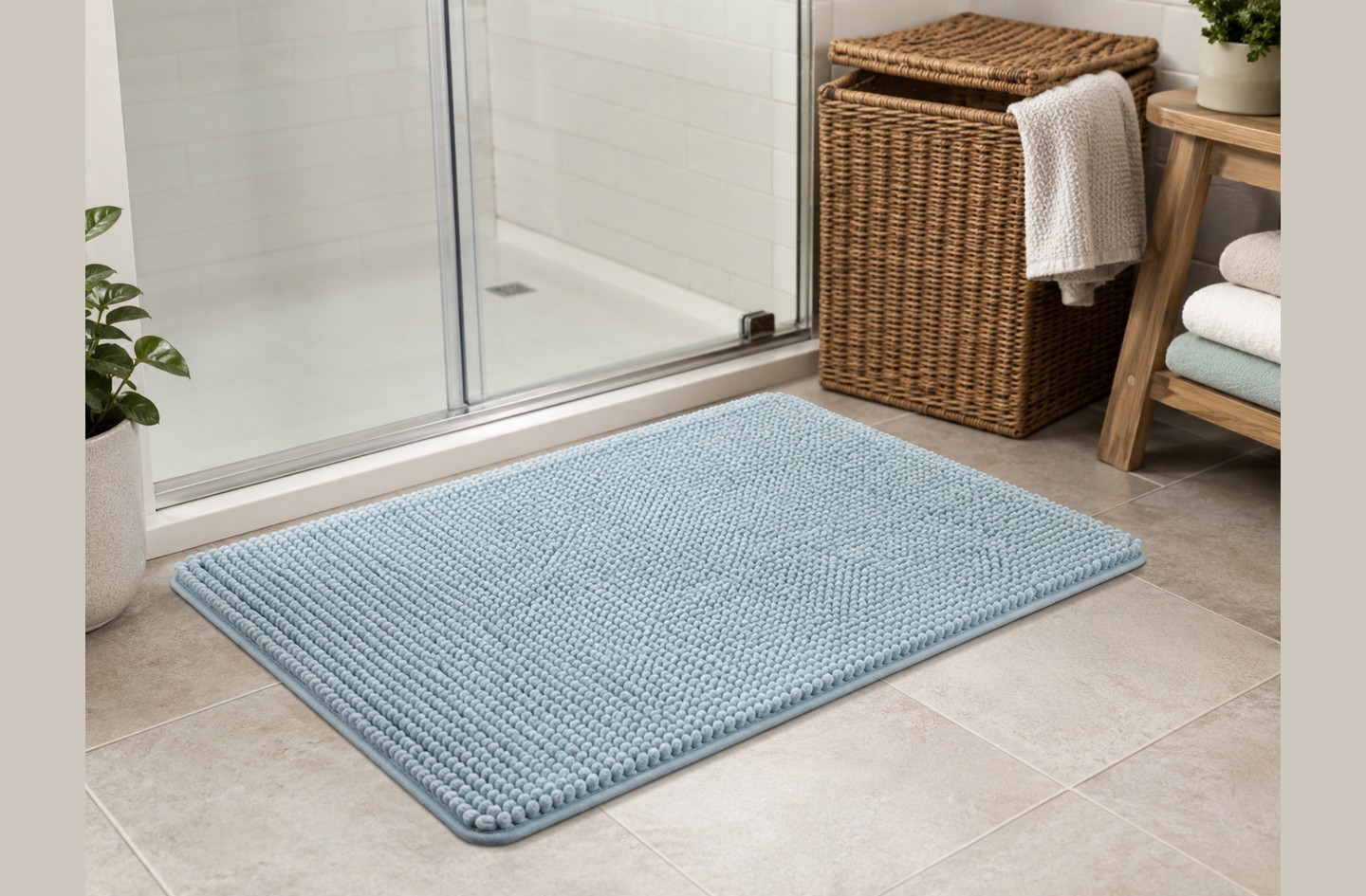
The edge is where most bathroom rug failures announce themselves. A rug that grips well underfoot can still become a hazard if its border curls upward and catches a foot on the way out of the shower. The profile of the rug’s edge, specifically how the pile thickness tapers at the border, determines how the rug behaves as the backing softens over time.
A beveled or tapered edge is thinner at the outer border than at the center, so the transition from rug surface to bare floor is gradual rather than abrupt. When the backing softens and loses some stiffness, a beveled edge remains relatively flat because there is less pile height at the border to lift. A squared, thick edge keeps its full pile height all the way to the border, which means any backing deformation at the corner creates a raised lip that sits above the floor surface at an angle.
The trip hazard threshold for a raised floor surface in residential settings is often cited around 6mm (roughly a quarter inch) for abrupt changes. A curled rug corner frequently creates a raised edge of 8-15mm, well above that range, in a high-frequency traffic zone. The risk is compounded by the movement pattern involved: stepping out of a shower or tub typically involves a forward-and-down motion with limited visibility of the floor, especially in low lighting. A person does not look down at the rug edge while stepping out. They assume it is flat.
When evaluating a rug in person or from a product image, look at whether the edge profile tapers visibly toward the border. If the pile appears to end at a uniform height all the way to the edge, the rug relies on the backing staying stiff and flat to prevent curling. For a bathroom, that is a condition that degrades with every washing and every month of humidity exposure.
The combination of latex foam backing and a squared edge profile creates compounding failure risk. The foam softens through washing, reducing grip; simultaneously, corners lift as the foam loses stiffness at the perimeter while the center compresses under foot traffic. Choosing a rubber or PVC backing with a beveled edge avoids both failure modes independently.
Absorbency, Drying, and Surface Compatibility: How Moisture and Floor Type Change the Equation
Absorbency and grip are related but separate properties. A highly absorbent rug does not automatically stay in place, and the trade-offs between how quickly a rug dries and how well it grips under damp conditions shape which materials work best in the bathroom exit zone.
Absorbency and Moisture Management
High-absorbency pile materials, microfiber and looped chenille in particular, pull water off wet feet quickly and hold it in the pile fibers rather than letting it pool on the surface underfoot. This is a genuine comfort and safety benefit: less water on the standing surface means less water between your feet and the rug, which maintains traction between foot and rug pile.
The problem shows up at the backing level. When a thick, highly absorbent rug becomes fully saturated, its total weight increases significantly. This additional mass can reduce the effective friction between the backing and the floor, particularly if the backing material has softened or if the floor surface is smooth and the backing is already working at the lower end of its friction range. A very heavy, wet rug on a smooth ceramic floor with a latex foam backing is at greater risk of shifting than a moderately absorbent rug with rubber backing on the same floor.
Drying speed is the related variable. A rug that dries slowly between uses stays damp for hours. A damp backing on a smooth floor does not grip as well as a dry one. If your bathroom rug stays wet until the next morning, it is spending significant time in a reduced-grip state. Thinner rugs and those with open-weave or mesh-like pile structures dry faster. Hanging a rug over the shower rod or a towel bar between uses, while impractical for many households, allows both sides to dry evenly and extends the effective life of any backing material.
Surface Compatibility by Floor Type
Not all backing materials grip equally well on all floor surfaces. Smooth ceramic and porcelain tile gives rubber and PVC backings a reliable surface to grip because the tile surface is flat, consistent, and relatively uniform. On this surface type, both rubber and PVC grid backings perform well, and the selection comes down to other factors (washing preferences, latex sensitivity, color transfer concerns).
Luxury vinyl tile (LVT) and luxury vinyl plank (LVP) introduce two variables. First, some LVT products have a surface coating that is slightly softer than ceramic. Natural rubber conforms to this surface well and grips firmly. PVC grid backings also work on most LVT, but certain formulations of PVC can react chemically with the plasticizers in vinyl flooring over months of contact, causing surface softening or discoloration of the floor. This is not universal, but it is worth checking the flooring manufacturer’s guidance before placing a PVC-backed rug permanently on LVT. The safest approach on LVT for long-term installation is natural rubber or a rug pad specifically rated for vinyl compatibility.
How to Size a Bathroom Rug for the Exit Zone
Most bathroom rugs are sized for appearance. The result is a rug that sits in roughly the right area but does not actually cover the zone where wet feet land when stepping out of the shower or tub. Sizing for the exit zone is a different calculation, and getting it right means fewer wet bare-tile steps between the shower and the towel.
The exit zone is the floor area your feet contact immediately after you step over the threshold of the shower or tub. For a standard tub-shower combination, this zone is typically 18-24 inches in front of the tub edge and 24-30 inches wide. For a walk-in shower with a door, the zone extends from the door threshold forward to where you stand to towel off, which is often 30-36 inches of depth depending on how far you step before stopping.
Standard bathroom rug sizes run 17×24 inches (most common) and 21×34 inches. The 17×24 covers the step-out area for a standard tub but falls short for walk-in showers, where the exit step carries you further from the wall. The 21×34 or 24×36 covers the exit zone for most shower configurations. For elongated or double-door showers, a 24×60 runner or two rugs end-to-end may be necessary.
Sizing too small creates a specific problem: the rug’s far edge sits in the area where you stand while drying, which means one or both feet are on bare tile during the toweling routine. This is a different risk from the exit step itself. Standing on one foot while drying the other on an unsupported surface, with wet tile around the rug’s perimeter, is exactly the instability scenario a well-sized bathroom rug is meant to prevent.
When measuring, do not size to the room. Size to the movement. Stand in front of your shower or tub and note where both feet land after you step out, how far forward you step before stopping, and how far to each side your feet move during toweling. That rectangle is your rug’s minimum coverage area. If the largest standard rug size does not cover it, two adjacent rugs with non-slip backing on both, positioned so their edges meet without a gap, is preferable to one undersized rug with bare tile at the edges.
Which Rug Fits Your Situation
The right bathroom rug depends on floor surface and whether household members have specific allergy considerations. These profiles cover the most common combinations.
Smooth Ceramic or Porcelain Tile Floor
Natural rubber or PVC grid backing works well here. Either provides strong wet grip on the consistent, flat surface of factory-finished ceramic tile. If the bathroom is used by someone who steps out slowly or transfers weight carefully on exit, a heavier rubber-backed rug (1,000 GSM and above) with a beveled edge gives the most stable and durable combination. For households concerned about color transfer from rubber onto grout or lighter tile, a PVC grid backing avoids that issue entirely.
Luxury Vinyl Tile or Vinyl Plank Floor
Natural rubber is the safest long-term choice on LVT and LVP. It grips reliably, does not typically damage vinyl surfaces, and does not introduce the plasticizer-compatibility question that some PVC backings raise. Before installing any rug permanently, confirm the flooring manufacturer does not restrict rubber-backed accessories, as this guidance varies by product line. If the vinyl is relatively new or expensive, placing a thin rubber rug pad rated for vinyl use between the rug and floor, rather than relying on the rug’s own backing alone, gives an extra layer of surface protection while maintaining grip.
Household with a Latex Sensitivity
Latex foam backing is the concern here. Natural rubber, nitrile rubber, and PVC grid backings carry no processed latex allergens. For severe latex sensitivities, verify with a physician before selecting any backing type, since individual responses vary. Natural rubber and PVC options deliver equivalent or better grip than latex foam on wet tile.
Large Walk-In Shower or Wide Exit Zone
A single 21×34 or 24×36 rug may not cover the full exit footprint of a wider shower. A 24×60 runner with rubber or PVC backing is the cleanest solution when the shower threshold is wider than about 30 inches. Runners in this size range are available in both rubber-backed and PVC-backed construction. Confirm the runner lies completely flat before use; a long rug with any lateral bow or buckle in the middle is a trip hazard longer than a small bath mat with curled edges.
Frequently Asked Questions
What is the difference between a non-slip and an anti-slip bathroom rug?
The terms are interchangeable in retail marketing and carry no standardized technical definition. Neither label specifies backing material, floor compatibility, or grip force under wet conditions. Falls account for 81.1 percent of nonfatal bathroom injuries in U.S. emergency departments.1 What matters is backing type, floor surface match, and whether the edge profile stays flat as the backing ages, not what the label says.
Does a heavier bathroom rug stay in place better?
Within the same backing type, yes. A denser, heavier pile (higher GSM) holds the backing flat against the floor more consistently and resists edge lift better than a lighter construction does. The effect is most visible at the corners. Backing material still decides the base level of grip; weight helps maintain that grip uniformly across the rug’s surface and edges over time.
How often should I replace an anti-slip bathroom rug?
Replace it when the backing shows signs of failure, not on a fixed schedule. Warning signs include corners that curl back after you press them flat, backing that feels hard or cracked rather than grippy, and a rug that slides on a surface where it previously held. Latex foam backings typically show these signs within 12-24 months of regular bathroom use. Rubber backings last longer under the same conditions.
Can I use a non-skid bathroom rug on luxury vinyl plank flooring?
Natural rubber-backed rugs generally work well on luxury vinyl plank. Some PVC grid backings can react with vinyl plasticizers over extended contact, potentially softening the flooring surface. Check the LVP manufacturer’s accessory guidance before committing to a PVC-backed rug on new or expensive flooring. A rug pad specifically rated for vinyl compatibility provides an additional protective layer under any rug type.
How do I wash a non-slip bath mat without damaging the backing?
Machine wash in cold or warm water on a gentle cycle. Avoid hot water and tumble drying on high heat; both accelerate backing degradation in latex foam and harden natural rubber faster than cool washing does. Air drying over a shower rod or towel bar lets both sides of the mat dry fully before it returns to the floor, which extends backing life and prevents moisture accumulation under the rug.
Limitations and Edge Cases
- This article covers rugs and mats placed in the bathroom exit zone, outside the shower or tub. For traction surfaces placed inside the shower or tub (suction-cup mats, adhesive anti-slip strips, pebble inserts), surface compatibility and installation criteria differ significantly.
- GSM values come from manufacturer labeling and retail convention, not from an independent standardized test for stability. Treat GSM comparisons as directional, not as certified stability ratings.
- NFSI certification is a U.S.-based program. Equivalent traction standards and testing bodies exist in other countries; verify your regional standard before selecting a rug based on a U.S. traction classification.
References
- CDC / Morbidity and Mortality Weekly Report – Nonfatal Bathroom Injuries Among Persons Aged >=15 Years, United States, 2008. Judy Stevens et al. Vol. 60, No. 22, June 10, 2011.
- National Council on Aging (NCOA) – Get the Facts on Falls Prevention. Updated 2024-2025. Cites 2021 surveillance data from CDC and related federal sources.
- PubMed Central / Journal of Injury and Violence Research – Rosen T, Mack KA, Noonan RK. Slipping and tripping: fall injuries in adults associated with rugs and carpets. Journal of Injury and Violence Research. 2013 Jan;5(1):61-69. Loose-rug prevalence data (78% of homes) cites Gill TM et al., American Journal of Public Health, 1999;89(4):553-6.
- National Floor Safety Institute (NFSI) via AcroMat – NFSI 101-C Test Method for Measuring Dry TCOF of Floor Mat Backing Materials; traction zone thresholds and slip-risk reduction data confirmed November 13, 2023 by Russell Kendzior, NFSI President. Published November 27, 2023.
Conclusion
An anti-slip bathroom rug stays put or it doesn’t based on the interaction between backing material, floor surface, pile weight, and edge geometry. A “non-slip” label on the package does not tell you which of those properties the rug actually delivers, or whether it will still deliver them after six months of washing and humidity exposure. Selecting by backing type first, then verifying floor compatibility and sizing to cover the full exit zone, is a more reliable approach than trusting the label.
For a broader look at how bathroom rug selection fits into surface traction decisions across the home, see the slip-resistant flooring overview for how this fits the wider topic of safer home surfaces.