Most non-slip bathroom flooring decisions start with the wrong question. Asking whether a material is “slippery” misses what actually controls wet grip: the finish, surface texture, and care history of a specific floor. The overview in Slip-Resistant Flooring maps this topic across surface types. This article compares tile, vinyl, and other options by the traits that determine traction when wet. More than 80 percent of the estimated 234,000 nonfatal bathroom injuries treated in U.S. emergency departments each year involve slips and falls,1 and the material name is rarely the most important variable.
Quick Answer
Which bathroom flooring is safest when wet?
The option most likely to feel safer in wet conditions is any floor whose installed finish meets ANSI A326.3’s wet DCOF minimum: 0.42 for general bathroom areas and 0.50 for shower floors and other barefoot zones.3 Unglazed and matte tile finishes typically meet both. Polished porcelain tile measured a wet COF of 0.15 in a peer-reviewed study, well below either threshold.4 Textured luxury vinyl typically meets the 0.42 standard. The material name tells you very little. The finish and the verified DCOF figure tell you almost everything.
Key Takeaways
- ANSI A326.3-2021 sets the minimum wet DCOF at 0.42 for general bathroom areas and 0.50 for shower floors and other barefoot wet zones.3
- Polished porcelain tile measured a wet COF of 0.15 in controlled testing, an 84 percent drop from its dry value of 0.95.4
- ANSI A326.3 states explicitly that its test does not predict whether a person will or will not slip, so the number is a spec tool, not a safety guarantee.3
- Surface continuity, seam height, and threshold transitions matter for walkers and wheelchairs as much as wet traction does for barefoot use.
- More grout lines from small-format tile probably add some grip, but no controlled study has quantified the amount.8
Quick Comparison: Non-Slip Bathroom Flooring Options
This table summarizes how tile, vinyl, and rubber flooring compare across the properties that matter most for a wet bathroom environment. Keep in mind that material categories overlap: polished porcelain and unglazed matte tile perform very differently from each other even though both are “tile.” Read the sections that follow before treating these summaries as final decisions.
| Property | Ceramic / Porcelain Tile | Vinyl (LVP / LVT) | Rubber |
|---|---|---|---|
| Wet DCOF range | 0.15 (polished) to 0.70+ (unglazed textured) | 0.42-0.55 (texture-dependent) | Typically above 0.60 wet SCOF |
| Meets Interior Wet Plus (0.50) threshold | Yes, with unglazed or matte finish | Product-dependent; verify spec sheet | Typically yes |
| Surface texture mechanism | Grit, relief, or grout-line edges | Embossed pattern depth | Inherent elastomeric grip |
| Grout joints / seams | Yes (mosaic: 15-25 per sq ft; large format: 1-2 per sq ft) | Minimal seams, no grout | Minimal seams or sheet format |
| Soap residue accumulation | In grout channels and on tile face | In embossed texture pockets | On surface only |
| Walker / wheelchair rolling | Slight resistance from grout lines | Low rolling resistance | Moderate resistance from grip |
| Renovation complexity | High (mortar bed, grout, curing time) | Moderate (click-lock or glue-down) | Moderate (adhesive or interlocking) |
| Best suited for | Shower floors (unglazed or matte finish) | Main bathroom floor (continuous surface) | Utility areas and secondary baths |
Wet Traction: How Finish Determines the Numbers
Wet traction is what most people focus on when choosing non-slip bathroom flooring. The answer is almost never about the material name. It is almost always about the finish and surface texture. Dynamic Coefficient of Friction (DCOF) is the measure of resistance to sliding between a foot, or a test sensor, and a wet floor. It is measured under ANSI A326.3-2021,3 and the result falls between 0 and 1. Higher means more grip.
ANSI A326.3-2021 is the U.S. standard that sets the minimum wet DCOF for each floor type. For bathrooms, the minimum is 0.42. For shower floors and barefoot wet zones, the minimum rises to 0.50 under the use class called Interior Wet Plus.3 A floor that meets 0.42 is fine for the main bath but too low for the shower. The standard states directly that a DCOF result does not predict whether a person will slip. It is a product rating, not a safety promise. It reflects surface traits but ignores soap buildup, wear, and foot angle at each step.
Finish type is the most decisive variable for tile. A peer-reviewed study published in Materials in 2021 tested five tile finishes under wet and dry conditions.4 A polished pre-levigato porcelain tile measured a dry COF of 0.95 and a wet COF of 0.15, an 84 percent reduction. An unglazed semi-polished tile measured 0.60 dry and 0.58 wet. A glazed unpolished tile measured 0.58 dry and 0.58 wet. These are not marginal differences. A polished and an unglazed matte tile of similar visual appearance produce numbers that differ by a factor of nearly four under wet conditions. The polished tile fails the 0.42 minimum by a wide margin. The unglazed and matte options exceed both thresholds with near-zero wet degradation.
The most actionable step before buying any bathroom tile is requesting the manufacturer’s wet DCOF certificate for the specific product SKU, not for the material category in general.
Vinyl and rubber: what the texture variables mean
For vinyl, the key variable is surface embossing depth. Smooth sheet vinyl can score well when dry but may fall short when wet with soap. Deep-embossed or stone-textured luxury vinyl plank typically meets the 0.42 threshold. NFSI B101.1 rates wet surfaces above 0.60 SCOF as High-Traction and those between 0.40 and 0.59 as Moderate Traction.5 No public database lists wet DCOF by LVP brand or product. Getting the rating requires the maker’s spec sheet for the exact product. Ask for it before you commit to a choice.
Rubber flooring has grip built into its rubber material. It typically meets or beats the NFSI High-Traction threshold of 0.60 wet SCOF, placing it above both ANSI minimums.5 The tradeoff is rolling friction for wheelchairs and walkers, which rises with the same material trait that creates grip underfoot.
Surface Continuity and Transitions
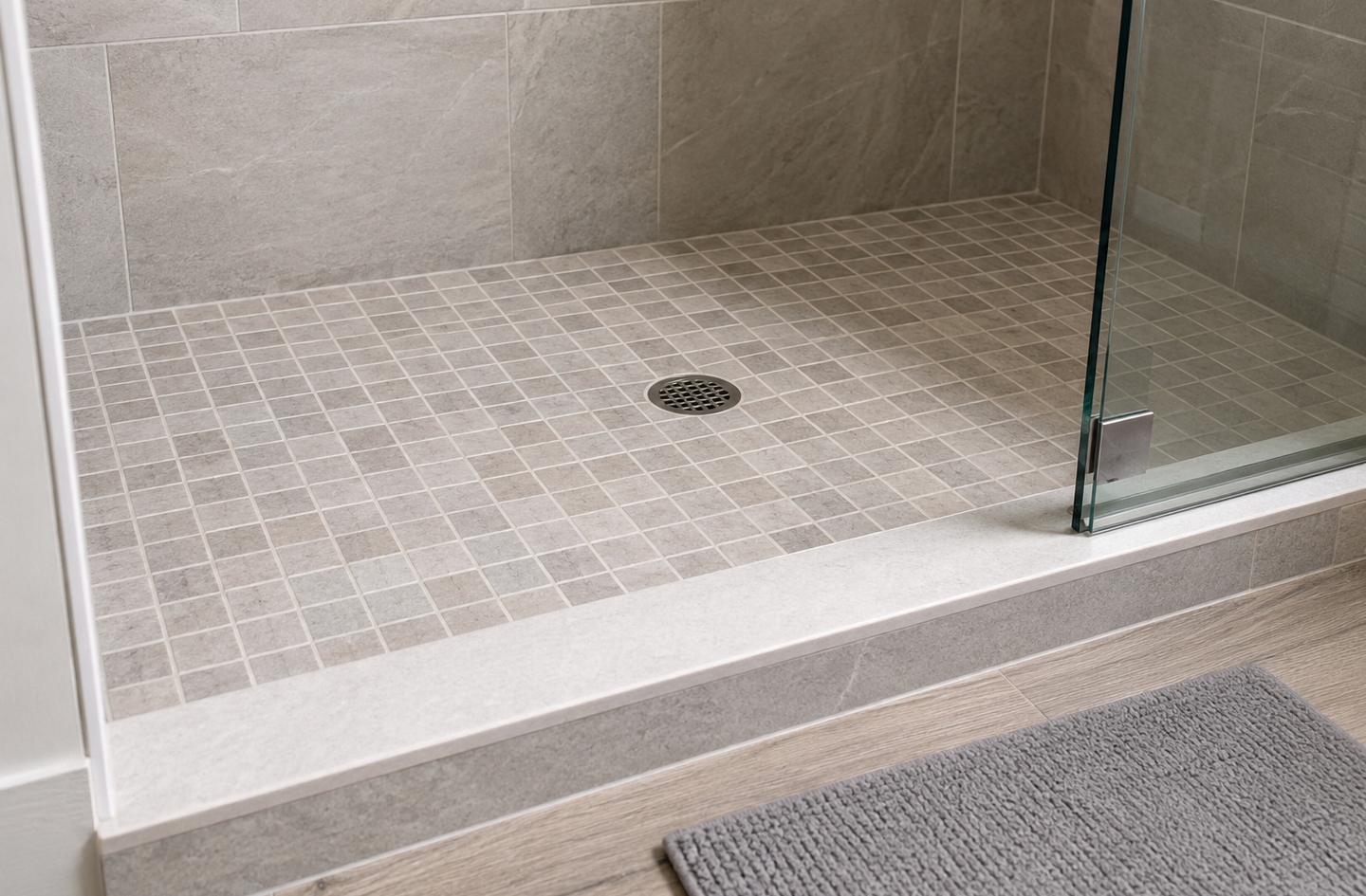
For someone using a walker or wheelchair, surface continuity matters as much as slip resistance. Frequent grout lines interrupt the floor surface. A 1-inch hexagon mosaic tile produces between 15 and 25 grout joints per square foot.7 A 12×12 tile creates one or two. Those micro-edges help bare feet contact the surface when wet. They also add small resistance increments as a walker tip or wheelchair wheel crosses each one across a full route.
Grout joint density is the number of grout lines per square foot of floor area, determined by tile format and layout. High grout joint density means more textural interruptions per stride, which matters differently depending on whether the primary concern is barefoot grip or rolling mobility. The two objectives pull in opposite directions when the bathroom serves both uses.
“It is assumed that small tiles with lots of grout joints will be more slip resistant, which is likely to some degree, but there is no data substantiating that opinion.”
Ceramic Tile and Stone Consultants (CTASC), expert answers on residential shower floor standards8
Threshold height at room transitions is often the more significant safety variable than the floor traction number, particularly for anyone whose gait is affected by balance or strength changes.
Vinyl’s advantage in continuity is real. A properly installed luxury vinyl plank with tight seams presents a near-flat surface with minimal gaps. Walker tips and wheelchair wheels cross it without the small resistance steps that grout lines add to tile. Floor rigidity also matters. A rigid or semi-rigid plank provides a stable push-off base. A thin, flexible sheet vinyl can flex slightly under a walker tip. That flex creates a small instability at push-off. Over a full day of bathroom trips, the effect adds up more than a single test step suggests.
Threshold transitions at room edges
DCOF measures grip at the foot contact zone. It says nothing about where two floor types meet. A raised transition strip breaks walking stride and forces the foot to clear a real edge. A standard home threshold height creates a real tripping risk for someone with reduced foot lift or balance changes. Flush or low-profile transitions remove this risk regardless of the materials on either side. The threshold is a separate choice from the floor, but both belong in the same review. For walkers, the strip between the bedroom and the shower is often the riskiest point on the whole path.
For wheelchair users, a raised threshold requires additional forward force to cross and creates a tipping risk at the front casters. A zero-threshold or flush transition at the bathroom entry is one of the highest-leverage modifications a bathroom renovation addresses. The floor’s traction rating becomes a secondary concern when the entry transition prevents safe access in the first place.
Maintenance and Contamination Risk
Traction ratings are measured on clean surfaces under standardized lab conditions. Real bathroom floors accumulate soap film, mineral deposits, body oils, cleaning product residue, and mildew. Each changes friction. A floor that meets the ANSI threshold when new may not maintain it after two weeks of normal use without the right cleaning routine.
Tile: grout channels and surface care
Tile presents two surfaces to maintain: the tile face and the grout channels. Grout traps soap scum and grows mildew in areas with poor air flow. Both cut traction over time. Epoxy grout is denser and less porous than cement grout and resists staining and mildew better in wet areas. The cleaning needed to keep grip depends on water hardness, products used, and room air flow. Hard water leaves mineral deposits that need acidic cleaners to clear. Acidic cleaners degrade cement grout over time, which creates a conflict. Knowing this before you pick a grout type is part of a full floor plan.
Vinyl: surface film and embossing depth
Vinyl has no grout channels, but embossed texture creates microscopic pockets that collect soap film. The depth of those pockets affects how much residue accumulates and how thoroughly it rinses with normal cleaning. A shallower embossed pattern is easier to clean but provides less mechanical texture for barefoot grip. That tradeoff between cleanability and texture is real, and it is worth raising when comparing vinyl products rather than assuming that all embossed vinyl performs identically across wet conditions.
A polished tile floor cleaned weekly is less safe when wet than an unglazed matte tile floor cleaned monthly, because finish type dominates wet traction more than cleaning frequency does.
Rubber: chemical compatibility
Rubber flooring cleans easily with mild soap and water and has no grout channels. Its primary maintenance concern is chemical compatibility. Bleach-heavy cleaners and strong solvents degrade rubber’s surface elasticity over time, reducing the material property that contributes most to grip. Checking the flooring manufacturer’s cleaning specifications before choosing a bathroom cleaning product matters more for rubber than it does for tile or vinyl. This is a simple check that is often skipped until damage is visible.
Water Management and Wet Zone Exposure
Not every part of a bathroom floor gets equally wet. The shower floor lives in direct water flow throughout use. The step-out zone just outside the shower receives wet feet. The main bathroom floor beyond that sees splashing and tracked moisture but not sustained exposure. These different exposure zones need different traction thresholds and, in some cases, different materials or installation methods.
ANSI’s Interior Wet Plus category (minimum 0.50 DCOF) applies to the shower floor. The general Interior Wet category (minimum 0.42) covers the main bathroom floor outside the shower.3 Using the higher threshold throughout the whole bathroom is safe but not required outside the shower. The key decision is whether the shower floor meets 0.50, not whether every surface does.
Shower floor slope and tile format
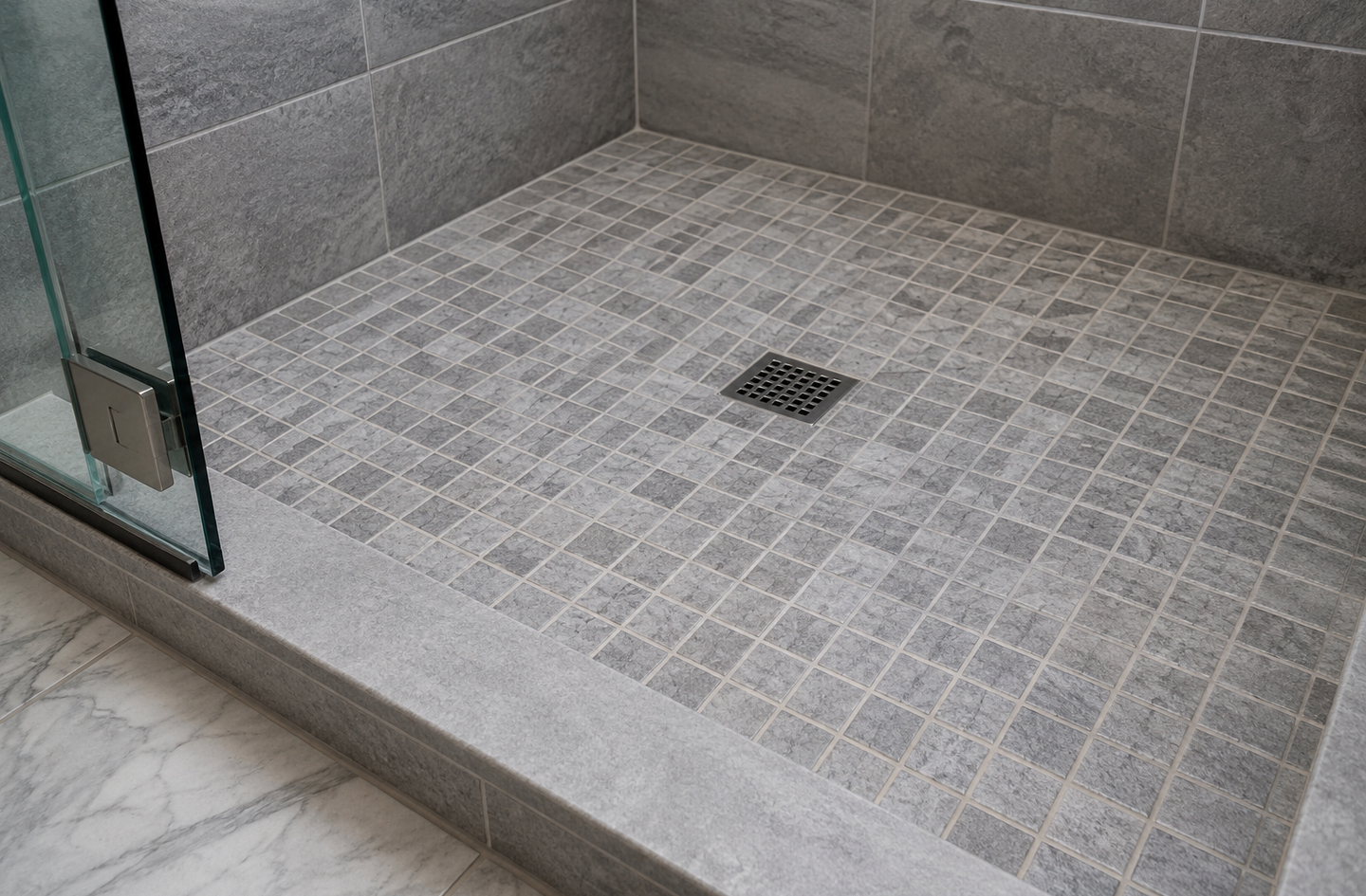
A shower floor must slope toward the drain at about one-quarter inch per foot of run. Large-format tile creates a fitting problem on a sloped pan. The tile must bridge the slope across a long span, which produces high and low spots, causes water to pool near the drain, and risks cracking at unsupported points. Small mosaic tile conforms to a sloped surface more easily. Each piece spans a short distance and follows the slope in small steps. This is one of the strongest arguments for small-format tile on a shower floor, separate from its traction traits. Both the drainage case and the traction case point to the same format choice.
Vinyl and waterproofing in wet zones
Sheet vinyl and rubber follow the floor profile continuously and do not create the conformity problem that large-format tile does on a sloped pan. Vinyl in a shower requires sealed seams and proper waterproofing at the perimeter and all penetrations. An unsealed seam or perimeter allows water to migrate beneath the flooring into the subfloor, causing damage over months before it becomes visible. This is not a reason to avoid vinyl in wet zones, but it is a reason to specify waterproofing explicitly in the installation scope rather than assuming the installer includes it. The floor material alone is not sufficient; the installation system matters equally.
Compatibility With Walkers and Wheelchairs
One in four adults over age 65 falls each year, and home modifications to reduce slip risk rank among the primary prevention strategies the National Council on Aging identifies for this population.2 For residents who use a walker or wheelchair, the floor’s effect on daily mobility extends beyond slip risk. Rolling resistance, surface firmness, and seam height all affect how much effort a floor adds to every bathroom trip.
Walker compatibility
Walker tips need a firm, continuous surface for stable push-off. A highly compliant surface, such as thick foam-backed vinyl, allows the rubber tip to sink slightly before pushing off, which introduces a small instability at each step. Rigid or semi-rigid luxury vinyl plank and tile are both firm enough to avoid this issue. Grout lines add small resistance increments with each crossing. For a person making 20 to 40 bathroom trips per day, that cumulative friction matters more than it appears in a single test step. Mosaic tile on a main bathroom floor creates perceptibly more rolling resistance than a smooth vinyl surface over a full daily route.
Bath rugs and mats in the step-out zone complement, but do not replace, the floor beneath them. The anti-slip bathroom rug selection guide covers how backing type and placement interact with different floor surface types.
Wheelchair compatibility
Wheelchair rolling effort increases with surface texture. A highly textured tile that earns high marks for barefoot traction creates resistance for wheels and makes self-propulsion harder across a full day. For a resident who uses both a walker and a wheelchair at different times, the floor optimized for one mode adds friction for the other. Smooth vinyl with flush seams is the better choice for the main bathroom travel route when wheelchair access is a priority. Textured tile performs better for barefoot shower use. When the bathroom serves both needs, a smooth continuous vinyl main floor with a separate small-format textured tile shower floor addresses both. The two surfaces are separated by the shower threshold, which should itself be flush or as close to flush as the shower waterproofing system allows.
The Decision Framework
Framing the choice as tile versus vinyl misses the real question. The more useful structure is: which combination of finish, format, seam treatment, and maintenance matches the specific bathroom, the daily route, and the mobility context of the person using it? The National Institutes of Health specifically recommends nonslip floor surfaces and nonskid mats for bathroom wet areas as a fall prevention measure in home environments.6
For a shower floor, unglazed or matte tile is the more durable long-term choice. The finish meets the 0.50 Interior Wet Plus threshold,3 smaller formats conform to drainage slopes, and the material has a long track record in wet-area use. The mortar bed and grout install adds time and cost, and the grout needs regular care to prevent soap scum from cutting grip over time.
For the main bathroom floor outside the shower, vinyl offers adequate wet traction when properly specified, near-flat surface continuity for rolling mobility, and lower remodel complexity. A full-bathroom vinyl install avoids the threshold created where two different materials meet at the shower edge. A true curbless shower design requires waterproofing to a higher standard than many standard vinyl installs address. If the remodel includes a curbless design, waterproofing details belong in the scope, not in an assumption.
Rubber works best in utility areas, laundry rooms, and secondary bathrooms where maximum grip and low maintenance are priorities and wheelchair rolling distance is short.
Full bathroom renovation
Combining an unglazed porcelain shower floor (verified 0.50 DCOF from the maker’s spec sheet) with continuous luxury vinyl plank or large-format matte tile on the main floor removes extra transitions and gives a safer-feeling surface for both barefoot and rolling use.3 Waterproofing at the shower perimeter, under the floor, and at all pipe openings is the detail most often missed in remodel documents. That gap is worth closing before work begins, not after a leak appears.
Existing tile bathroom
Identify the finish before deciding on an intervention. A polished tile floor in the shower area calls for a specific response: surface treatment, tile replacement, or a well-secured mat sized to cover the standing zone. A matte or unglazed tile floor already performs in the right traction range. The more useful intervention there is grout maintenance: removing soap film and mineral deposits that reduce grip over time, and checking grout condition for cracking or loosening that creates uneven edges underfoot. Choosing a non-slip bath mat suited to the floor’s texture is a meaningful supplement to a matte tile floor, not a substitute for assessing the floor first.
Walker or wheelchair user
Specify vinyl with flat seams and flush thresholds at every transition for the main bathroom travel route. Highly textured vinyl adds rolling friction without the trip-hazard profile of grout lines; the floor does not need to meet the shower threshold in the travel area outside the shower. An occupational therapist can review the bathroom layout, mobility aids, and daily movement pattern before a remodel is done. That review often reveals limits not visible from a floor spec alone, such as turning radius at the toilet or grab bar placement relative to where the person’s feet land.
Category Verdict
No single floor material wins every comparison category. The table below summarizes where each option performs best across the dimensions that matter for bathroom safety and daily movement.
| Category | Best Option | Notes |
|---|---|---|
| Wet traction: shower floor | Unglazed or matte tile | Textured vinyl is a viable second if spec sheet confirms 0.50 DCOF |
| Wet traction: main bathroom floor | Tie (tile or vinyl) | Both meet 0.42 when properly specified; finish determines outcome |
| Surface continuity | Vinyl | No grout lines, flat seams, lower rolling resistance |
| Maintenance | Tie | Tile requires grout care; vinyl requires surface film management |
| Water management | Tile | Small-format tile conforms to sloped shower pans; established waterproofing methods |
| Walker and wheelchair rolling | Vinyl | Continuous flat surface, no grout-line resistance increments |
| Renovation complexity | Vinyl | Click-lock installation, no curing period, no grout |
| Overall: shower floors | Unglazed or matte tile | Verified 0.50 DCOF spec; small format for sloped pans |
| Overall: main bathroom floor | Textured vinyl | Verified DCOF, flat seams, flush thresholds throughout |
The configuration most likely to support a safer-feeling bathroom route is a matte or unglazed tile shower floor combined with a continuous vinyl or large-format matte tile main floor and flush transitions throughout. An occupational therapist can evaluate the specific bathroom layout, mobility aids, and daily movement pattern before a renovation is finalized, which is especially useful when the existing layout and flooring present competing constraints.
Frequently Asked Questions
What is the minimum DCOF for a bathroom floor?
ANSI A326.3-2021 sets a minimum wet DCOF of 0.42 for general bathroom areas and 0.50 for shower floors and barefoot wet zones.3 These are classification minimums, not safety guarantees. The standard states that DCOF does not predict whether a person will slip. Request the manufacturer’s wet test certificate for the specific product SKU, not just the material category.
Is vinyl flooring slippery in a bathroom?
Deep-embossed or stone-textured luxury vinyl typically meets the 0.42 wet DCOF minimum.3 Smooth vinyl does not reliably meet this threshold when wet with soap present. The key factor is embossing depth, not the material name. No public database lists wet DCOF by LVP product, so you need the maker’s spec sheet for the actual SKU.
Why does polished tile get slippery when wet?
Polished tile has very low surface roughness, which allows water to form a continuous film between foot and tile face rather than breaking into pockets. A peer-reviewed study measured a wet COF of 0.15 for polished porcelain, an 84 percent drop from its dry value of 0.95.4 Unglazed and matte finishes hold near-identical friction whether wet or dry.
Do tiles with more grout lines provide better traction?
Probably to some degree, but no controlled study has measured how much. The Ceramic Tile and Stone Consultants note that more grout joints are assumed to improve grip but no data supports that assumption.8 Grout lines add texture breaks for bare feet. A verified wet DCOF certificate is more reliable evidence than tile format alone.
What floor features matter most for a walker or wheelchair user?
Surface continuity and flush thresholds at every room transition matter most. Textured tile adds rolling resistance for wheels even when it provides excellent barefoot grip. Continuous vinyl with flat seams suits wheelchair users better. When the bathroom serves both uses, a textured tile shower floor combined with a smooth vinyl main floor addresses both needs in one layout.
Limitations
- This article addresses hard floor surfaces only. For mats, coatings, and adhesive traction strips on existing floors, see the related guides on anti-slip bathroom rugs and non-slip bath mat selection.
- All DCOF figures cited here come from standardized lab tests under controlled conditions. Real-world traction varies with soap residue, cleaning product buildup, surface wear, and temperature at the time of measurement.
- No publicly available product-level DCOF database exists for residential vinyl or rubber flooring. Verification requires the manufacturer’s specification sheet for the specific product SKU, not the product line or material category.
References
Methodology: every figure cited below links to the specific page where it appears, drawn from peer-reviewed research, government guidance, ANSI standards documentation, and industry credentialing-body statements compiled for this article in September 2026.
- Centers for Disease Control and Prevention – Nonfatal Bathroom Injuries Among Persons Aged >=15 Years, United States, 2008, MMWR, 2011.
- National Council on Aging – Get the Facts on Falls Prevention, updated May 2025.
- Safety Direct America – 2022 Revised ANSI A326.3 Has Five Situation-Specific DCOF Minimums and Crucial Caveats, 2022. (Summarizing the ANSI A326.3-2021 standard.)
- PubMed Central – Sudol et al., “What Makes a Floor Slippery? A Brief Experimental Study of Ceramic Tiles Slip Resistance Depending on Their Properties and Surface Conditions,” Materials, November 2021. DOI: 10.3390/ma14227064.
- National Floor Safety Institute – NFSI Testing Standards overview, including B101.1, B101.3-2022, and B101.4 traction classifications, 2022.
- National Institute on Aging (NIH) – Preventing Falls at Home: Room by Room, last updated January 2026.
- Tile Choices – Mosaic vs. Large Format Tile for Shower Floors, Bruno Mendolini, April 2026.
- Ceramic Tile and Stone Consultants (CTASC) – Expert answers on standards for residential shower floors.
Conclusion
The safest-feeling bathroom floor for wet conditions is not a specific material but a specific specification: the right finish, verified by DCOF data, installed with flat transitions and maintained to remove traction-reducing residue. Polished tile fails the most basic wet threshold. Unglazed matte tile and textured vinyl both meet it. The decision between them turns on renovation scope, budget, mobility priorities, and whether the bathroom includes a shower that needs a sloped drainage surface.
For a broader look at surface selection across the home, see the overview in Slip-Resistant Flooring.