Senior safety in the home improves fastest when the riskiest hazards are fixed first, not when every tip on a list gets equal attention. In one national analysis, 79.2% of fall-related emergency visits by US adults 65 and older followed a fall at home.1 This article sits under our fall-prevention priorities overview, which summarizes how to order safety work in a home. The angle here is narrower: a scoring method that ranks each hazard by severity, exposure, and ease of correction.
Quick Answer
Which fall risks in the home should be fixed first?
Score each hazard from one to three on severity, exposure, and ease of correction, then multiply the three scores. The highest products go first. Any hazard that is both severe and met every day goes first regardless of cost. Targeting matters: home hazard programs cut falls by 38% in people at higher risk of falling.2
Key Takeaways
- Most injurious falls start at home: 79.2% of fall-related emergency visits by adults 65 and older followed a fall at home.1
- Exposure clusters in three places: the bedroom (25.0%), stairs (22.9%), and bathroom (22.7%) of at-home falls with a recorded location.1
- Severity differs by hazard: stair-related upper-limb fractures in older adults rose 56% over ten years, and 89% happened in homes.3
- Cheap fixes count: low-cost home modifications and repairs cut the rate of fall injuries at home by 26% in a randomized trial.5
- Targeting decides results: hazard programs cut falls by 38% in higher-risk people, with no reduction in groups not selected for risk.2
Why Senior Safety in the Home Needs a Ranking, Not a List
A home safety list treats every item as equal, but hazards differ in how badly they hurt, how often they are met, and how hard they are to fix. Each year about 3 million older adults are seen in US emergency departments for fall injuries, and more than 950,000 are hospitalized.1 Those injuries come from very different hazards. A loose bath mat and a dark staircase sit side by side on every checklist. They do not carry the same weight.
Failure mode and effects analysis is an engineering method that ranks what can go wrong by multiplying separate scores for severity, occurrence, and detection. The product, called a risk priority number, tells an engineering team which problem to work on first. The method here borrows that logic for a home. Severity stays severity, exposure replaces occurrence, and ease of correction replaces detection. An easy fix should move up the queue, because it delivers protection this week instead of next season.
The method serves two readers at once. A senior planning ahead can score their own home in an afternoon and keep control of every decision. An adult child helping a parent can use the same scores to talk about priorities without turning the talk into a list of worries. Both end up with the same thing: a short, ordered list that starts with the changes that protect the most.
For a household with limited time or money, three high-scoring hazards fixed well protect more than twelve low-scoring ones fixed halfway.
Before You Begin: What You Need to Score Fall Risks
Scoring takes one slow walk through the home, a notebook or phone, and an hour or two of attention. Plan two walks if you can: one in daylight and one after dark. Lighting changes the score of almost every route, and the night walk is where hidden hazards show up.
- The person who lives there, walking their own routes at their own pace. Their hesitation points are the data.
- A notebook with four columns: hazard, severity, exposure, and ease.
- A list of recent falls, near misses, and places where someone reaches for furniture to steady themselves.
- No tools. Measuring and fixing come later, once the list is ranked.
If you are helping a parent, let them lead the walk and name the spots that feel hard. You will learn more by watching than by asking. If you are scoring your own home, walk it the way you move on a tired evening, not on your best morning. Both views count, and the scores work best when the two of you agree on them together.
Step 1: List Every Hazard Along the Daily Routes
By the end of this step you will have a raw list of hazards, each tied to a route and a movement. Start with routes, not rooms. Mark every point where someone grips, turns, hesitates, reaches, or changes level. Those friction points are what the home is asking you to solve.
- Walk the night route first: bed, hallway, toilet, and back to bed.
- Walk the daily routes: kitchen, main chair, entry, and any stairs.
- Walk the outside routes used each week, such as porch steps, the driveway, and the path to the mailbox.
- Add the tasks that change body position: stepping into the tub, rising from the toilet, and reaching a high shelf.
A fall hazard is any feature of the home that raises the chance of a slip, trip, or loss of balance during a normal movement. Hazards hide at junctions more than in open floor. US emergency data on rug and carpet falls among adults 65 and older show the pattern. Frequent injuries occurred at carpet-to-floor transitions, on wet rugs, and while hurrying to the bathroom.4
Write each hazard as a movement, not an object. A loose bath mat is an object. Stepping out of the shower onto a loose mat with wet feet is a movement, and the movement is what gets scored. This keeps the list honest, because one object can create two hazards on two different routes. For a room-by-room prompt list to check against, use the senior home safety checklist.
A list written as movements is already half-ranked, because the movements a person repeats every day stand out on the page.
Step 2: Score Severity by What a Fall Would Cost
By the end of this step every hazard carries a severity score from one to three. Severity is the expected injury cost of a fall at that spot. It is judged by the height of the drop, the hardness of the landing, and what the body strikes on the way down.
Stairs sit at the top of almost every severity scale. A national analysis estimated 251,041 stair-related upper-limb fractures among US adults 65 and older between 2012 and 2021.3 Over the same decade, the hospitalization rate for these injuries rose 38%, and 89% of the injuries happened in homes.3
Severity is not only about stairs. About one third of community-dwelling people 65 and older fall each year, and about 10% of falls result in serious injury.7 In a Boston cohort of older adults, the chance of a seriously injurious fall varied by personal characteristics, activity, and location.7 That variation is exactly what a severity score tries to capture.
| Score | Severity level | Typical examples |
|---|---|---|
| 3 | High: a drop in height, a hard edge, or a hard wet landing | Stairs, tub edge, wet tile, outdoor concrete steps |
| 2 | Medium: a fall at floor level onto a hard surface | Kitchen tile, bathroom floor away from fixtures, hard hallway flooring |
| 1 | Lower: a fall at floor level onto a softer surface with open space around it | Carpeted bedroom with clear floor, flat living room carpet |
A score of one never means harmless. Any fall can injure an older adult, and the score only compares hazards with each other. Score severity for the person as well as the house. A past fracture or a condition a physician has flagged can justify moving a hazard up one level, so ask the physician which conditions apply.
When two hazards tie on everything else, the one with the higher severity goes first, because severity is the one score a household cannot lower by changing habits.
Step 3: Score Exposure by How Often the Body Meets the Hazard
By the end of this step every hazard carries an exposure score. Exposure is how often a person passes a hazard, weighted by the conditions at that moment: wet, dark, rushed, or carrying something. A hazard met ten times a day scores higher than one met once a month.
National data show where exposure concentrates. Of at-home falls with a recorded location, 25.0% happened in the bedroom, 22.9% on stairs, and 22.7% in the bathroom.1 The pattern shifts with age. Stairs led at ages 65 to 74 (30.0%), while the bedroom led at 85 and older (31.6%).1 For a location-by-location view of that pattern, see high-risk areas first.
Night trips raise exposure in a way daytime walks hide. Nocturia is waking at night to pass urine. A meta-analysis found nocturia was associated with an approximately 1.2-fold increased risk of falls.6 Each extra night trip adds a dark, sleepy pass along the bed-to-toilet route, so that route earns a higher score.
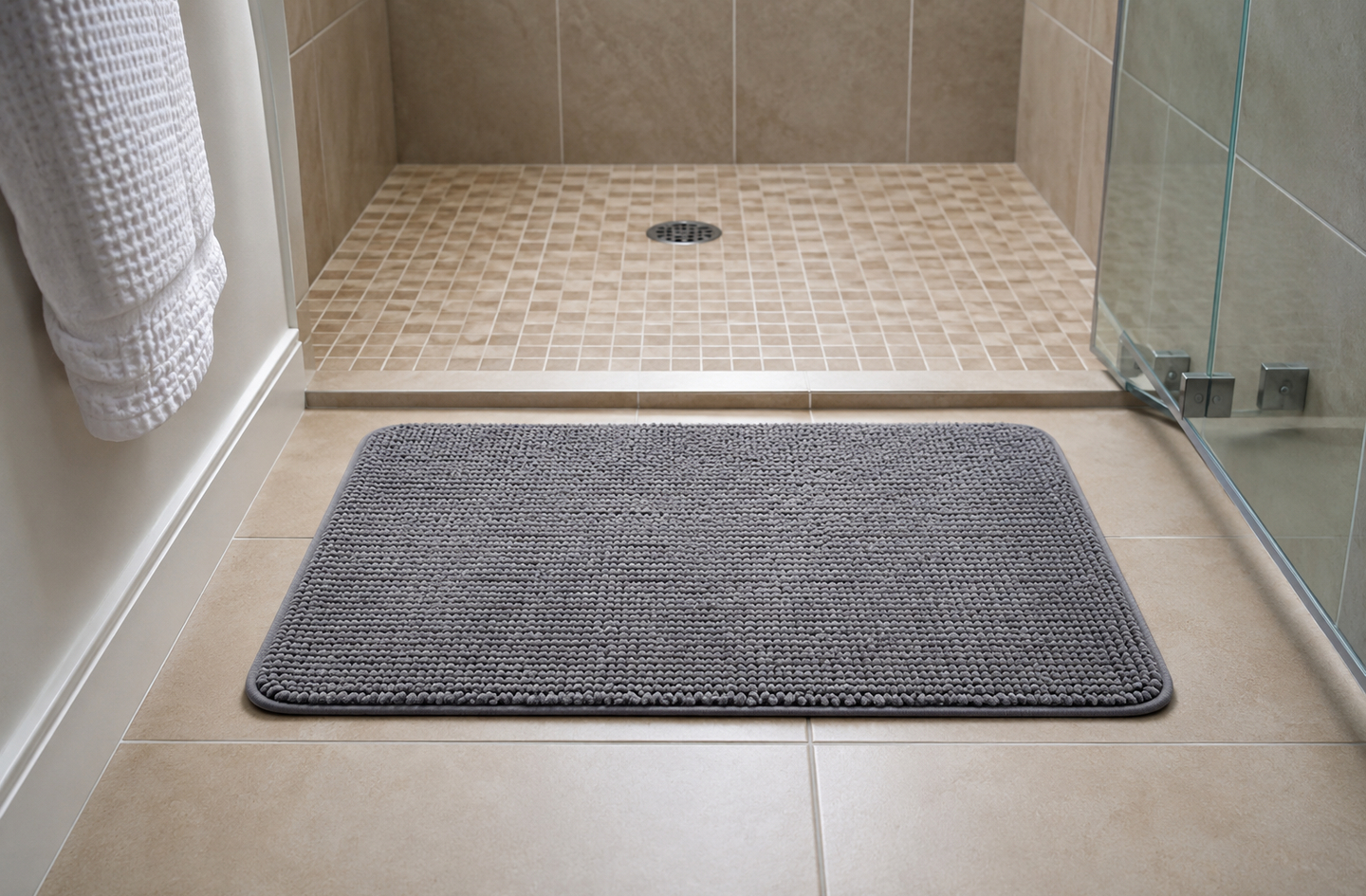
The bathroom adds a second multiplier: water. From 2001 to 2008, US emergency departments treated an estimated 37,991 adults 65 and older a year for falls involving rugs and carpets. The bathroom was the most common home location for those falls, at 35.7%.4
- Score 3: met daily and also at night, wet, rushed, or while carrying something.
- Score 2: met daily in good conditions, or weekly in poor ones.
- Score 1: met weekly or less, in good light, on a dry surface.
Exposure is the easiest score to get wrong, because the hazards met at night or in a hurry are the ones a daytime walk never sees.
Step 4: Score Ease of Correction by Cost, Effort, and Reversibility
By the end of this step every hazard has its third score. Ease of correction refers to how quickly, cheaply, and reversibly a hazard can be reduced, scored so that the easiest fix earns a three. Removing a loose rug is a three. Adding a second stair handrail is a two. Rebuilding a shower entry is a one.
Easy fixes are not token gestures. In a New Zealand cluster-randomized trial, low-cost changes cut the rate of fall injuries at home by 26%.5 The package included stair handrails, bathroom grab rails, outside lighting, and slip-resistant surfacing. Injuries specific to those modifications fell by 39% per year of exposure.5
“Our findings suggest that low-cost home modifications and repairs can be a means to reduce injury in the general population.”
Michael D. Keall and colleagues, University of Otago, Wellington, HIPI trial published in The Lancet5
Reversibility counts too. A renter, or a senior who wants to test a change first, gains from fixes that can be undone. Plug-in night lights, a removable mat, and furniture moved to clear a path all qualify. Structural work still belongs on the list. It scores lower on ease, and it needs a licensed contractor before anything is cut, plumbed, or anchored into a wall.
- Score 3: under an hour, low cost, simple or no tools, fully reversible.
- Score 2: a weekend job or a handyperson visit, moderate cost, fixings into walls or floors.
- Score 1: a contractor, permits, plumbing, or any structural change.
Scoring ease honestly stops the list from stalling: when the top item needs a contractor, the easy items below it still get done while the quote is pending.
Step 5: Multiply the Scores and Rank the List
By the end of this step you will have a ranked list. Multiply severity by exposure by ease for each hazard. The product runs from one to twenty-seven, and the highest numbers go to the top. Multiplying, rather than adding, makes a low score on any one factor pull the whole product down sharply.
Then apply one override. Any hazard that scores three on severity and three on exposure goes to the top, whatever its ease score. This mirrors how engineers treat a failure with grave consequences: high severity earns action even when the overall number looks modest. A wet shower entry with no grab point is the classic case, because it is hard to rebuild and met every day.
| Hazard, written as a movement | Severity | Exposure | Ease | Priority |
|---|---|---|---|---|
| Stepping out of the shower onto wet tile with no grab point | 3 | 3 | 1 | 3 x 3 x 1 = 9, override: first |
| Climbing stairs daily with a rail on one side only | 3 | 3 | 2 | 3 x 3 x 2 = 18, override: first |
| Walking to the toilet at night along a dark hallway | 2 | 3 | 3 | 2 x 3 x 3 = 18 |
| Crossing a loose rug at the bathroom doorway | 2 | 3 | 3 | 2 x 3 x 3 = 18 |
| Rising from a low toilet with nothing to push on | 2 | 3 | 2 | 2 x 3 x 2 = 12 |
| Stepping over a lamp cord in the living room | 2 | 2 | 3 | 2 x 2 x 3 = 12 |
| Climbing porch steps with no rail, twice a week | 3 | 1 | 2 | 3 x 1 x 2 = 6 |
| Reaching a high kitchen shelf from a step stool | 2 | 1 | 3 | 2 x 1 x 3 = 6 |
Notice what the ranking does. The two overrides lead, but the next two items are a night light and a rug removal, both done in an afternoon. The shower moves first only because of the override, and its first fix can be an interim one while the larger plan is priced. Porch steps used twice a week fall to the bottom for this person, though they would rise for someone who walks daily.
How does bathroom senior safety score?
Bathroom senior safety scores high on two of the three scales almost by default. Wet tile and hard fixtures push severity up, and daily use, including night trips, pushes exposure up. That leaves ease as the deciding score. Traction mats and a properly anchored grab bar rank high because they are quick to add. A curbless shower conversion ranks lower on ease, but the override can still move its interim fixes to the top.
The exact numbers matter less than the multiplication. A hazard that scores low on any one factor drops sharply, which keeps rare or costly items from crowding out daily ones.
Step 6: Fix in Order, Then Re-Score After Each Change
By the end of this step the top items are fixed or booked, and the list has a date for its next review. Work down the ranking in order. After each fix, re-score that hazard. A good fix drops it below the next item on the list, and a weak one leaves it near the top.
Targeting is what makes the effort pay. A Cochrane review found home fall-hazard programs reduced the overall rate of falls by 26%.2 The reduction was 38% in people selected for higher fall risk, and there was no reduction when people were not selected for risk.2
An occupational therapist is a licensed clinician who assesses how a person performs daily tasks and adapts the task or the setting to fit. In a St Louis trial of adults 65 and older at high fall risk, an occupational therapist-led hazard removal program produced a 38% reduction in the rate of falling.8 After a recent fall or hospital stay, an OT assessment is the strongest check on a self-scored list.
“Fall prevention programs should be tailored to personal characteristics, activities, and locations.”
Jennifer L. Kelsey and colleagues, MOBILIZE Boston study, American Journal of Public Health7
Re-score the full list when any of these happen:
- A fall or a near miss anywhere in the home.
- A hospital stay, a new medicine, or a change in vision.
- A new walker, cane, or wheelchair, which changes both routes and clearances.
- Six months pass, even when nothing seems to have changed.
For a calendar view of the same work, the priority-based home plan sequences it from immediate hazards through support, lighting, access, habits, and ongoing review.
A ranking is a snapshot of one person in one home, so it should change whenever the person or the home changes.
Common Mistakes When Ranking Fall Risks
Scoring the house instead of the person: the same staircase scores differently for someone who climbs it ten times a day and for someone who now lives on one floor. Score the routes this person actually uses.
Skipping the night walk: the bed-to-toilet route looks harmless at noon. At night it is dark, the person is drowsy, and the trip is often rushed, which is when exposure peaks.
Letting ease decide everything: if only the easy items get done, the severe ones wait forever. The override rule exists to stop that drift.
Ignoring habits a home cannot fix: rushing, loose footwear, and medicine side effects all raise risk on every route. Those belong in a conversation, and the guide on what to teach first covers safe movement, footwear, and medication review.
Scoring combined hazards as separate parts: carrying a hot pan across a slick floor is one movement with two hazards. Score the combination. The kitchen burn and fall guide covers that pairing, including unsafe carrying near hot surfaces.
What a Finished Risk Ranking Looks Like
A finished ranking fits on one page. It lists every hazard as a movement, carries three scores and a product for each, marks the overrides, and shows a date beside every item that has been fixed. The top three items are done or booked, and the next review date is on the calendar.
Success also shows in how the person moves. They walk the night route without reaching for furniture, step out of the shower onto a stable surface, and use the stair rail going down as well as up. Those observations are the real test of the scores, and they are worth noting at each review.
Frequently Asked Questions
What is the first thing to fix for senior safety in the home?
Fix the hazard with the highest product of severity, exposure, and ease, plus any hazard that is both severe and met daily. In US emergency data, the bedroom (25.0%), stairs (22.9%), and bathroom (22.7%) led at-home falls with a recorded location, so top items tend to sit on those routes.1
Do home modifications actually reduce falls?
Yes, when they are targeted. A Cochrane review found home fall-hazard programs cut the rate of falls by 38% in people at higher risk, with no reduction in people not selected for risk.2 That is why scoring a person’s own routes beats working through a generic checklist.
How should bathroom senior safety be scored?
Score each bathroom movement separately: stepping out of the shower, rising from the toilet, and walking in at night. Water raises both severity and exposure. The bathroom was the most common home location for rug and carpet falls among older adults, at 35.7%.4 Low-cost traction and support fixes rank near the top.
Are cheap fixes worth doing before a renovation?
Yes. In a randomized trial, low-cost home modifications and repairs cut the rate of fall injuries at home by 26%.5 Easy fixes deliver protection while larger work is planned and priced. Structural changes still belong on the list, with a licensed contractor involved before work begins.
How often should a fall risk ranking be re-scored?
Re-score every six months, and after any fall, hospital stay, new medicine, or new mobility aid. About 10% of falls among older adults result in serious injury, so a changed risk deserves a fresh score rather than a year-old list.7
Limitations and Edge Cases
- The scores are structured judgments, not measurements. They compare hazards within one home and do not predict whether a specific person will fall.
- The exposure and severity figures come mainly from US emergency data and a US cohort, and the ease figure comes from a New Zealand trial. Patterns differ by country, housing type, and climate.
- Anyone with a recent fall, dizziness, or a new diagnosis should have a physician or occupational therapist review the list before relying on it.
References
Methodology: every figure in this article comes from an independent published source, each link was checked live and matched to the sentence that states the figure on October 11, 2026, and the scoring method and worked example are an engineering synthesis by Home Age Fit’s founder, who wrote and reviewed the article.
- PubMed Central – Moreland BL, Kakara R, Haddad YK, Shakya I, Bergen G. A Descriptive Analysis of Location of Older Adult Falls That Resulted in Emergency Department Visits in the United States, 2015. American Journal of Lifestyle Medicine, published online August 2020.
- Cochrane Database of Systematic Reviews – Clemson L, Stark S, Pighills AC, Fairhall NJ, Lamb SE, Ali J, Sherrington C. Environmental interventions for preventing falls in older people living in the community. March 2023.
- Osteoporosis International – Solaiman RH, Irfanullah E, Navarro SM, Keil EJ, Onizuka N, Tompkins MA, Harmon JV Jr. Rising incidence of stair-related upper extremity fractures among older adults in the United States: a 10-year nationwide analysis. April 2023.
- Journal of Injury and Violence Research – Rosen T, Mack KA, Noonan RK. Slipping and tripping: fall injuries in adults associated with rugs and carpets. January 2013.
- The Lancet – Keall MD, Pierse N, Howden-Chapman P, Cunningham C, Cunningham M, Guria J, Baker MG. Home modifications to reduce injuries from falls in the home injury prevention intervention (HIPI) study: a cluster-randomised controlled trial. January 2015.
- The Journal of Urology – Pesonen JS, Vernooij RWM, Cartwright R, et al. The Impact of Nocturia on Falls and Fractures: A Systematic Review and Meta-Analysis. April 2020.
- American Journal of Public Health – Kelsey JL, Procter-Gray E, Hannan MT, Li W. Heterogeneity of Falls Among Older Adults: Implications for Public Health Prevention. November 2012.
- JAMA Network Open – Stark S, Keglovits M, Somerville E, Hu YL, Barker A, Sykora D, Yan Y. Home Hazard Removal to Reduce Falls Among Community-Dwelling Older Adults: A Randomized Clinical Trial. August 2021.
Conclusion
Senior safety in the home moves fastest when hazards are ranked before anything is bought. Score each movement on severity, exposure, and ease, multiply the three, apply the override, and fix from the top. Observation, not renovation, sets the order, and a licensed contractor or occupational therapist confirms the fixes that need one.
See the fall-prevention priorities overview for how this scoring fits the wider question of ordering safety work in a home.