Falls send about 4.5 million older adults to emergency departments every year in the United States.1 Most happen at home, in places used many times each day. The central question in home safety for the elderly is not about which room looks risky but which zone carries the highest combination of fall frequency and injury severity. This guide is part of the broader overview in fall-prevention priorities guide, and its task is to help you identify and rank those zones before spending time or money on any specific fix.
Quick Answer
Which areas of the home create the greatest fall risk for seniors?
Bedrooms (25%), stairs (22.9%), and bathrooms (22.7%) together account for roughly 70% of at-home fall-related emergency department visits in adults 65 and older.2 Bathrooms and stairs produce more serious injuries per fall than other rooms, which places them at a higher priority than raw frequency alone suggests. Identifying which of those zones applies to your specific home, and in what order, is the first step in any practical fall-prevention plan.
Key Takeaways
- Bedrooms, stairs, and bathrooms together account for roughly 70% of at-home fall-related emergency department visits in adults 65 and older, based on nationally representative data.2
- Bathrooms and stairs carry higher injury severity per fall than bedrooms; an assessment that weights consequence, not just frequency, produces a different and more protective repair order.
- Environmental hazards are implicated in 30% to 47% of all falls.7 Many of the highest-value changes involve no construction and cost very little.
Before You Begin: Home Safety for the Elderly Starts with Observation
This guide walks through six steps: mapping your daily routes, then assessing the bathroom, stairs, entrances, bedroom, and finally scoring each zone to produce a ranked repair list. You do not need tools or a contractor to complete the observation. You need a notebook, roughly 30 to 45 minutes, and ideally a second person who can watch while you or your parent moves through the home normally.
Difficulty: Observation only, no installation required
Time: 30 to 45 minutes for the walk-through, additional time to document findings
What you will have at the end: A ranked list of your home’s highest-risk zones, ordered by the combination of fall frequency, injury consequence, and how often each area is used
A few things this guide does not cover: structural modifications, wet-area waterproofing, or any change specific to a person’s balance, vision, or mobility profile. Those decisions belong with a licensed contractor, an occupational therapist, or an accessibility specialist. The goal here is to help you understand the home’s risk landscape so you arrive at those professional conversations with the right questions. If you want to connect this assessment to a broader learning foundation, fall prevention education at home is a good starting point.
A structured observation walk produces better repair priorities than any checklist designed for a generic home, because it reflects the routes and habits of the person who actually lives there.
Step 1: Walk the Routes Before Checking Any Room
Most fall-prevention assessments start with rooms. This one starts with routes, because the rooms matter in the order they are used. A bedroom that leads to a dark hallway and a high-threshold bathroom at 2 a.m. is a different risk than a bedroom two steps from a well-lit, level bathroom entrance.
Walk the three most-used paths in the home:
- Bedroom to bathroom: the path used most often at night and in early morning
- Kitchen to main seating area: the path used when carrying food, drinks, or other objects
- Entrance to main living space: the path used on arrival and departure, often in variable weather and footwear
As you walk each path, mark every point where you grip something for support, step onto a different surface, change direction sharply, or notice a drop in light. Friction points are any locations in the home where movement requires more grip, balance adjustment, or physical effort than the surroundings suggest. Those friction points, not a general room checklist, define the home’s real risk map.
Pay close attention to what happens at the beginning and end of each route. The transitions between areas, stepping from carpet onto tile, crossing a doorway threshold, or reaching for a light before moving, are where a large proportion of falls occur. A route that looks clear at eye height often has a raised threshold, a loose mat, or a table leg in the path that only shows up when you walk it slowly and deliberately.
The Bedroom-to-Bathroom Path
This path is walked in low light, often after a period of stillness or sleep, when blood pressure regulation and balance are temporarily reduced. Note whether a light is reachable before the first step out of bed. Note whether the floor surface changes within the first few feet. Note whether there is anything to hold between the bed and the bathroom door. A path with no grip points and a level-change or threshold within the first three steps is a high-priority finding, regardless of how the bathroom itself looks in full daylight.
The Main Living Route
Falls on this path tend to happen while carrying something, which means both hands are occupied and attention is on the object rather than the floor. Identify any point on this route where a person needs to turn, step up or down, or navigate around furniture. Those points carry higher risk whenever hands are full. A clear, straight path from kitchen to seating area is worth more to fall prevention than a grab bar in a room visited twice a day.
Walking routes in the sequence they are actually used reveals friction accumulation that a room-by-room review misses, because the hazards that matter most are often the ones that cluster on the same path.
Step 2: Assess the Bathroom
The bathroom is where falls cause the most harm per incident. A CDC surveillance study found that injury rates near toilets reached 266.6 per 100,000 among adults 85 and older, compared with 4.1 per 100,000 among adults in their early twenties.5 The three most common triggers for bathroom falls are bathing or showering (27.5%), slipping (17.3%), and toilet-related activity (14.1%).5
A transfer is the act of moving from one position or surface to another, such as sitting to standing at a toilet or stepping into a shower enclosure. Transfers are the highest-risk moments in the bathroom because they require the most balance and muscle load, and they frequently happen on wet or damp surfaces.
When you assess the bathroom, look for these conditions:
Tub and Shower Zone
Does the shower have a threshold step? If so, how high is it? Is the floor inside the shower wet after use, and does it stay wet for more than a few seconds? Is there a fixed or adjustable-height seat available? Is there a grab bar within reach at the point of entry and exit? A shower with a high curb, no seat, and no grip point at entry is one of the higher-risk configurations in any home used by someone with reduced balance or strength. Slip-resistant flooring reduces friction during the wet transition, but it does not replace grip support at the entry and exit points themselves.
Toilet Transfer Area
Can the person lower to and rise from the toilet seat without holding a wall, a towel bar, or the sink counter? If yes, this area is lower priority. If no, or if the approach involves gripping an unsecured surface, this is an urgent finding. Note the toilet seat height, the available grip points on each side, and whether there is enough clear floor space to approach from either direction. A standard toilet seat sits roughly 15 to 17 inches from the floor. For many seniors, a raised seat or a fixed safety frame converts a near-failure transfer into a controlled movement.
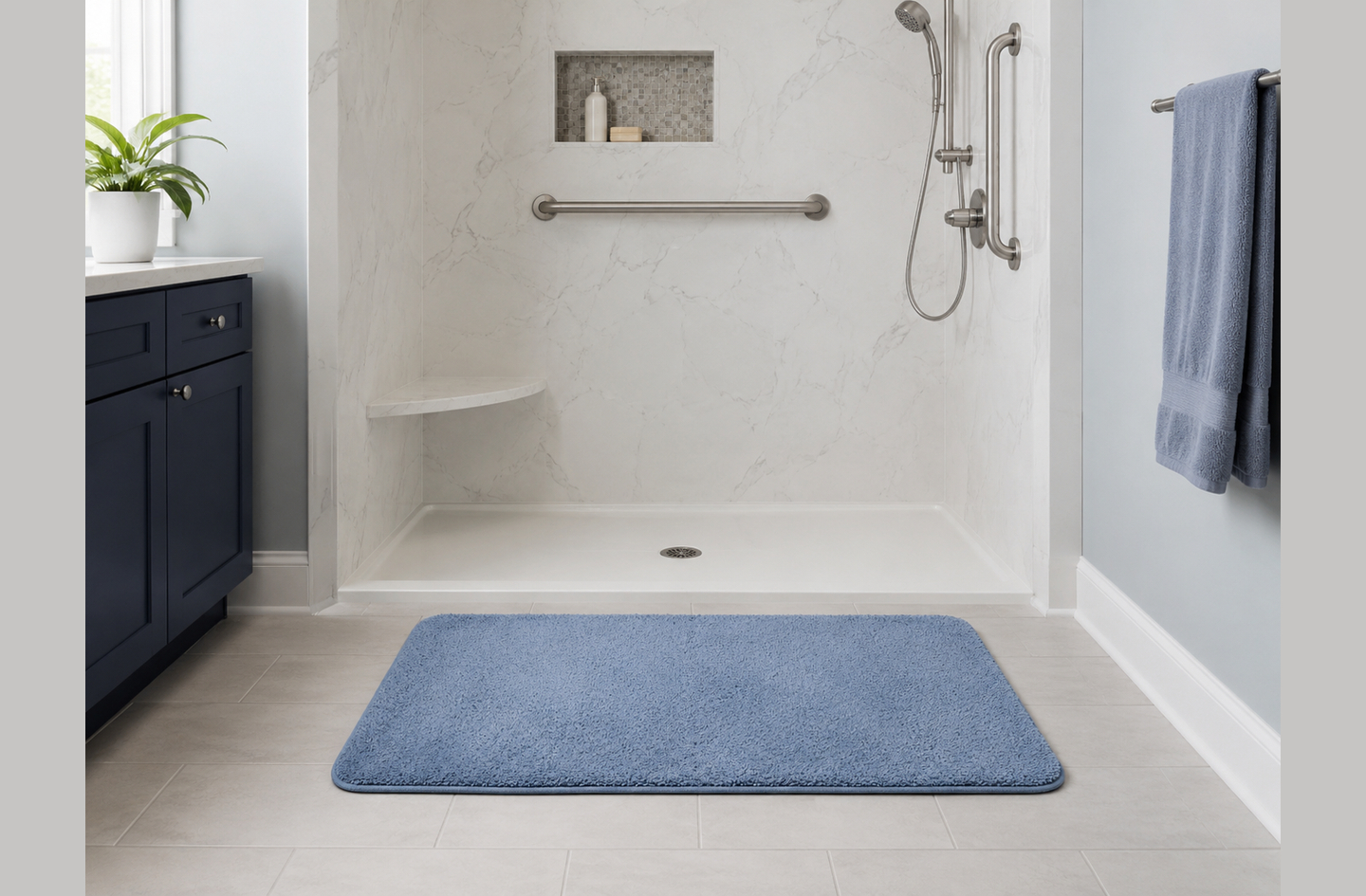
The bathroom’s combination of wet surfaces, confined space, and physically demanding transfers makes it the zone where corrective investments produce the most measurable reduction in injury risk, even when the raw fall-frequency count for bedrooms is slightly higher.
Step 3: Evaluate Stairs and Level Changes
Stairs are the second most common location for at-home falls in adults 65 and older, accounting for 22.9% of emergency department visits from falls at home.2 Among adults in the 65 to 74 age group specifically, stairs account for 30% of at-home falls, making them the dominant zone for this cohort.2 Stair-related upper-extremity fractures in older adults rose 56% between 2012 and 2021, and 89% of those injuries occurred in homes.4
“Indoor and outdoor stairs and bathrooms are locations of particular concern, because they are associated with a substantially higher proportion of injurious falls than those that occur in other locations.”
Edwards N et al., researchers in environmental fall epidemiology, International Journal of Environmental Research and Public Health7
Environmental hazards are physical conditions in the home that increase the likelihood of a fall, including uneven surfaces, absent handrails, poor lighting, and loose mats. On stairs, those hazards tend to cluster: a flight may have a handrail that ends before the bottom step, tread surfaces that are difficult to see in low light, and a landing with no overhead fixture. Each issue alone adds modest risk. Together they create a compounding problem that is harder to escape once a person is mid-descent.
Handrail Coverage
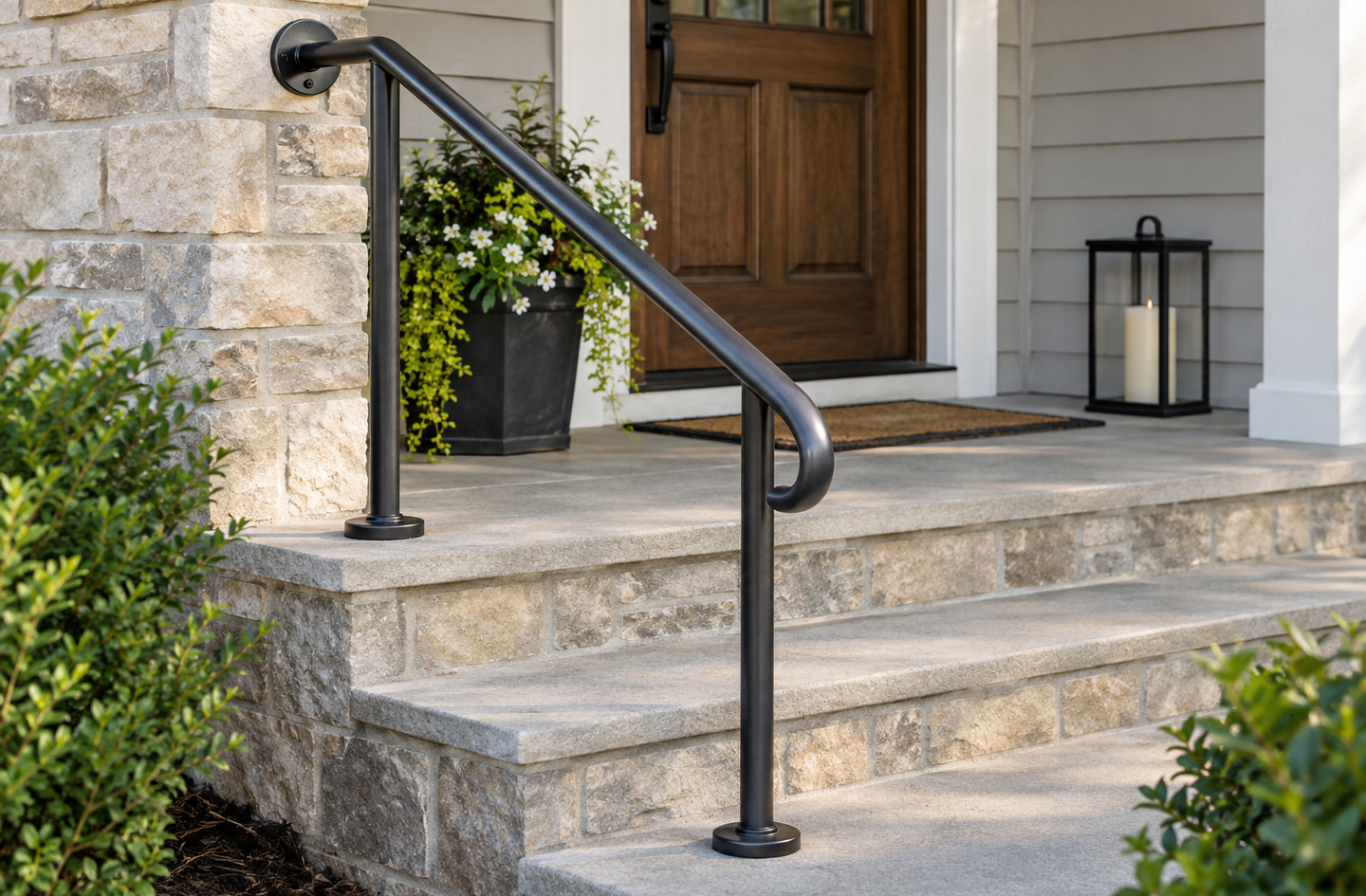
Is there a handrail on at least one side of every stair flight? Does it run the full length of the flight, from the top step to the bottom? Is it firmly mounted, and does it have a diameter that allows a full grip, roughly 1.25 to 1.5 inches? A handrail that ends two steps from the bottom, or that wobbles when gripped, provides significantly less protection than a properly mounted continuous rail. If a second rail on the opposite wall is practical, it doubles grip coverage and meaningfully reduces risk on the descent, which is riskier than the ascent for most adults.
Tread Surfaces and Step Lighting
Can the edge of each step be clearly seen from the top of the flight? Contrast between the tread surface and the riser, the vertical face of the step, is the primary visual cue for step depth and height. Carpet covering both the tread and riser without a contrasting edge strip reduces that cue substantially. Step lighting should illuminate the tread surface itself, not just the surrounding wall. If the flight is dark at night and handrail coverage is incomplete, it is a two-factor finding that belongs at the top of the stair assessment list.
For a room-by-room look that covers stair and hallway risks in more detail, the senior home safety room-by-room checklist is a useful companion to this zone-ranking guide.
On stairs, the priority is not to add a single grab bar but to confirm that handrail coverage is complete, continuous, and grippable for the full length of the flight, because a partial rail creates a false sense of support at the exact point where it disappears.
Step 4: Check Entrances and Outdoor Transitions
Entrances combine several risk factors that rarely appear together inside the home: steps without adequate handrails, threshold height differences, weather-related surface changes, and the additional burden of carrying bags, mail, or keys while negotiating the transition. The entrance is often used quickly, without the deliberate attention a person might bring to the bathroom or stairs.
Outdoor Steps and Approach Paths
Walk the approach from the street, driveway, or parking area to the main entry. Note the number of steps, whether each step has a consistent rise height (irregular heights are a known trip hazard), whether a handrail is present, and whether the surface is level and non-slip when wet. Pavers that have shifted, cracked concrete, or leaf-covered surfaces increase fall risk for someone navigating the approach in variable weather or footwear. If there is a garage-to-house interior connection, assess that path too: it is often a single step down onto a concrete floor in low light, which is a high-exposure friction point for daily use.
Door Hardware and Interior Threshold
The threshold strip at the bottom of an exterior door can vary from a few millimeters to over an inch in height. For someone using a walker or cane, even a modest threshold creates a trip hazard on the return path. Check whether the threshold is beveled and whether the door hardware can be operated with one hand while the other is occupied. Round knobs that require grip and twist are harder to use than lever handles, particularly for anyone with reduced hand strength. A lever-style handle removes a daily friction point without altering the home’s appearance or requiring any structural work.
Entrances earn a higher priority than their frequency share alone suggests because the conditions there combine in ways that reduce the margin for error: variable weather, hands-full carrying, and the habit of moving quickly through a space that feels familiar.
Step 5: Audit the Bedroom and the Nighttime Path
The bedroom is the most common location for at-home falls in adults 65 and older, accounting for 25% of emergency department visits from falls at home, rising to 31.6% in adults 85 and older.2 Most bedroom falls happen during the transition from sleep to standing, during nighttime bathroom trips, or during dressing. Falls are the leading cause of injury-related death in older adults, with about 100 older adults dying from fall-related injuries every day in 2021.3 Many of those incidents begin with a routine movement on a familiar path.
Bed Height and Bedside Support
Sit on the edge of the bed. Your feet should reach the floor with your hips at roughly a 90-degree angle. If the bed is too high (feet dangling) or too low (requiring a deep squat to rise), the transfer from sitting to standing places additional load on the knees, hips, and lower back. A bed that is too high creates a drop on exit; one that is too low makes it harder to rise under control. Note whether there is a stable surface within arm’s reach of the exit point: a sturdy nightstand, a bed rail, or a transfer pole. A chair back, a wall lamp, or a side table that can tip is not stable support.
Lighting the Nighttime Path
Mornings and afternoons account for 69% of fall-related emergency medical service activations combined, but nighttime trips remain a distinct risk category because of low light, recent stillness, and reduced alertness.6 Can a light be reached before the first step out of bed? Is the path from the bedroom to the bathroom lit by at least a night light, or does it pass through a completely dark corridor? A motion-activated plug-in light costs under $20 and removes one of the most consistent risk factors on the nighttime route without changing the bedroom’s character during the day.
The bedroom leads on raw fall frequency, but because bedroom falls often occur at lower force and onto softer surfaces than stair or bathroom falls, the injury severity weighting is lower, which is why the scoring step below places bathrooms and stairs ahead of bedrooms in the priority tier.
Step 6: Score Each Zone and Set Your Senior Home Safety Priorities
After the observation walk, you have a list of friction points organized by zone. Now convert that list into a repair order. Rate each zone on three dimensions, then read across them to set the sequence.
- Frequency: How many times per day is this zone or path used? (occasional, several times a day, or constant)
- Consequence: How severe is a fall likely to be in this zone, given the surface, height, and confined space? (low, moderate, or high)
- Ease: How quickly and cheaply can the main hazard be corrected? (needs a professional, takes an afternoon, or takes under an hour)
A zone with a high frequency score, a high consequence score, and a high ease score is your first priority. Zones that score high on frequency and consequence but require professional involvement are still urgent; they go on a professional-referral track rather than a weekend-project list. One in five falls leads to a fracture or head injury,8 which is why consequence weighting matters more than frequency alone.
| Home Zone | At-Home Fall Share2 | Typical Injury Severity | Priority Tier |
|---|---|---|---|
| Bathroom | 22.7% | High (wet surfaces, confined transfers) | 1 |
| Stairs | 22.9% | High (fracture risk, drop height, speed) | 1 |
| Bedroom | 25.0% | Moderate (floor-level, softer surroundings) | 2 |
| Entrance / Exterior | varies by home | High outdoors (weather, uneven surface) | 1 to 2, assess in context |
| Kitchen | ~7% | Moderate (standing, wet floors, reaching) | 3 |
| Living Room / Hallway | ~5% | Lower (more space, usually dry surfaces) | 4 |
Once you have your zones ranked, use the ease score to decide what to tackle first within each tier. A non-slip mat in the shower, a lever handle at the entrance, and a motion-activated night light on the bedroom-to-bathroom path are Tier 1 changes that take an hour each. A grab bar installation or stair handrail extension may need a contractor but belongs on the same urgent timeline, not deferred in favor of easier Tier 3 improvements that feel more satisfying to complete.
For guidance on connecting these findings to a whole-home action plan, a priority-based fall prevention plan for seniors covers the sequencing from observation to implementation.
The most common error in this step is treating all Tier 1 items as equal: bathroom and stair hazards that require professional involvement should still be scheduled first, not displaced by easier Tier 3 tasks.
Common Home Safety Mistakes for Older Adults
Several consistent errors appear when seniors or caregivers assess a home without a structured method. Each one reduces the effectiveness of whatever changes are eventually made.
Starting with Products Instead of Routes
Grab bars, raised toilet seats, and stair handrails are the right tools for specific friction points. Buying them before observing the actual friction points often results in bars installed in the wrong position, seats that do not match the toilet height, and handrails that end two steps from where they are needed. The walk comes first. The product follows the finding.
Treating All Rooms as Equal Risk
A home has limited time and budget. Spending it on a new bath mat in a bathroom that is already well-configured, while ignoring a stair flight with an incomplete handrail, is a predictable outcome of an unranked assessment. The scoring step exists specifically to prevent this. Environmental hazards account for 30% to 47% of all falls,7 and that exposure is not distributed evenly across zones.
Underestimating the Nighttime Route
The bedroom-to-bathroom path at night is walked in low light, after a period of lying still, often without the footwear worn during the day. It is one of the highest-exposure routes in the home, and it is frequently overlooked because it feels familiar. Assessing it during the day, in full light, gives an inaccurate picture of the risk. Walk it under the conditions it is actually used: low light, first thing in the morning, and treat any stretch with no grip point and no visible light as a priority finding.
Postponing Action After the Observation Walk
An assessment that identifies specific friction points and then waits for a better time does not reduce risk. Many of the highest-value initial changes, clearer paths, a night light, secured mats, take under an hour and cost very little. For seniors managing this alongside a caregiver, knowing what to address first in fall prevention is a useful guide for assigning the right tasks to the right people quickly.
The structural finding from route-first, consequence-weighted assessments is that the highest-priority changes are usually modest in cost and effort, while the changes most commonly deferred are the ones involving professional installation that carry the highest injury consequence if left unaddressed.
Frequently Asked Questions
Which room in the home has the highest fall risk for seniors?
The bedroom accounts for the highest raw share of at-home fall-related emergency department visits at 25%, but bathrooms and stairs produce more serious injuries per fall.2 If you are prioritizing one zone first, the bathroom is the stronger starting point because of its combination of wet surfaces, demanding transfers, and confined space. Stairs follow at essentially the same frequency with similarly high injury consequence.
How do you start a home safety walk-through without professional help?
Walk the three most-used daily routes first: bedroom to bathroom, kitchen to main seating area, and entrance to living space. Mark every point where you grip something for support, step onto a different surface, or notice a drop in light. Those friction points produce a more useful starting list than any room-by-room product scan, because they reflect the paths actually used every day.
What home safety changes can be made without a contractor?
Securing loose rugs with non-slip backing, adding a motion-activated night light on the nighttime route, replacing a round door knob with a lever handle, rearranging furniture to clear walking paths, and moving frequently used items into easier reach are all changes that take under an hour and require no tools beyond a screwdriver. They address the friction points that environmental hazards create in 30% to 47% of falls.7
When should an occupational therapist be involved in a home assessment?
An occupational therapist evaluates how a specific person’s balance, vision, strength, and daily habits interact with the specific home. Bring one in when any finding from the observation walk involves structural modification, or when the resident has a known mobility or balance condition. The walk in this guide identifies which zones to prioritize; the therapist evaluates how the person’s specific situation interacts with those zones.
Does fixing one high-risk zone reduce overall fall risk at home?
Partially. A bathroom fix reduces avoidable risk during that part of the daily routine. But risks accumulate across connected zones: a well-configured bathroom matters less if the path to it is dark and uneven. One in 5 falls leads to a fracture or head injury,8 so a zone-ranking approach that targets the full sequence produces better outcomes than a single-room fix.
Limitations and Edge Cases
- This guide uses aggregated national data. Individual risk depends on the specific person’s mobility, balance, vision, and medical history, which only a qualified occupational therapist or clinician can evaluate for a specific home and resident.
- The room-frequency percentages (Moreland et al. 2021) reflect adults 65 and older as a group. Stairs dominate risk for adults aged 65 to 74 (30% of at-home falls); bedrooms dominate for adults 85 and older (31.6%). Starting priorities may differ depending on the resident’s age and condition.2
- The entrance and exterior fall share is not broken out separately in the Moreland et al. data set. The “varies by home” notation in the scoring table reflects this gap; assess exterior paths as part of your observation walk rather than assigning them a fixed frequency rank.
References
Methodology: all figures cited below come from independently published research and government surveillance data, and each reference links directly to the page that carries the statistic.
- CDC – Facts About Older Adult Falls, Centers for Disease Control and Prevention, current.
- PMC / American Journal of Lifestyle Medicine – Moreland B et al., A Descriptive Analysis of Location of Older Adult Falls That Resulted in Emergency Department Visits in the United States, 2021.
- CDC MMWR – Nonfatal and Fatal Falls Among Adults Aged 65 Years and Older, United States, 2020-2021, Vol. 72 No. 35, 2023.
- PMC / Osteoporosis International – Solaiman RH et al., Rising incidence of stair-related upper extremity fractures among older adults in the United States, 2023.
- CDC MMWR – Nonfatal Bathroom Injuries Among Persons Aged 15 Years and Older, United States, 2008, Vol. 60 No. 22, 2011.
- PMC / Archives of Gerontology and Geriatrics Plus – Sheridan E et al., Timing of Emergency Medical Services Activations for Falls, 2024.
- PMC / International Journal of Environmental Research and Public Health – Edwards N et al., A Scoping Review Examining the Links between Stair and Bathroom Falls and the Built Environment, 2019.
- PMC / JAMA – Colon-Emeric CS et al., Risk Assessment and Prevention of Falls in Older Adults, JAMA, 2024.
Conclusion
The highest-risk zones in most homes are the bathroom, stairs, and the nighttime route from bedroom to bathroom. An observation walk that maps those areas and scores them by frequency and consequence produces a more useful repair sequence than any room-by-room checklist, because it reflects the paths and habits of the person who actually lives in the home.
For a broader view of how this zone ranking connects to a whole-home fall-prevention approach, see the overview in Fall-Prevention Priorities: A Practical Guide.