
The shower is where older adults often feel most uncertain on their feet. About two-thirds of all bathroom injuries occur in the tub or shower,1 and falls cause most of them. A non slip shower mat for seniors can help reduce that hesitation, but only when the mat’s suction, texture, drainage, and coverage match the specific floor and movement pattern. This article compares those four dimensions so you can read a product spec and know what it actually tells you. For the broader surface context, see the slip-resistant flooring overview first.
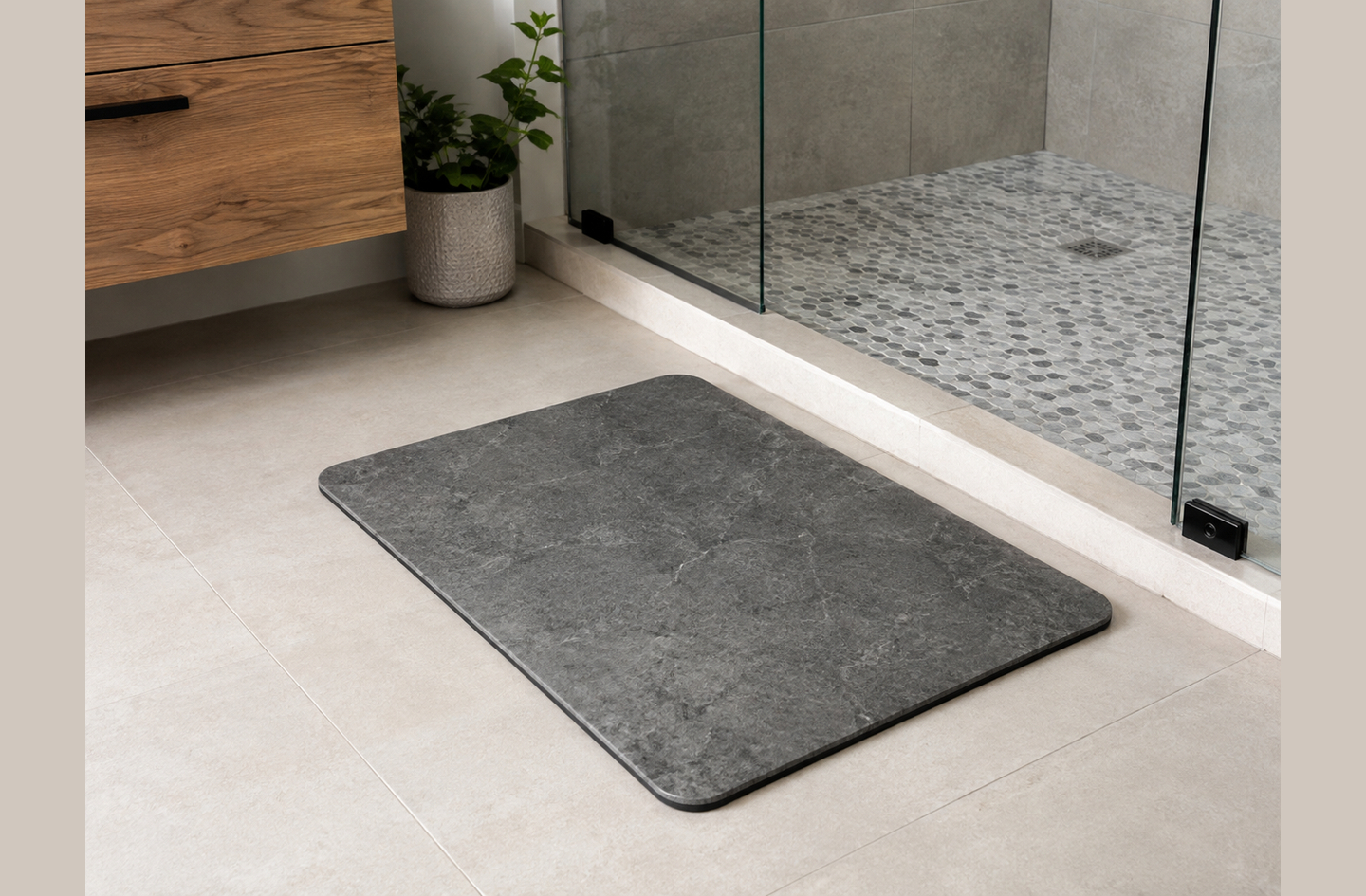
Quick Answer
Which non-slip shower mat is right for seniors?
No single mat fits every floor. The right choice depends on suction compatibility with your specific floor material, surface texture deep enough to grip bare wet feet, drainage holes that keep water moving away from the standing zone, and mat dimensions that cover the entry, standing, and turning areas. Falls cause 81.1% of bathroom injuries,1 and a well-fitted mat addresses the surface conditions that contribute to most of those events.
Key Takeaways
- About two-thirds of bathroom injuries occur in the tub or shower,1 making the shower entry and standing zone the highest-priority surface to address.
- ANSI A137.1 sets a minimum wet dynamic coefficient of friction (DCOF) of 0.42 for level interior wet surfaces;4 mat surface texture determines how a mat performs on that scale.
- Suction cups work best on smooth, non-porous tile or fiberglass. On textured tile, porous stone, or soap-coated surfaces, they lose grip and the mat shifts under load.
- Coverage is the dimension most often underestimated: most standard-size mats protect the standing zone only, not the entry step or turning zone where balance transitions are greatest.
- About 1 in 4 adults over 65 falls each year.6 Matching a mat to the specific floor material and movement path is the most direct way to reduce avoidable risk in the bathroom.
Shower Mat Dimensions at a Glance
The table below maps the four comparison dimensions against the configurations available in each category. Use it to identify which intersection matches your floor material and bathroom movement pattern before reading the detailed sections.
| Dimension | Configuration options | Works best on | Watch for |
|---|---|---|---|
| Suction | Flat vacuum cups / ridged thermoplastic backing / suction-free PVC grip | Smooth, non-porous tile or fiberglass | Textured tile, soap residue buildup, porous surfaces |
| Texture | Raised nubs / ribbed channels / pebbled profile / flat rubber | Bare wet feet on any surface | Shallow texture wears flat; deep ridges trap soap residue |
| Drainage | Circular holes / elongated slots / single drain cutout / channel grooves | High-volume shower spray or tub overflow | Tight spacing causes pooling; large cutouts reduce traction area |
| Coverage | Small (17×24 in) / standard (20×30 in) / large (24×36 in) / extended (40×16 in) | Entry, standing, and turning zones together | Standard sizes often cover the standing zone only |
The bathroom accounts for about 22.7% of at-home fall ED visits among older adults,3 nearly equal to the stairway share, and most of those bathroom injuries happen in the tub or shower specifically. In 2023, the unintentional fall death rate for adults 65 and older was 69.9 per 100,000 population,2 which explains why wet-surface traction remains a priority in bathroom planning. The chart below synthesizes room-location data from two independent sources to show where the risk concentrates.
Suction and Floor Compatibility
Suction cup adhesion is the mechanical process by which a flexible cup creates a partial vacuum against a flat surface and resists lateral sliding. On a smooth, non-porous substrate, a mat with 150 to 200 suction cups can hold firmly during normal standing use. On a textured or porous surface, the cups cannot form a complete seal, and the mat shifts under load even when pressed firmly into place.5
The most common configuration uses small flat vacuum cups molded into the mat’s underside. They work reliably on factory-finished fiberglass tub floors and smooth glazed tile. Temperature and residue both matter: a surface coated in body wash or shampoo reduces the contact area available to each cup, which compounds over time as the mat ages and the cup edges lose their original flexibility. Cleaning both the floor and the mat’s underside weekly restores grip performance.
Ridged thermoplastic backing is a second configuration. Instead of individual cups, a series of parallel ridges on the mat’s underside grips the surface through friction rather than vacuum. This type performs more consistently on lightly textured tile but provides less resistance to pulling forces directly parallel to the ridges. On a wet tile floor with directional surface texture, aligning the ridges perpendicular to the entry movement direction improves stability.
Suction-free PVC grip patterns use a micro-textured underside to increase friction against the floor without relying on vacuum seal. These mats are simpler to remove and clean, but they generally require a smoother floor to match the holding force of cup-based mats. For heavily textured or uneven floors, a suction-free mat can outperform cup-based alternatives because the cups have no flat surface to adhere to in the first place.
Suction type should be the first selection criterion, not the last. A mat chosen for its appearance and then placed on an incompatible floor will shift during use regardless of its texture or drainage quality.
How to test suction compatibility before buying
Press a single suction cup firmly against the floor where the mat will sit, then try to pull it sideways. If it releases with light lateral force, the floor surface is too textured or porous for cup-based adhesion. A suction cup that holds through moderate lateral pressure signals adequate compatibility for a mat in that product category.
For porous stone floors such as unglazed slate or natural pebble, an adhesive anti-slip strip or a rubber bathmat with suction-free backing typically provides more reliable holding. For a side-by-side look at backing grip across product categories, see the article on choosing a bath mat by grip and backing.
Surface Texture and Wet Traction
Wet dynamic coefficient of friction (DCOF) is a number that describes how much resistance a surface offers to a foot in motion when both the foot and the surface are wet. ANSI A137.1, the industry standard for interior wet-area surfaces, sets a minimum wet DCOF of 0.42 for level interior spaces expected to be walked on while wet.4 Shower mat surfaces are designed to exceed that threshold on compatible substrates. To meet slip-resistance classification under BS 8445:2012, a mat must achieve a ramp angle of 20 degrees or greater during standardized testing.5
Raised nub texture is the most widely available configuration. Nubs of about 3 to 5 millimeters in height create dozens of contact points between the bare foot and the mat surface, with channels between them for water displacement. Traction performance depends on nub density and height: sparse, low-profile nubs wear smooth quickly and offer little different performance from flat rubber once they are worn. Denser, taller nubs maintain more grip across the life of the mat.
Ribbed channels run in parallel rows or a grid pattern. Each rib raises the contact surface above the waterline and directs water toward drainage holes or toward the mat edges. This configuration performs well for forward-facing entry and exit motion but provides less lateral resistance during turning. For seniors who pivot at the shower wall or at a grab bar while toweling, a nub or pebbled profile offers better multidirectional grip than ribbed channels.
Pebbled stone-look texture mimics the raised profile of natural pebble. The irregular surface keeps bare feet elevated above pooled water and distributes pressure unevenly, which some users find more comfortable during longer standing periods. The texture is harder to clean thoroughly than ribbed mats; soap residue accumulates in irregular cavities and reduces effective grip if the mat is not rinsed and dried after each use.
Texture depth and density matter more than overall surface area. A smaller mat with dense, well-maintained texture outperforms a larger mat with worn or soap-clogged surface features.
“In order for a mat to be classified as being slip resistant, it must achieve an overall angle of 20 degrees or greater.”
SATRA Technology Centre, independent accredited test house, citing BS 8445:20125
Texture and cleaning frequency
The grip benefit of any surface texture degrades as soap, shampoo, and body oils fill the channels between raised features. A mat rinsed and dried after each use maintains grip much longer than one left flat on the floor between showers. For pebbled and nub-profile mats, a weekly scrub with a stiff brush removes the residue that forms inside the texture channels and would otherwise raise the effective waterline above the contact points.
For comparison of anti-slip surface choices beyond the shower, the article on anti-slip bathroom rugs covers backing grip and texture performance in dry-floor bathroom zones.
Drainage Design and Water Clearance
Drainage design refers to the pattern and spacing of holes or channels cut through the mat body that allow shower water to flow through to the floor drain rather than pooling under and around bare feet. Water pooling on top of the mat raises the effective waterline above the contact points of the surface texture, reducing wet traction toward the same level as bare tile with no mat.
Circular drainage holes spaced every 2 to 4 centimeters are the most common design. The hole diameter and spacing determine both the volume of water that can pass through per minute and the solid mat area available for traction. Tight spacing (many small holes) maximizes drainage rate but can leave a mat that flexes too freely and allows edges to lift off the floor under foot pressure. Wider spacing (fewer, larger holes) retains more solid material for grip but may allow pooling in high-spray zones.
Elongated slot channels run in parallel rows and move more water per opening than circular holes of equivalent total area. Some designs combine slots with a ribbed upper surface so each channel both directs water and provides texture height for barefoot grip. This dual-function configuration works well for walk-in showers with a fixed showerhead aimed at a single standing zone, where water volume in one location is consistently high.
A single large drain cutout, placed centrally or at the showerhead end of the mat, suits floors where the drain is fixed in a position the mat would otherwise block. This style maximizes drainage efficiency at one point but reduces the total traction area. If the shower drain sits near the center of the standing zone, a mat with a central cutout allows full drainage while still covering the perimeter of the standing area with grip surface.
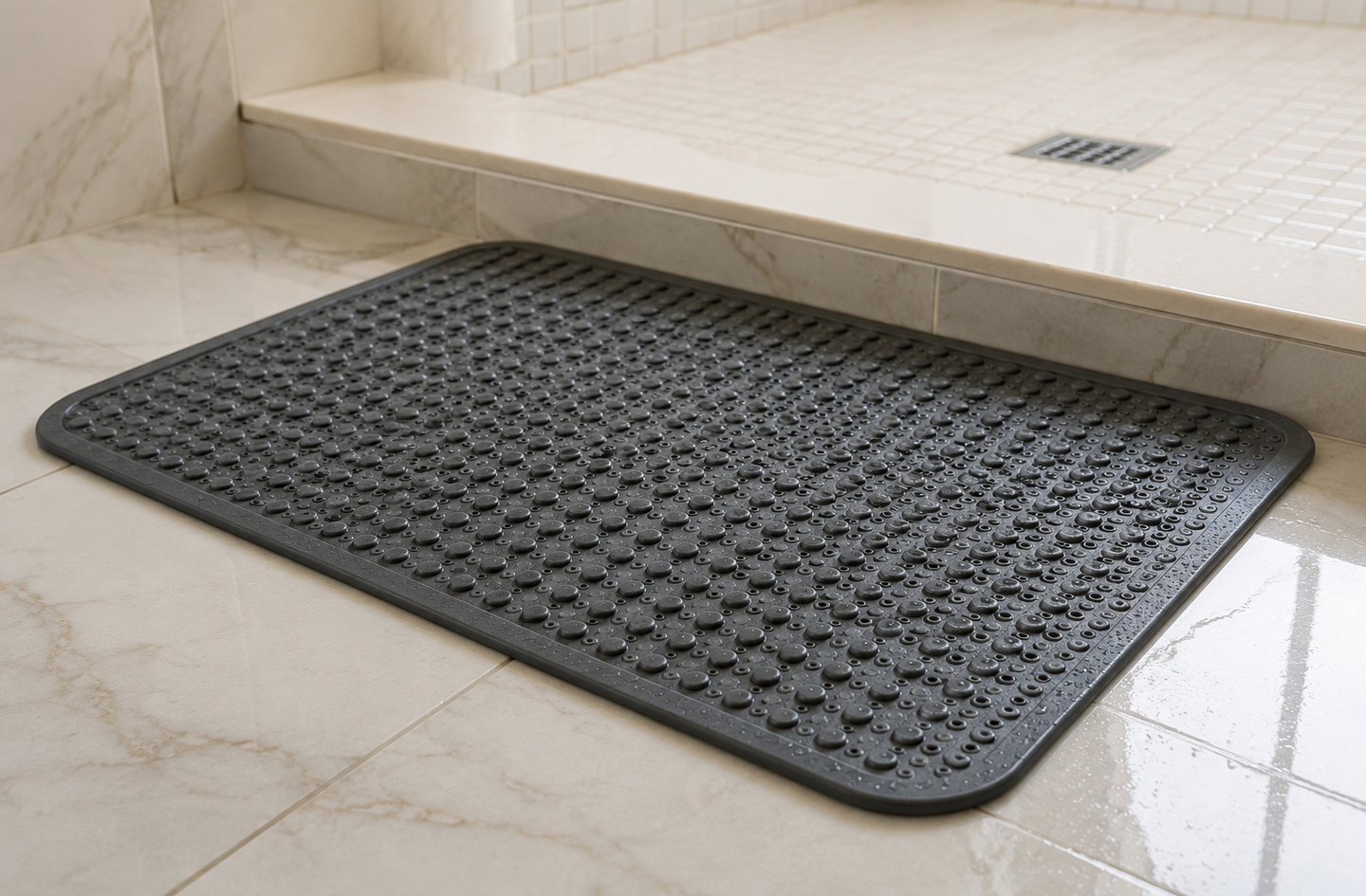
Drainage rate and traction area are in tension. Matching the drainage style to the spray volume and drain position in the specific shower is more useful than choosing the design with the highest hole count.
What happens when drainage fails
A mat that drains slowly creates a shallow pool on its surface. That pooling raises the waterline to or above the texture contact points, which can reduce traction to roughly the level of wet tile with no mat. The tile underneath a poorly draining mat also becomes wet, which matters when stepping off the mat onto the uncovered floor. For a detailed look at surface water management across the bathroom floor, the article on making tile floors less slippery covers floor-level approaches that complement a well-drained mat.
Size, Coverage, and Zone Fit
Coverage zone refers to the floor area a mat actively protects with grip surface, measured by its length and width. Three distinct movement zones exist in most shower entries. The entry zone spans the transition from dry tile to the wet shower floor. The standing zone is the main position during showering. The turning zone is the area used when pivoting toward the wall, a grab bar, or the showerhead control.
Standard shower mat sizes run from about 17 by 24 inches at the small end to 24 by 36 inches for large models, with some extended mats reaching 40 by 16 inches or wider. A 17-by-24-inch mat covers the standing zone for most adults but leaves the entry step as bare wet tile. A 24-by-36-inch mat can cover entry and standing together in a standard shower stall. The 40-inch extended mat is proportioned for walk-in showers and tub surrounds where the distance from the door threshold to the main standing position is longer than a standard stall allows.
The entry zone is where most balance transitions happen. Stepping into a wet shower from dry tile involves a weight shift that is brief but requires confident footing at the moment the wet foot first contacts the shower floor. A mat that begins at the door threshold and extends to the standing zone covers that transition. A mat sized only for the standing zone leaves the entry step on bare tile, which is often the first contact with a wet surface and the point where hesitation is highest.
The turning zone is most often overlooked. After shampooing, reaching for the showerhead control, or beginning to towel off while still inside the shower, the body weight shifts laterally and one foot pivots on the shower floor. A wider mat or two mats placed end-to-end can cover this zone. Where space is limited, a grab bar positioned within arm’s reach of the turning zone provides a support point that reduces the traction demand on the mat during the pivot.
Coverage decisions are best made by walking the shower entry path and noting exactly where the first wet-floor contact happens, where the main standing position falls, and where any pivoting or turning occurs. Those three points define the minimum mat coverage needed.
Measuring your movement zones before buying
Stand at the shower threshold and note where your lead foot first touches the wet floor: that point marks the start of the required coverage area. Walk to where you stand to shampoo and rinse: that point marks the center of the standing zone. Turn 90 degrees in each direction as you would when reaching for controls or a towel: the width of that turning arc determines whether a standard mat or a wider mat is needed. Measure the total length and width those three positions define, then match that rectangle to mat dimensions before purchasing.
Maintenance and Long-Term Grip
A non-slip shower mat deteriorates in three ways that affect its safety performance over time: suction cup edge wear, surface texture loading from soap residue, and mat body degradation from mold or mineral buildup. Each reduces effective grip without necessarily making the mat look worn from the standing side.
Suction cup edges develop small tears and hardened spots over months of use, particularly when the mat is peeled off the floor quickly rather than lifted gradually from one corner. Once a cup edge no longer forms a complete ring contact, it holds with reduced force. A quick check: press the flat of a finger against each suction cup and release. A cup that bounces back promptly still holds well; one that stays collapsed or lifts immediately has lost its elasticity and contributes little to overall adhesion.
Soap residue fills drainage holes and texture channels over weeks. A mat cleaned only by the shower spray retains residue in the deeper channels. A scrub brush used once a week, combined with a thorough rinse and drying flat or hung over the shower door, keeps the channels clear and the mat dry between uses. Mats left folded on a wet floor develop mildew and mineral deposits that discolor and stiffen the material. That stiffening changes the way suction cups contact the floor and reduces the mat’s ability to conform to minor surface variations.
Material degradation timelines vary by mat construction. A natural rubber mat in a hard-water environment may develop surface cracking within one to two years. A thermoplastic elastomer (TPE) mat in the same environment typically holds its flexibility longer. If a mat no longer lies flat without peeling up at the edges, or if visible splits appear around the suction cup bases, it should be replaced regardless of how the surface looks from above.
Maintenance frequency, not just material quality, determines how long a mat performs at its original grip level. A lower-cost mat cleaned weekly can outperform a higher-cost mat that is cleaned monthly.
When to replace a shower mat
Three signs suggest replacement regardless of overall mat appearance. First, suction cups that no longer hold firmly after being pressed onto a clean dry floor. Second, a surface texture that feels smooth when rubbed with bare wet feet. Third, persistent dark staining inside texture channels that does not clear with scrubbing. Any of these indicates the mat is no longer performing at its original grip level. For a broader look at which floor surfaces and surface treatments deliver durable traction in wet areas, see the overview of non-slip bathroom flooring options.
Choosing a Non Slip Shower Mat for Seniors
The four dimensions interact differently for different floor types and movement patterns. The profiles below map common bathroom situations to the suction, texture, drainage, and coverage choices most likely to match them.
Smooth fiberglass tub, standard tub size: A cup-based mat with a small to medium profile (17 by 24 or 20 by 30 inches) and circular drainage holes is a reliable fit. Flat vacuum cups seat fully on smooth fiberglass. If the primary concern is the pivot when stepping out of the tub, choose raised nub texture over ribbed channels, since nubs provide more multidirectional grip during that transition.
Glazed tile shower, walk-in configuration: A larger mat (24 by 36 or 40 by 16 inches) with dense nub or pebbled texture and open drainage spacing covers both entry and standing zones. Cup-based adhesion works on smooth glazed tile. For walk-in showers where the floor slopes toward a center drain, confirm that the mat’s drainage cutout aligns with the drain position before purchase, or choose a mat with evenly spaced holes across its full area.
Textured or natural-stone shower floor: Standard suction cups are unreliable on porous or heavily textured stone because they cannot seal across uneven surfaces. A suction-free mat with rubber friction backing, or an adhesive anti-slip strip system supplemented with a removable mat for texture and drainage, is a more consistent combination. Testing a single suction cup against the floor before purchasing is a simple way to confirm whether a cup-based mat will hold on that specific surface.
Shared shower used by people with different mobility levels: Prioritize coverage and drainage over any single surface feature. A larger mat with dense texture and open drainage holes serves a wider range of balance and movement patterns. A grab bar in the entry zone, positioned within arm’s reach of the first wet-floor contact point, supports the transition the mat does not control. Physics, not popularity: the combination of stable footing and a fixed support point addresses the mechanics of balance recovery in ways that mat surface texture alone cannot.
| Situation | Suction priority | Texture priority | Size priority |
|---|---|---|---|
| Smooth fiberglass tub | Flat vacuum cups | Raised nubs | 17×24 or 20×30 in |
| Walk-in tile shower | Flat cups or ridged backing | Pebbled or nubs | 24×36 or 40×16 in |
| Textured or stone floor | Suction-free rubber grip | Any high-profile texture | Measure zones first |
| Shared/multi-user shower | Most stable available | Dense nubs or pebbled | Largest that fits |
Frequently Asked Questions
How many suction cups should a non-slip shower mat have?
Most safety-focused shower mats have 150 to 200 suction cups. The count matters less than cup quality and substrate compatibility: 200 cups on an incompatible floor provide less grip than 150 cups on the right surface. Confirm that the mat’s backing type matches your specific floor material before using suction cup count as the primary selection criterion.5
Can a shower mat replace a grab bar for bathroom safety?
No. A shower mat improves traction on the standing surface but does not provide support during a transfer, a stumble, or a balance recovery. Grab bars and shower mats serve different biomechanical roles. Falls cause 81.1% of bathroom injuries,1 and the most effective configuration combines stable footing from a well-fitted mat with fixed support points from correctly positioned grab bars.
How often should a non-slip shower mat be replaced?
Replace a shower mat when suction cups no longer hold firmly on a clean surface, when the texture surface feels smooth on bare wet feet, or when mildew inside the channels does not clear with scrubbing. For most PVC or TPE mats used daily, this typically occurs within one to three years, depending on water hardness and cleaning frequency.
What size non-slip shower mat is recommended for seniors?
A minimum of 24 by 36 inches is a common recommendation for step-out coverage in a standard shower stall.6 For walk-in showers with a longer entry path, a 40-inch extended mat or two mats placed end-to-end may be needed to cover entry, standing, and turning zones together. The right size depends on measuring the actual movement path in the specific shower, not on a standard specification.
Do non-slip shower mats work on textured tile floors?
Standard suction cup mats do not hold reliably on heavily textured tile because the cups cannot form a complete seal across an uneven surface. For textured tile, a mat with suction-free rubber friction backing or an adhesive anti-slip strip system provides more consistent adhesion. Testing a single suction cup against the actual floor before purchasing is the simplest way to confirm compatibility.
Limitations and Edge Cases
- This article covers the most common shower mat configurations and their physical performance characteristics on typical residential floor materials. It does not evaluate specific commercial products or brand claims, which require hands-on testing for each floor surface combination.
- The DCOF values discussed reference ANSI A137.14 (a tile standard) and BS 8445:20125 (a UK bath mat standard). No single US consumer standard currently governs shower mats directly; ASTM F462 was withdrawn in 2016 and a replacement standard is under active CPSC review as of 2025. Apply the DCOF threshold as orientation, not as a product certification claim.
- For bathrooms where the floor material is unusual (poured concrete, solid surface, or luxury vinyl plank with embossed texture), the suction compatibility guidance in this article may not apply. Consult an occupational therapist or a licensed contractor for surface-specific assessment.
References
Methodology: every figure below comes from an independent published source and links to the page that carries it; the article was reviewed against captured verbatim evidence for each cited figure.
- CDC MMWR – Nonfatal Bathroom Injuries Among Persons Aged 15 Years and Older, United States, 2008. Centers for Disease Control and Prevention. 2011.
- NCHS – Unintentional Fall Deaths in Adults Age 65 and Older: United States, 2023. National Center for Health Statistics Data Brief No. 532. June 2025.
- PMC / NCBI – Moreland BL, Kakara R, Haddad YK, Shakya I, Bergen G. A Descriptive Analysis of Location of Older Adult Falls That Resulted in Emergency Department Visits in the United States, 2015. American Journal of Lifestyle Medicine. 2021.
- Safety Direct America – ANSI A137.1 Slip Resistance and DCOF Requirements for Interior Wet-Area Surfaces. Citing American National Standard for Ceramic Tile.
- SATRA Technology Centre – Avoiding Accidents with Bath and Shower Mats. Independent accredited test house. Citing BS 8445:2012 slip-resistance classification.
- NCOA – Get the Facts on Falls Prevention. National Council on Aging. Updated 2024.
Conclusion
No shower mat works equally well on every floor. Suction type determines whether the mat holds at all. Texture determines wet traction. Drainage determines whether pooling neutralizes that traction. Coverage determines whether the entry, standing, and turning zones are all protected. Evaluating all four dimensions against the specific floor material and the actual movement path is the system-before-symptom approach that makes a mat selection last. See how shower mats fit the wider picture in the slip-resistant flooring overview.