
Falls are the primary cause of 81.1% of all bathroom injuries treated in U.S. emergency departments,1 and 68.3% of those injuries happen in or around the bathtub and shower. Most non slip bath mats are sold on surface texture alone, not on whether the mat will hold its position on your specific floor. Our slip-resistant flooring overview covers the broader wet-zone picture. This guide focuses on the specific decisions that determine whether a bath mat is actually stable: surface compatibility, grip mechanism, coverage area, drainage design, drying time, and edge behavior.
Quick Answer
How do you choose a non-slip bath mat that actually stays put?
Check your floor surface first. Suction cups require a smooth, non-porous base to seal properly. Textured tile, pebble floors, and refinished surfaces break that seal, so the mat shifts regardless of how it was marketed. Once you confirm your surface supports the grip mechanism, match the mat’s footprint to the full zone where you stand and turn, verify it has drainage holes that allow water to pass through rather than pool under the mat, and confirm the edges lie flat without curling. A mat that meets all four conditions reduces the risk of a moving surface underfoot in the wettest part of the bathroom.
Key Takeaways
- Falls cause 81.1% of bathroom injuries in the U.S., and 68.3% of those occur in or around the bathtub or shower.1
- Suction cups cannot seal on textured tile, grout lines, or refinished surfaces. Surface compatibility is the first criterion, not the last.
- No current voluntary federal standard governs slip-resistance performance for bath mats or bathing surfaces. The label “non-slip” describes surface texture only, not grip strength under load.4
- The EPA recommends drying wet materials within 24 to 48 hours to prevent mold growth. A bath mat that stays wet between uses loses grip performance and becomes a hygiene problem.5
- Adults aged 85 and older face a bathroom injury rate of 515 per 100,000, compared to 59 per 100,000 for adults under 25. Placement decisions matter more as the consequence of a slip increases.1
Before You Start: Know Your Surface
Knowing the surface type before purchasing separates a reasoned choice from a guess. Three things to identify on your specific tub or shower floor before you look at any product listing:
- Surface texture: smooth, lightly textured, deeply textured, or pebble or mosaic composite
- Surface material: acrylic tub shell, ceramic tile, porcelain tile, natural stone, or a refinished or recoated surface
- Grout joint frequency and width: a surface with tight grout joints (1/16 inch or narrower) behaves differently than one with wide joints (1/4 inch or more)
These three factors determine which grip mechanisms are physically possible on your floor. Once identified, the rest of the selection criteria follow from them. Do this check before reading any product specifications.
What counts as smooth enough for suction cups
Run your palm flat across the surface. A smooth surface offers no noticeable texture catch against a moving hand. If your palm drags slightly on peaks or grout edges, the surface will interrupt suction cup seals. A smooth acrylic tub shell or a smooth-glazed ceramic tile floor without deep grout channels is typically compatible. Lightly sanded matte tile, even tile rated for wet-area use, is usually not.
How to identify a refinished surface
A refinished tub or shower has been spray-coated with a new finish layer over the original material. The surface often looks glossy or slightly thicker than a standard tile glaze. If the bathroom has been renovated in the past five to ten years and the tub color does not match the original porcelain, assume a refinished surface. Ask the previous owner or a building manager if unsure, because suction cups on a refinished surface carry a risk of coating damage that is not present on the original material.
Step 1: Confirm Surface Compatibility With the Mat’s Grip
The grip mechanism listed on the packaging only works when the surface allows it. The most common mismatch is suction cups on textured tile, and the problem is geometry, not product quality.
A suction cup forms a partial vacuum against a smooth, continuous, non-porous surface. Pressing one onto a surface with grout lines, texture ridges, or drainage channels breaks that vacuum at every interruption. The mat appears to hold during initial placement, but shifts underfoot when loaded with body weight because the vacuum has already failed at the contact breaks.
Tile surfaces where suction cups reliably fail to hold:
- Matte and textured ceramic or porcelain designed for wet-area slip resistance
- Natural stone with a honed, brushed, or tumbled finish
- Pebble and mosaic shower floors where grout lines occupy more surface area than the tile faces
- Any surface with grout joints wider than approximately 1/16 inch
On refinished surfaces, the issue is different. Suction cups bond mechanically to the refinishing coating and lift or scratch it on removal. Before placing any suction mat on a refinished tub, consult the refinishing company’s guidance. Replacing a refinished surface is expensive; replacing a bath mat is not.
The Consumer Product Safety Commission, which referenced ASTM F462 as the prior voluntary standard for bathing surface slip resistance, acknowledged the standards gap directly after ASTM withdrew that standard in 2016 without a replacement:4
“[CPSC’s objective is] to work with ASTM to re-establish F462, or develop a new voluntary standard to address fall hazards associated with adult bath tubs and shower facilities.”
U.S. Consumer Product Safety Commission, Voluntary Standards Program4
This means there is no independent benchmark against which a mat manufacturer’s “non-slip” claim is tested. The label is self-certified, and its meaning varies by manufacturer.
Step 2: Match the Grip Mechanism to Your Specific Floor
Once the surface type is clear, the choice of grip mechanism narrows considerably. The table below maps each backing type to the surfaces where it performs reliably, and the conditions where it does not.
| Grip Type | Smooth Acrylic or Porcelain | Textured or Matte Tile | Pebble or Stone Floor | Refinished Surface |
|---|---|---|---|---|
| Suction cups | Seals on contact; holds under weight | Breaks at grout joints; mat shifts under load | Will not seal; mat moves freely | Risk of coating damage; consult refinisher first |
| Natural rubber backing | Grips under mat weight; degrades with bleach | Partial grip on tile peaks; moves on ridges | Sits unevenly on pebbles; unstable | May bond to coating; test a corner before committing |
| PVC or foam backing | Light resistance; not sufficient as sole grip in a wet tub | Minimal friction; not recommended for wet use | Not recommended for wet zones | Test compatibility on a small area first |
| Weighted mat (no adhesive) | Stays by mass; no adhesion required | Stays by mass; edges may catch on texture | Stays by mass; works on uneven surfaces | Safe for most finishes; no suction to lift coating |
Natural rubber backing
Rubber-backed mats grip through friction between the backing material and the floor surface, not through vacuum. This makes them more tolerant of slight surface texture than suction cups, because the rubber conforms partially to the surface rather than requiring an unbroken seal. The trade-off is that natural rubber degrades with chlorine-based cleaners and hot-water washing. A bathroom where bleach is used regularly will shorten rubber backing life noticeably.
Weighted or heavy mats
A weighted mat stays in place by mass and material stiffness alone. No active grip mechanism is needed, so these mats work on textured tile, pebble floors, and surfaces where suction is not viable. The weight prevents casual shifting, but a weighted mat still moves if a foot catches a raised edge. These mats retain water longer than thinner alternatives because the dense material absorbs and holds moisture.
Step-out mats and bathroom rugs
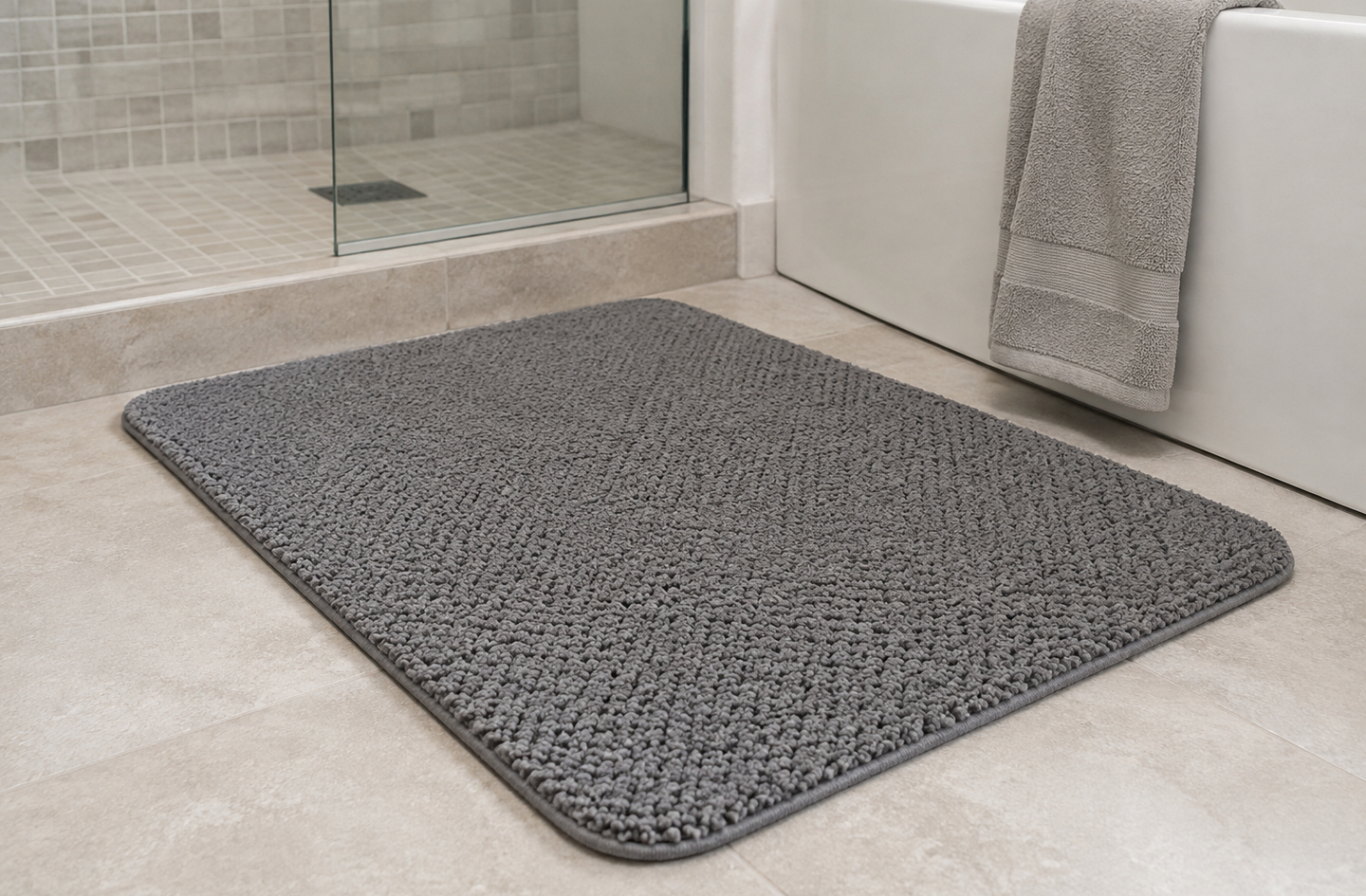
Microfiber and terry-backed mats are designed for step-out use on a damp bathroom floor, not for wet submersion inside a tub or shower. The backing provides light resistance against a damp surface but no meaningful grip in a fully wet environment. Placing a microfiber mat inside the tub or shower is a misapplication of the product’s design. For step-out rugs and the selection criteria specific to that surface and placement, the anti-slip bathroom rugs guide covers backing type, weight, and edge profile in detail.
Step 3: Cover the Full Zone Where You Stand and Turn
Coverage matters as much as grip. A mat sized to the center of a tub floor leaves the entry zone on bare wet surface. That gap is where a foot lands during the most vulnerable moment: stepping in and stepping out.
Map the standing zone before ordering a mat. For a standard bathtub (typically 60 inches long, 30 to 32 inches wide), identify three areas: the entry point where the first foot lands, the central standing area where most of the shower or bath occurs, and the turning zone where direction changes happen. A mat covering the center but missing the entry zone leaves unprotected wet surface at the highest-risk transition.
Sizing for a standard tub
A 17 by 28-inch mat covers the central standing area of most standard tubs. A 17 by 36-inch mat, or a large non-slip bath mat in the 17 by 40-inch range, extends coverage toward the drain or tap end. The longer mat also catches more of the turning zone if the entry and central standing positions are at opposite ends of the tub.
Sizing for a shower floor
Measure the flat portion of the shower floor separately from the sloped drain channel. The mat should cover the zone where you stand, not just where the drain is. Placing a mat over a floor slope means the mat sits on an angled surface, which reduces suction effectiveness and allows water to pool on the uphill side. An extra long non-slip bath mat (40 inches or more in length) suits walk-in showers where the standing zone extends from the entry threshold to the fixture.
The threshold gap problem
A gap of 6 to 8 inches between the mat edge and the shower threshold leaves wet, unprotected tile at exactly the point where weight transfers from the mat to the floor. Foot placement during exit is not always precise, especially when the body is warm, the floor is wet, and attention is split. The transition point at the mat edge is where slips concentrate in wet zones. A mat positioned to leave less than 2 inches between its edge and the threshold eliminates this gap. If the mat’s dimensions do not reach that close, two mats in sequence (one inside the threshold, one at the exit) are preferable to one mat centered in the standing zone.
Coverage for seated and transfer use
For anyone using a shower seat or shower chair, the turning zone extends across a wider area than the standing zone alone. The transfer pivot point, where the body rotates from seated to standing, often sits at the edge of where a mat sized only to the central standing zone reaches. Confirm the mat covers the rotation point, not just the standing position.
Step 4: Check Drainage Design for Your Floor Type
Water pooling under a bath mat reduces suction performance and creates conditions for mold growth. The EPA recommends cleaning and drying wet materials within 24 to 48 hours to prevent mold growth.5 A mat without drainage holes cannot meet that standard under normal daily use.
Drainage hole placement
Each hole punched through the mat body allows water to pass to the drain below rather than collecting in the space between the mat and the floor. Distribution matters more than total hole count. Holes concentrated at the center allow pooling at the mat’s edges; holes distributed evenly across the full surface prevent pooling across the entire footprint. Look for hole diameter wide enough to pass hair and soap debris without clogging in normal bathroom conditions.
Elevated ribbed backing
Some mats substitute drainage holes with a ribbed or latticed underside. The ribs create channels between the mat surface and the floor, allowing water to move laterally toward the drain. On a properly sloped floor with a centered drain, this design performs comparably to drainage holes. On flat floors or floors with off-center drains, water moves slowly or pools at the edges because gravity does not assist the flow.
When drainage design is not enough
If the tub or shower floor does not drain adequately (a slow or partially blocked drain, or a floor without sufficient slope toward the drain), water pools regardless of the mat’s drainage design. A drainage-hole mat on a flat, slow-draining floor still sits in standing water between uses. Clearing the drain condition is the upstream fix. The mat design cannot substitute for adequate floor drainage.
Step 5: Plan for Cleaning and Full Drying Between Uses
A bath mat that stays wet between uses is not functioning as a safety surface. Wet rubber backing grips less than dry rubber backing, and wet textured surfaces allow foot movement that a dry surface resists more firmly.
The drying protocol
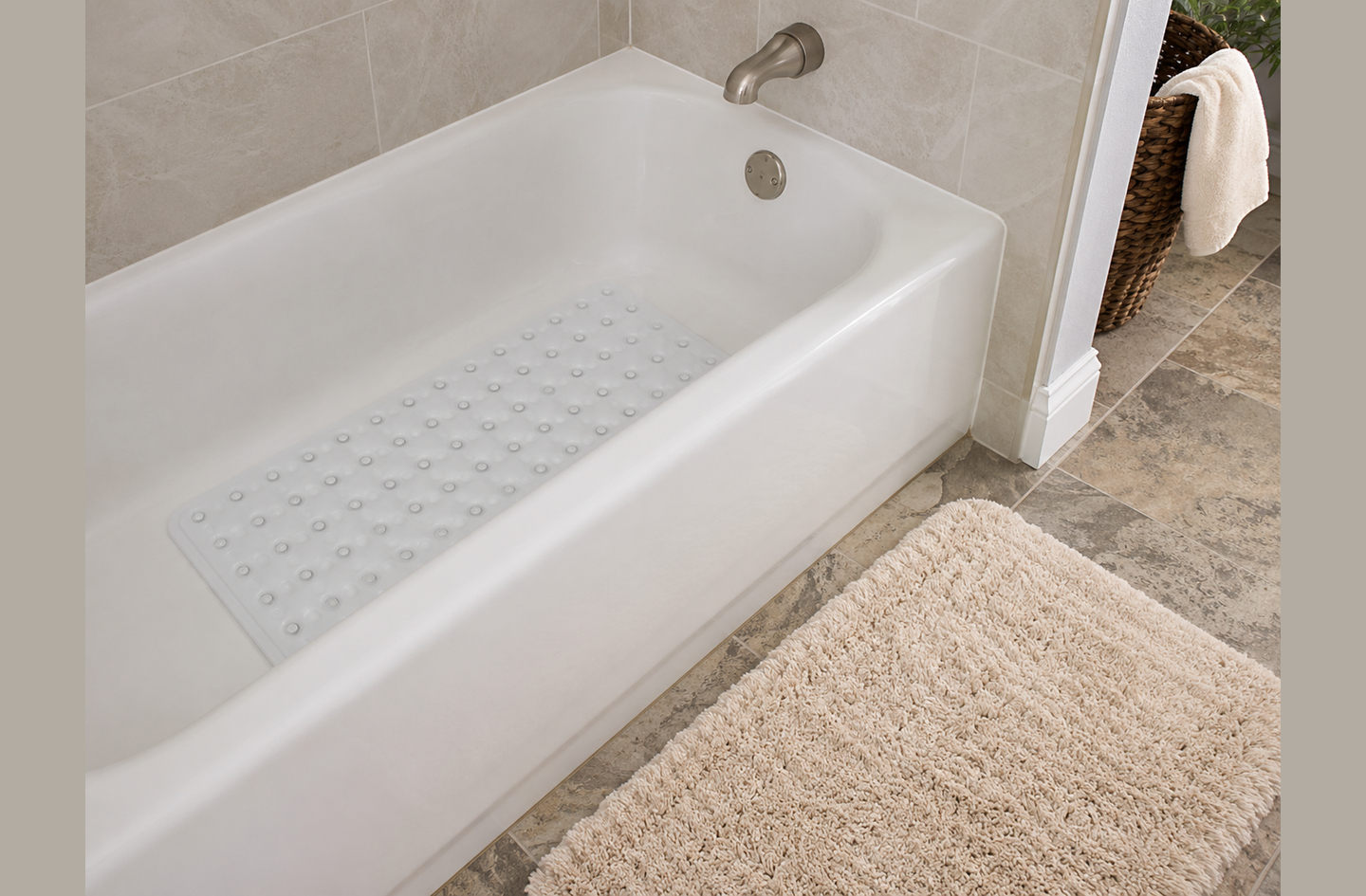
Remove the mat after each use. Shake off standing water. Hang it over the shower rod, a towel rack, or the tub rim with the textured surface facing out so air reaches both sides. A mat left flat on the tub floor after use, or folded damp, creates a moisture-trapping condition on both the mat underside and the tub surface beneath it. The floor beneath the mat also needs to dry between uses; a mat left permanently in place prevents that.
Machine washing
Most rubber-backed mats tolerate a cold or lukewarm machine wash on a gentle cycle. Hot water softens and deforms rubber over repeated cycles. High heat in the dryer accelerates the hardening and cracking of rubber and PVC backing that causes suction cups to lose elasticity. The useful approach is cold wash, line or rack dry. Wringing a rubber-backed mat after washing can deform the suction cups; lay it flat or hang it without twisting.
Bleach and harsh cleaners
Chlorine bleach degrades natural rubber rapidly. A bathroom where the regular cleaning routine uses bleach will shorten rubber backing life to months rather than years. PVC and synthetic backings tolerate brief bleach contact better than natural rubber, but prolonged exposure still accelerates material breakdown. If bleach cleaning is routine in the household, a PVC-backed or weighted mat is more durable than a rubber-backed one.
What washing does not restore
A mat whose backing has hardened, cracked, or permanently curled does not recover grip function from washing. The suction cups look intact but no longer flex enough to create a seal. Cleaning extends appearance, not performance. The indicator for replacement is when the mat shifts underfoot during use despite being clean and correctly placed: at that point, the grip mechanism has failed and the mat adds a moving surface to the wet zone rather than a stable one.
Step 6: Inspect Edge Behavior Before You Rely on the Mat
A mat with curling or raised edges is a trip hazard at the exact location it was placed to prevent one. Edge behavior is most critical at the point where a foot crosses from the bathroom floor onto the mat, or from the mat surface back to the shower floor.
Edge thickness
Mats thicker than approximately half an inch create a raised step that the foot must clear during shower entry or exit. For anyone with a shortened gait swing, a raised mat edge at the shower threshold presents a catch point. Thin-profile mats (under 3/8 inch) reduce this risk. Thickness is usually listed in product specifications in millimeters; 6 mm is approximately 1/4 inch, 13 mm is approximately 1/2 inch.
Edge curl
Natural rubber and PVC mats tend to curl upward at the edges when stored folded, when exposed to repeated heat cycles, or when the backing hardens with age. A curled edge at the entry zone of a shower is a specific fall risk during exit, when one foot is still on the shower floor and the other is contacting the mat edge. This is a common failure mode in mats older than one to two years.
To test before relying on a mat: press a corner flat to a hard surface and release it. If the corner springs back, the material has memory that will worsen over time. A mat that lies flat under its own weight during this test is more likely to lie flat on the shower floor under body weight.
Beveled edges
Some mats are manufactured with a tapered underside that angles the mat body toward the floor surface at the perimeter rather than presenting a vertical cut edge. This creates a lower transition height where the foot crosses from floor to mat. Not all products describe their edge geometry explicitly. Looking at a product’s side-profile image or reading reviews specifically for “edge curling” or “trip hazard” language provides more reliable information than the product name or marketing description alone.
Common Mistakes When Buying a Non Slip Bath Mat
The most common error is treating the “non-slip” label as a performance specification. It is not. The label describes the surface texture of the top layer or the backing material. It does not state how strongly the mat holds position on a given floor type, how long that hold lasts, or under what load conditions the grip fails.
Bathroom injury data puts the stakes clearly:
“Falls were the most common primary cause of injury (81.1%), and the most frequent diagnosis was contusions or abrasions (29.3%).”1
Stevens JA, Haas EN, and Haileyesus T, CDC Morbidity and Mortality Weekly Report
Understanding where mats are most likely to fail helps avoid the most common selection errors.
Mistake 1: Choosing based on appearance rather than surface match
A mat selected for color or pattern without checking whether the grip mechanism suits the floor will shift. The visual match to towels is irrelevant if the mat moves underfoot during use. Surface type determines the grip mechanism; everything else follows from there.
Mistake 2: Sizing to the center of the tub
Covering the central standing area while leaving the entry zone on bare wet tub surface places unprotected tile at the highest-risk transition point. Entry and exit are the movements that concentrate slip risk in a bathtub or shower. A mat sized only to the center misses both transition moments.
Mistake 3: Leaving the mat in place permanently
A mat left flat on the tub floor between uses traps moisture underneath, promotes mold and mildew growth on both surfaces within the EPA’s 24 to 48-hour window, and degrades suction cup performance as soap and water accumulate in the cups. Removing the mat after each use and hanging it to dry is not an optional maintenance task; it is what keeps the mat functional.
Mistake 4: Using the same mat inside and outside the tub
In-tub mats and step-out mats serve different functions. An in-tub mat is designed for wet submersion, water drainage, and suction or weighted grip against a wet tub surface. A step-out mat is designed for absorbency and light grip on a damp bathroom floor. Using a drainage-hole in-tub mat outside the tub places a heavy non-absorbent mat where absorbency is needed. Using a microfiber step-out mat inside the tub provides no meaningful grip against the wet tub surface.
Mistake 5: Expecting suction cups to work on a textured shower floor
A shower floor textured for barefoot traction is designed to increase friction between the bare foot and the tile surface. That same texture prevents suction cups from sealing. Choosing a different mat with suction cups does not resolve this: the surface is the barrier, not the specific product. Textured shower floors require a grip mechanism that does not depend on an unbroken surface seal, such as a weighted mat or a rubber-backed mat rated for textured surfaces.
Frequently Asked Questions
Will a non-slip bath mat prevent falls?
No mat prevents falls absolutely, and no product claim to that effect is supportable. The right mat reduces the risk of a moving surface underfoot in a wet zone. Non-fatal falls among adults 65 and older already cost the healthcare system $80 billion per year,3 and the bathtub and shower zone accounts for the majority of bathroom injuries. A properly matched and maintained mat removes one specific friction point. It does not address lighting, grab bar placement, floor slope, or footwear, all of which affect wet-zone safety independently.
How often should I replace a non-slip bath mat?
Replace the mat when the grip mechanism fails, not on a fixed schedule. The indicators are: suction cups no longer seal on first press, the mat shifts underfoot during use despite being clean and correctly placed, the backing has cracked or hardened, or the edges curl persistently. A mat that passes all four checks is still functional regardless of age. One that shifts during use has failed as a safety surface regardless of how new it is.
What type of bath mat works on a textured shower floor?
A weighted mat or a natural rubber-backed mat rated for textured surfaces is the starting point. Suction cups will not seal on textured tile, matte tile, pebble, or stone floors. The U.S. Consumer Product Safety Commission is currently sponsoring research into bathing surface slip resistance testing methodology to better characterize friction demand across surface types,6 but no current labeling standard distinguishes mat performance by surface texture. Checking the surface type first narrows the choice before reviewing any product specifications.
Why does my bath mat keep sliding even though it has suction cups?
Three conditions break suction cup adhesion: soap film or debris blocking the cup face, a surface with grout lines or texture preventing a full seal, or suction cups that have hardened or cracked with age. Clean both the mat cups and the tub surface with a non-bleach cleaner and test again. If the mat still shifts after cleaning, the surface is likely incompatible with suction cup grip, or the backing material has deteriorated past the point where cleaning restores function.
Is a rubber non-slip bath mat better than a PVC bath mat?
Natural rubber grips a smooth surface more firmly than most PVC alternatives, conforms slightly better to minor surface variation, and tends to hold its shape longer before edge curling begins. PVC tolerates chlorine-based cleaners better than natural rubber and is generally less expensive. The more important distinction is backing thickness and suction cup quality relative to your specific surface type. Neither material outperforms the other on a surface where suction cups cannot seal.
Limitations and Edge Cases
- This guide addresses fixed residential tub and shower floors. Portable tubs, foldable shower pans, and travel shower setups have different surface properties and drainage conditions that affect which grip mechanisms apply.
- Anti-slip surface treatments applied to an existing tile floor after installation change the surface texture in ways that affect both barefoot traction and suction cup compatibility. A treated surface should be evaluated in its post-treatment condition, not by its original tile specification.
- For broader wet-zone surface decisions beyond mat placement, including tile selection, grout joint sizing, and floor slope, see the slip-resistant flooring overview on homeagefit.com.
References
- CDC Morbidity and Mortality Weekly Report – Stevens JA, Haas EN, Haileyesus T. Nonfatal Bathroom Injuries Among Persons Aged 15 Years or Older – United States, 2008. MMWR Morb Mortal Wkly Rep. 2011;60(22):729-733. June 10, 2011.
- CDC, Older Adult Falls Data – “Older Adult Falls Data.” Centers for Disease Control and Prevention. Page last reviewed 2024.
- National Council on Aging – “Get the Facts on Falls Prevention.” NCOA. Updated 2021.
- U.S. Consumer Product Safety Commission – “Voluntary Standards – Bath Tubs (Adult).” CPSC. Accessed 2025. (ASTM F462 withdrawn 2016; no current replacement standard.)
- U.S. Environmental Protection Agency – “Ten Things You Should Know About Mold.” EPA. Evergreen standing guidance.
- Federal Register – “Agency Information Collection Activities: Bathtub Slip Resistance Study.” CPSC and Arizona State University. Federal Register Notice, April 16, 2025.
Conclusion
A non-slip bath mat’s effectiveness depends on matching four variables to your specific situation: the surface type that determines which grip mechanism works, the coverage area that spans the full standing and transition zone, the drainage design that allows the floor beneath to dry, and the edge profile that does not introduce a new trip point at the mat’s perimeter. No label substitutes for that check. See the slip-resistant flooring overview for the broader context of wet-zone surface decisions in a bathroom designed to work reliably over time.