Home safety in the kitchen burn and fall prevention works best as one plan, because the same few movements cause both injuries. In a UK burns unit, 31.2% of burn injuries in people over 65 happened during food preparation.2 This article sits under our fall-prevention priorities overview, which summarizes how to order safety work in a home. The angle here is narrower: which kitchen hazards to fix first, and why the hot carry, the wet floor, and the high shelf come before anything else.
Quick Answer
Which kitchen hazards should seniors and families fix first?
Fix the movements that combine heat, water, and balance. First, shorten and steady the hot carry from stove to table. Second, keep the floor dry and even where water and grease land. Third, bring daily items into easy reach so no one climbs on a chair. Kettle and saucepan spills caused 42.3% of food-preparation scalds in one burns unit study.2
Key Takeaways
- Food preparation caused 31.2% of burn injuries in adults over 65 admitted to one UK regional burns unit, and 75.4% of those were scalds.2
- Older adults treated for burns in US emergency departments were burned at home 75.9% of the time, against 67.4% for younger adults.3
- The kitchen or dining room was the site of 7.2% of at-home falls that sent adults 65 and older to an emergency department.1
- Climbing with items in hand was the most common unsafe habit, reported by 75% of older step ladder users in one study.5
- The misconception to drop: burns and falls are not separate projects. The hot carry across a wet floor is one movement, and fixing it reduces avoidable risk for both.
Home Safety in the Kitchen Burn and Fall Prevention: Why One Plan Covers Both
Kitchen burns and kitchen falls share a cause: a short sequence of movements done many times a day while holding something hot, wet, or heavy. In US emergency department data from 2004 to 2022, the top burn sources for adults 65 and older were hot water, cookware, and ranges or ovens.3 Each one sits in the kitchen, and each one asks the body to lift, turn, carry, or reach on a floor that can be wet.
A scald is a burn caused by hot liquid or steam rather than by a flame or a hot surface. Scalds made up 36.9% of burns in older adults in that US dataset, slightly more than in younger adults.3 Older adults also had more full-thickness burns, the deepest kind, at 10.4% against 5.5% in younger adults.3 The study authors link the pattern to reduced heat sensitivity, weaker vision, and slower reaction time.
The hot carry is the movement of lifting a full pot, pan, or kettle and walking it from the stove to the sink, counter, or table. It is the point where a burn and a fall become one event: a slip spills the liquid, and a splash makes the person flinch and lose balance.
The kitchen is not where most home falls happen. The bedroom, stairs, and bathroom each account for more, and our guide to high-risk areas first ranks those rooms by exposure. The kitchen earns its own plan because it is the one room where a minor slip can also end in a serious burn.
The diagram traces four kitchen movements against two injury paths. In the burns unit study, 31.2% of burns in people over 65 came from food preparation.2 In US emergency data, flooring was involved in 29.1% of injuries to older adults.4 In the Australian ladder study, 75% of step ladder users climbed with items in hand.5
For a household with limited time, the first hour of kitchen work belongs to the hot carry. It is the only movement that can cause both injuries at once.
Before You Begin: What to Gather for a Kitchen Walk-Through
A kitchen review takes one ordinary meal, a notebook, and someone willing to watch without stepping in. Cook a real dish on a normal evening, when attention is lower than on a careful morning.
- The person who cooks, using their own routine at their own pace, because their hesitation points are the data.
- A notebook with three columns: movement, hazard, and first fix.
- A note of any recent burns, spills, near slips, or moments of holding the counter for balance.
If you are planning for yourself, cook the way you do when you are tired or in a hurry. If you are helping a parent, let them cook while you watch from a seat, and ask about the spots they find awkward. Shared observation keeps decisions with the person who uses the kitchen. Footwear, medication review, and safe movement belong in the guide on patient education at home, which covers what to learn first.
The walk-through is observation, not renovation. Nothing gets bought or moved on the first day. Watch for five movements: lifting a hot pot, turning from stove to sink, and stepping on a wet patch. Then watch for reaching above the shoulder or below the knee, and for standing on anything to reach higher.
Step 1: Shorten and Steady the Hot Carry
By the end of this step, every hot item will travel the shortest possible distance, with both hands free to hold it. This step comes first because handling hot liquid caused most food-preparation burns in older adults. In a study of 442 burn patients over 65 at a UK regional burns unit, 42.3% of food-preparation scalds came from spills from a kettle or saucepan.2 Counting cups of tea and coffee, that share rose to 73.1%.2
“The majority of the food preparation burn injuries were a scald burn due to the handling of hot fluids, either from a saucepan or a kettle.”
Nisha K. Chana, Regional Burns Unit, Pinderfields General Hospital, with J. Yarwood and J. Smith, writing in the journal Burns2
- Clear a landing space on the counter right beside the stove, so a pot moves sideways instead of being carried.
- Drain pasta and vegetables at the stove with a strainer-lid pot or a slotted spoon, so boiling water stays put.
- Fill pots at the sink only partway, then add water at the stove with a jug if more is needed.
- Turn pot handles inward, away from the counter edge and the walking path, so a sleeve or hip cannot catch them.
- Use a small cart or a tray with raised edges for plates going to the table, so the free hand can hold the counter.
Hot oil deserves its own rule, because cooking with hot oil caused 21.2% of food-preparation scalds in the same burns unit study.2 Shallow frying in a deep pan, with a lid and a splatter guard within reach, keeps the oil lower and contains spatter.
Verify the step by watching one meal again and counting how often a hot item crosses open floor. The goal is one crossing at most, and none while the floor is wet.
The cheapest fix in the kitchen is a cleared counter beside the stove, and it removes more burn exposure than any product.
Step 2: Keep the Floor Dry and Even Where Water and Grease Land
By the end of this step, the floor in the cooking zone will stay dry and level, with no loose edges to catch a foot. Floors matter because so many injuries trace back to them. In US emergency department data from 2007 to 2017, flooring materials were involved in 29.1% of injuries among older adults.4 Flooring was linked to fall injuries with an adjusted odds ratio of 3.09.4
An adjusted odds ratio is a measure of how strongly a factor is associated with an outcome after accounting for other factors such as age and sex. It describes an association, not proof that flooring caused each fall.
- Map the wet zones on the notebook sketch: water lands in front of the sink and dishwasher, and grease lands in front of the stove.
- Wipe spills at once with a towel kept on a hook beside the stove.
- Remove loose throw rugs from the cooking zone. If a mat is needed in front of the sink, choose one with a rubber backing and flat, low edges.
- Check thresholds where the kitchen floor meets another floor. A raised edge at a doorway is a trip point during a carry.
- Wear closed shoes with grip while cooking. Socks on a smooth floor turn every splash into a slip risk.
Women carry a higher share of kitchen falls. Among at-home falls that led to an emergency visit, 8.1% happened in the kitchen for women and 5.6% for men.1 The figures do not explain the gap. They do suggest setting up the floor for whoever cooks most.
Verify the step after a normal meal: walk the cooking zone slowly and look for any shine, crumb line, or curled mat edge.
A dry floor in front of the stove protects against both injuries, because a slip there happens next to the heat.
Step 3: Bring Daily Items Into the Comfortable Reach Zone
By the end of this step, every item used weekly will sit between hip and shoulder height. The comfortable reach zone is the band of storage a person can reach while standing flat-footed, without bending low or stretching high. The 2010 ADA Standards set the unobstructed forward reach range at 15 inches minimum and 48 inches maximum above the floor.7 That range was written for accessible design, but it gives a useful outer boundary for any home kitchen.
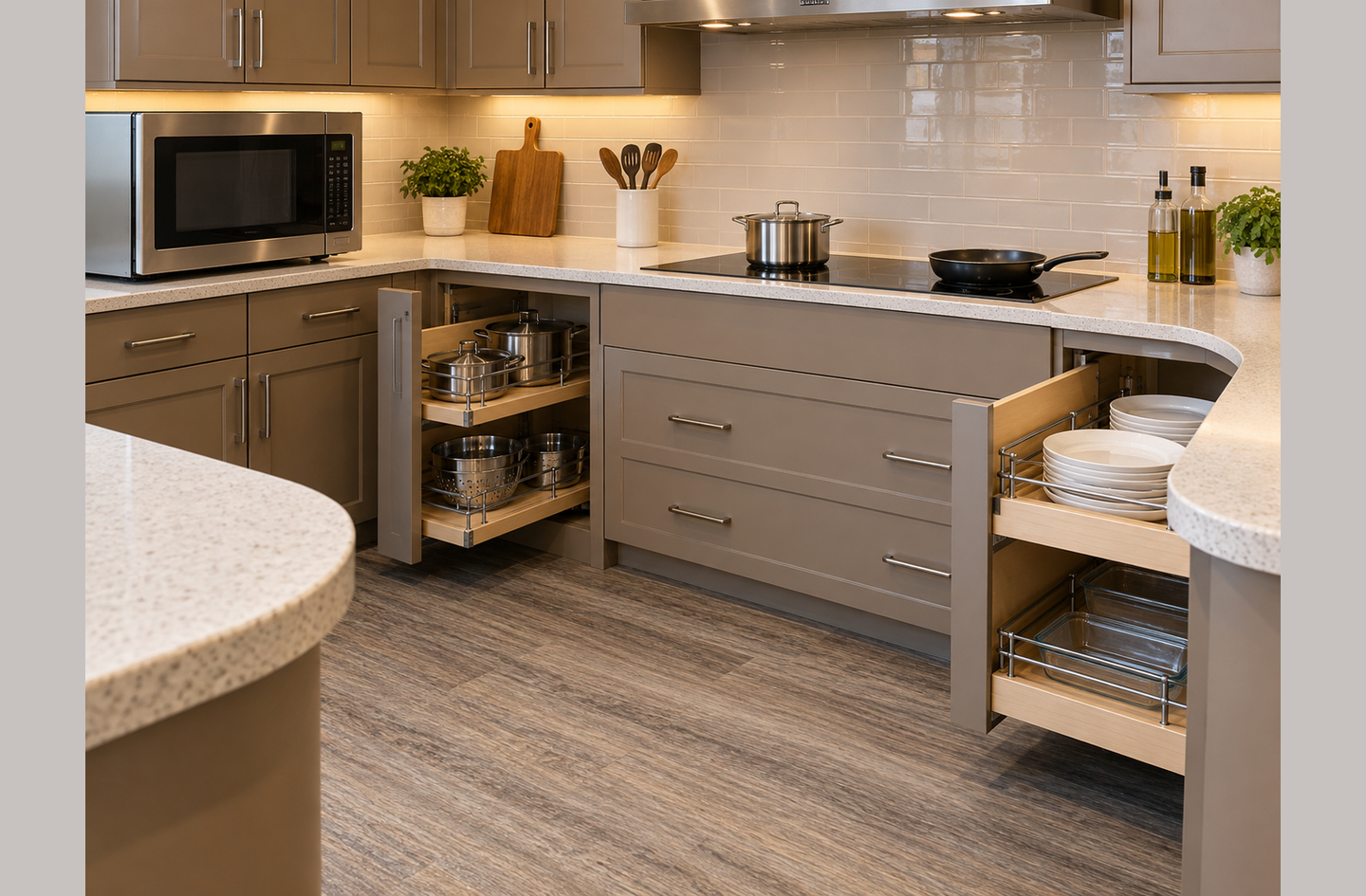
- Empty the top shelf of anything used more than once a month. Move it to a drawer or a lower shelf.
- Fit pull-out shelves in base cabinets, so pots slide forward instead of being fished out from the back on hands and knees.
- Store heavy items low but not on the floor, at about waist height, where lifting needs no deep bend.
- Put the kettle, mugs, and daily pan on the counter or the first shelf, so the most frequent hot task starts from an easy grip.
- Keep the microwave at or below shoulder height, so a hot bowl comes out at chest level and not above the face.
Reach and heat interact because stovetops sit at trunk height, which the NEISS burn study authors link to clothing catching fire while cooking.3 Reaching over a lit burner to a back shelf puts a sleeve directly over the flame. Nothing used daily should be stored above or behind the cooktop.
Verify the step by cooking one full meal without rising onto the toes or bending below the knees. Any item that forces either movement belongs at a better height.
Moving ten items to a lower shelf costs nothing and removes the reason to climb, which is the most dangerous kitchen habit.
Step 4: Replace Chair-Climbing and Unstable Seating
By the end of this step, no one in the kitchen will stand on a chair, and every seat will hold still under load. Climbing is common: in an Australian study of 102 people aged 65 and over, 61% used a step ladder at least monthly, mostly inside the home.5 The most common unsafe habit was climbing with items in hand, reported by 75% of step ladder users.5 Overreaching while on a ladder was reported by 34%.5
A low height does not make a fall minor. In a US trauma registry study, patients over 66 who fell from ladders had 5.3 times the odds of hospital admission of patients aged 18 to 45.6 They fell from lower heights on average and still had more severe injuries.
“Although older patients fell from ladders at lower heights, they sustained more severe injuries with higher admission rates.”
Jorge Con, MD, Department of Surgery, West Virginia University, with colleagues from the University of Arizona, writing in the Journal of Surgical Research6
Unstable seating is any seat that rolls, swivels, tips, or slides when weight shifts onto one edge. In a kitchen that includes office chairs on casters, bar stools with a narrow base, and folding chairs. Each is fine to sit on squarely but fails when used as a step or pushed against at an angle.
- Remove the reason to climb first, because once Step 3 moves weekly items down, anything still overhead is either rare or suits a helper visit.
- If a step is still needed, use a purpose-built step stool with a wide base, non-slip feet, and a tall handrail to hold. Never use a chair, a box, or an open drawer.
- Climb empty-handed. Hand items down to someone, or set them on the counter before stepping down.
- Choose a kitchen chair with four legs and armrests for seated prep. Armrests give two push points when standing up.
- Retire rolling or swivel seats from the kitchen.
In US emergency visits by older adults from 2007 to 2017, ladders had the strongest link to fall injuries of the products reported. Their adjusted odds ratio was 5.48, ahead of flooring at 3.09.4 That figure covers all ladder use, indoors and out. Indoors, the Australian study found step ladders were used for tasks such as changing a lightbulb and retrieving objects from a height.5
Verify the step with one question: does anything in the kitchen still need a climb? If so, move the item or plan a helper visit for it.
A stable seat for prep work lowers fatigue at the stove, and a tired cook is the one who reaches for a chair to climb.
Step 5: Clear the Walking Paths Between Stove, Sink, and Table
By the end of this step, the route between the stove, sink, refrigerator, and table will be clear, wide, and lit. The work triangle is the walking route that links the stove, sink, and refrigerator, the three stations used in almost every meal. For accessible kitchens, the 2010 ADA Standards require at least 40 inches of clearance between opposing counters, appliances, or walls in a pass-through kitchen.7 In a U-shaped kitchen enclosed on three sides, the minimum is 60 inches.7
A home kitchen does not need to meet those standards, but they show whether a route is tight. A walker, a hot pot, and a turning body all need more room than empty hands.
- Lift everything off the floor along the work triangle: bins, pet bowls, bags, and stacks of newspapers.
- Close the dishwasher and oven doors as soon as they are loaded. An open door at shin height is a trip point.
- Move cords for the kettle, toaster, and mixer back from the counter edge, so nothing hangs into the path.
- Add task lighting under the wall cabinets, so the counter, the stove top, and the floor edge are all visible.
- Leave the table end free as a second landing space for hot dishes, so the carry has a short finish.
Lighting connects to burns as well as falls, because a poorly lit stove top hides a low gas flame or a glowing element. Visibility before confidence applies at the stove as much as on the stairs.
Verify the step by walking the work triangle with a full tray. If the tray has to tilt or pass over anything on the floor, the path needs more work.
For a person using a walker, path width decides whether the kitchen works at all, so measure it before buying any aid.
Step 6: Rank the Fixes and Re-Check After One Week
By the end of this step, the notebook will hold a short, ordered list of fixes. The order follows the movements that can cause both injuries, then the ones that cause one. Targeting matters: a 2023 Cochrane review found home hazard programs cut falls by 38% in people at higher risk.8 The same review found no reduction when people were not selected for risk.8
| Rank | Movement | Injury path | First fix, no cost | Next fix, small cost | When to call a professional |
|---|---|---|---|---|---|
| 1 | Hot carry from stove | Burn and fall | Clear landing space next to the stove | Strainer-lid pot, splatter guard, serving cart | Moving the cooktop or sink closer together |
| 2 | Turning on a wet floor | Fall, then burn if near heat | Towel on a hook, spills wiped at once | Rubber-backed mat with low edges | Replacing a slick floor surface |
| 3 | Reach over a lit burner | Burn, clothing fire | Nothing stored above or behind the cooktop | Close-fitting sleeves while cooking | Relocating wall cabinets |
| 4 | Climbing to a high shelf | Fall | Move weekly items below shoulder height | Step stool with a tall handrail | Lowering cabinets or fitting pull-downs |
| 5 | Walking a cluttered route | Fall | Floor of the work triangle cleared | Under-cabinet task lighting | Widening a tight galley for a walker |
The ranking puts cost last on purpose: the first column of fixes costs nothing and protects at once, and the second column is a small purchase. The third column involves plumbing, gas, cabinets, or floors, and belongs with a licensed contractor. When balance, vision, or a recent fall is part of the picture, an occupational therapist can evaluate the kitchen for the specific person.
The same ranking logic runs through the priority-based home plan for the whole house. For a check of every room rather than just the kitchen, the room-by-room checklist lists the hazards to look for in each one.
Re-check after one week of normal cooking, since a fix that got worked around, such as a mat pushed aside, needs a different answer.
A kitchen plan is finished when the person who cooks says the hard moments are gone, not when every row of the table is ticked.
Common Mistakes in Kitchen Fall Prevention for Seniors
The most common mistake is buying products before watching a meal being cooked. A grab bar, a mat, or a gadget fixes one spot. It does not change the movement that made the spot risky.
Treating burns and falls as separate lists: the hot carry links both, so the fix order should follow that movement.
Adding a rug to soften the floor: a loose rug in front of the sink adds an edge to trip on and a surface that slides when wet. If a mat is used, it needs a rubber backing and flat edges.
Deciding for a parent instead of with them: a kitchen rearranged without the cook’s input gets rearranged back, because the cook knows which moves feel hard.
Fixing once and never checking again: needs change with a new medication, a hip replacement, or a change in vision. Re-walk the meal after any health change.
What a Safer-Feeling Kitchen Looks Like
A safer-feeling kitchen lets a full meal be cooked without a carry across wet floor, a climb, or a reach over heat. Pots move sideways onto a landing space beside the stove. Spills get wiped from a towel within reach, and daily items sit between hip and shoulder height. The floor of the work triangle is clear, and the counter is well lit.
The cook should notice less effort, fewer pauses, and fewer grabs for the counter edge. Those are the signs that the friction points are gone.
The kitchen should still look like a home, since none of these changes calls for clinical fixtures. Comfort without institutionalizing the home keeps the person cooking.
Frequently Asked Questions
What causes most kitchen burns in older adults?
Hot liquids cause most of them. In a UK burns unit study of people over 65, 75.4% of food-preparation burns were scalds.2 Spills from a kettle or saucepan caused 42.3% of those scalds. Shortening the carry from the stove is the first fix.
How high should kitchen storage be for seniors?
Keep daily items between hip and shoulder height. The 2010 ADA Standards set an unobstructed forward reach range of 15 to 48 inches above the floor.7 A personal range is often narrower, and an occupational therapist can measure it for a specific person.
Should seniors use a mat in front of the kitchen sink?
Only a mat with a rubber backing and flat, low edges. Flooring materials were involved in 29.1% of injuries among older adults in US emergency data.4 A loose rug adds an edge to trip on and slides when wet, which matters most in front of the sink and stove.
Is a step stool safe for older adults in the kitchen?
Moving items lower is the better answer. Ladder fall patients over 66 had 5.3 times the odds of hospital admission of younger adults, despite falling from lower heights.6 If a step is still needed, use one with a wide base and a tall handrail, and climb empty-handed.
Do home safety changes actually reduce falls?
Yes, when they are targeted. A 2023 Cochrane review found home hazard programs reduced falls by 38% in people at higher risk of falling.8 It found no reduction when people were not selected for risk, so start with the movements a person actually finds hard.
Limitations and Edge Cases
- The burn figures come from admitted patients at one UK burns unit2 and from US emergency visits between 2004 and 2022.3 Minor burns treated at home do not appear in either source.
- The kitchen fall share of 7.2% comes from 2015 US emergency data and combines the kitchen with the dining room.1
- Gas burners and open coils carry the clothing-fire risk; an induction cooktop changes the reach-over-burner hazard but not the hot carry.
- For a wheelchair user, reach and clearance needs differ from a standing cook. An accessibility specialist or occupational therapist should set those dimensions.
References
Methodology: every figure in this article comes from an independent published source, each link was checked live and matched to the sentence that states the figure on October 11, 2026, and the movement ranking and diagram are an engineering synthesis by Home Age Fit’s founder, who wrote and reviewed the article.
- PubMed Central – Moreland BL, Kakara R, Haddad YK, Shakya I, Bergen G. A Descriptive Analysis of Location of Older Adult Falls That Resulted in Emergency Department Visits in the United States, 2015. American Journal of Lifestyle Medicine, published online August 2020.
- Burns – Chana NK, Yarwood J, Smith J. Burn injuries in the older population and understanding the common causes to influence accident prevention. June 2023, published online July 2022.
- Journal of Burn Care and Research – Boroumand S, Katsnelson B, Dony A, et al. Understanding Epidemiological Trends in Geriatric Burn Injuries: A National Multicenter Analysis from NEISS 2004-2022. March 2025.
- International Journal of Injury Control and Safety Promotion – Aldailami D, Banta JE, McCleary KJ, et al. Predictors of fall-related injuries due to common consumer products among elderly adult emergency department visits in the United States during 2007-2017. June 2022.
- International Journal of Environmental Research and Public Health – Hicks C, Pliner EM, Lord SR, Sturnieks DL. Ladder Use in Older People: Type, Frequency, Tasks and Predictors of Risk Behaviours. September 2021.
- Journal of Surgical Research – Con J, Friese RS, Long DM, Zangbar B, O’Keeffe T, Joseph B, Rhee P, Tang AL. Falls from ladders: age matters more than height. October 2014.
- U.S. Access Board – 2010 ADA Standards for Accessible Design, sections 308.2.1 (forward reach) and 804.2 (kitchen clearance).
- Cochrane Database of Systematic Reviews – Clemson L, Stark S, Pighills AC, Fairhall NJ, Lamb SE, Ali J, Sherrington C. Environmental interventions for preventing falls in older people living in the community. March 2023.
Conclusion
Kitchen burns and kitchen falls come from the same few movements, so one plan covers both. Fix the hot carry first, then the wet floor, the reach over heat, the climb, and the cluttered path. Observation, not renovation, sets the order, and a licensed contractor or occupational therapist confirms the changes that need one.
See the fall-prevention priorities overview for how the kitchen fits the wider question of ordering safety work in a home.