Patient education on fall prevention at home works best when it follows an order: teach what changes the outcome of a fall first, then what changes the odds of one. The need is broad, since at least one-third of community-dwelling people over 65 fall each year.1 This article is one focused angle under our fall-prevention priorities overview, which summarizes how to rank safety work in a home. Here the angle is teaching: what a senior and the people helping them should learn first, in what sequence, and how to tell a lesson has become a habit.
Quick Answer
What should patient education on fall prevention at home teach first?
Teach the floor plan first: how to get up after a fall and how to reach help. In one cohort of people over 90, 80% of those who fell could not get up after at least one fall.2 Then teach indoor footwear, route hazards, the medication review question, and daily balance practice. Information alone is not enough, because tailored education before hospital discharge did not reduce falls at home.3
Key Takeaways
- Information that never turns into practice does not move fall rates: after tailored education before discharge, home fall rates were 5.9 per 1,000 patient-days in both trial groups.3
- Teaching with trained follow-up is different: cognitively intact hospital patients who received it fell at 4.01 per 1,000 patient-days, against 8.72 with usual care.4
- Getting up and calling for help belongs in lesson one, since 30% of fallers over 90 in one cohort lay on the floor for an hour or more.2
- Bare feet and socks are a teachable risk: going barefoot or in stocking feet carried an adjusted odds ratio of 11.2 for a fall.5
- Exercise takes longest to pay off and has the strongest evidence: balance and functional exercise cut the rate of falls by 24%.1
Why Patient Education on Fall Prevention at Home Needs an Order
Patient education on fall prevention at home needs an order because its lessons work on different clocks. Patient education on fall prevention is structured teaching that helps a person understand their own fall risks and practice the habits that reduce them. Some lessons change the outcome of the next fall today. Others change the odds of a fall, but only after weeks of practice. Worldwide, falls are the second leading cause of unintentional injury death, with an estimated 684,000 deaths each year.8
Trial evidence adds a second reason for care. In a randomized trial of 382 older adults leaving hospital rehabilitation, tailored education with a video, a workbook, and therapist-led goal setting did not change falls at home.3 Fall rates were 5.9 per 1,000 patient-days in both groups, and 42.9% of participants fell within six months of discharge.3
A hospital trial from overlapping researchers found a different result on the ward. Cognitively intact patients who received multimedia education plus follow-up from a trained health professional fell at 4.01 per 1,000 patient-days, compared with 8.72 under usual care.4 Patients who received the same materials without the follow-up fell at 8.18 per 1,000 patient-days, close to usual care.4
Read together, the two trials point to where teaching happens, not only to what it says. Lessons rehearsed on the ward, with a professional checking them, changed behavior on the ward. Lessons delivered before discharge did not carry over to a home with different stairs, different light, and no one checking. So this guide treats education as a sequence of practiced lessons inside the actual home, each one checked before the next begins.
Treat fall prevention education for seniors as a set of skills to rehearse at home, one at a time, rather than a talk to sit through once.
Before You Begin: People, Materials, and the Teaching Order
A teaching plan starts with the right people in the room. The senior is the learner and the decision-maker for their own home. A spouse or adult child joins as a partner who observes, asks questions, and helps with follow-through, not as the person being briefed instead. When the senior is planning alone, the same lessons apply, and a trusted friend can fill the partner role.
Gather a few things before the first session. Bring the full medication list, including sleep aids and other products bought without a prescription. Set out the shoes and slippers actually worn indoors. Charge the phone that the senior carries day to day. Keep a notebook for the routes you walk and the questions you collect for professionals.
Plan short sessions of about twenty minutes, one lesson each, spaced over two to three weeks. Teach-back is a method in which the learner explains or demonstrates a lesson in their own words, so the teacher can check what actually landed. Every lesson in this guide ends with a teach-back check, and nothing moves forward until the check passes.
| Order | Lesson | What it changes | Evidence anchor | Who can lead |
|---|---|---|---|---|
| 1 | Getting up and reaching help | The outcome of a fall | 30% of fallers over 90 lay on the floor an hour or more2 | Physical therapist, then home practice |
| 2 | Indoor footwear | Slip and trip odds, starting today | Barefoot or stocking feet: adjusted odds ratio 11.25 | Senior and partner |
| 3 | Route observation and hazard removal | Exposure on daily routes | Hazard removal with self-management teaching cut the fall rate by 38%6 | Occupational therapist and household |
| 4 | The medication review question | Dizziness, drowsiness, slowed reactions | Supervised psychotropic withdrawal: relative hazard 0.347 | Physician or pharmacist |
| 5 | Balance and strength practice | Physical capacity over weeks | Exercise cut the rate of falls by 23%1 | Physical therapist or class leader |
| 6 | Teach-back and review | Whether lessons last | Materials alone: 8.18 falls per 1,000 patient-days vs 4.01 with follow-up4 | Whoever taught the lesson |
The order runs from what helps tonight to what helps in two months, so early sessions protect the person while slower lessons take hold.
Step 1: Teach How to Get Up and How to Reach Help
The first lesson is what to do on the floor, because it changes the outcome of a fall that has already happened. In a Cambridge cohort of people over 90, 82% of reported falls happened when the person was alone.2 Of those who fell, 80% could not get up after at least one fall, and 30% had lain on the floor for an hour or more.2
Long lie is the term clinicians use for remaining on the floor for an extended time after a fall. In the same study, long lies were strongly associated with serious injuries, hospital admission, and later moves into long-term care.2 Call alarms were widely available to participants, yet they went unused in most falls that led to a long lie.2
“People need training in strategies to get up from the floor.”
Jane Fleming and Carol Brayne, University of Cambridge, BMJ cohort study of people over 902
By the end of this step, the senior can describe a getting-up sequence and can reach help from floor level. A physical therapist can teach the sequence and judge whether it suits the person’s joints, strength, and balance. The usual pattern runs like this:
- Stay still for a moment, breathe, and check for pain before moving.
- Roll onto one side, then push up onto hands and knees.
- Crawl to a sturdy chair, a bed edge, or the bottom stair.
- Place both hands on the support, bring the stronger leg forward, push up, then turn and sit.
- If getting up is not possible, slide toward a phone, keep warm with anything nearby, and call.
The help half of the lesson matters as much as the movement half. A phone on the kitchen counter cannot be reached from the hallway floor, so the habit is a phone in a pocket or a pendant that stays on. Practice the first attempts with a partner present, on carpet, and only after a clinician has cleared the movement.
Verification: the senior explains the sequence in their own words and shows where the phone or alarm is carried right now.
An alarm in a drawer and a phone on the counter amount to no plan; the first lesson is complete only when help can be reached from the floor.
Step 2: Teach the Indoor Footwear Rule
Footwear is the second lesson because it costs almost nothing and changes fall odds from the first day. In a Washington State study, 1,371 adults aged 65 and older were monitored for falls over two years, and 327 fall cases were compared with 327 matched controls.5 Going barefoot or in stocking feet was associated with sharply increased risk, with an adjusted odds ratio of 11.2.5
The same study found that athletic and canvas shoes were the styles linked to the lowest fall risk.5 Other footwear carried a smaller and less certain increase, about 1.3-fold compared with athletic shoes.5 The finding ran against earlier gait-laboratory results, which is one reason it is worth teaching directly rather than assuming people already know it.
By the end of this step, the senior has one pair of indoor shoes they like and a place for them by the bed. The lesson itself is short:
- Wear closed-back shoes with a firm, thin, textured sole indoors, not socks alone on hard floors.
- Retire slippers that slide off the heel or fold under the foot.
- Keep the shoes beside the bed, because night trips to the bathroom are when socks and bare feet show up.
- Replace soles that have worn smooth, just as you would a worn tire.
Preference matters here. A shoe the person finds ugly or tight will end up in the closet, so let the senior choose among acceptable options. Partners can help by checking the bedside spot once in the evening for the first week.
Verification: the shoes are by the bed at night, and the senior can explain why socks on a hard floor are the riskier choice.
Footwear is the cheapest lesson in the sequence, which is exactly why it gets skipped; teach it early and check it at night.
Step 3: Teach Route Observation and Hazard Removal
The third lesson teaches the senior to see their own home the way a fall would find it. In a US randomized trial, a home hazard removal program that also taught self-management strategies reduced the rate of falls by 38% compared with usual care.6 The mean number of hazards per home fell from 10.0 at baseline to 4.5 at the six-month booster session.6
The program was led by occupational therapists, and the teaching piece mattered. At the six-month booster, 44% of participants in the intervention group reported making additional changes to their homes or routines on their own.6 That is the sign a lesson has transferred: the person keeps spotting and fixing friction points after the professional leaves.
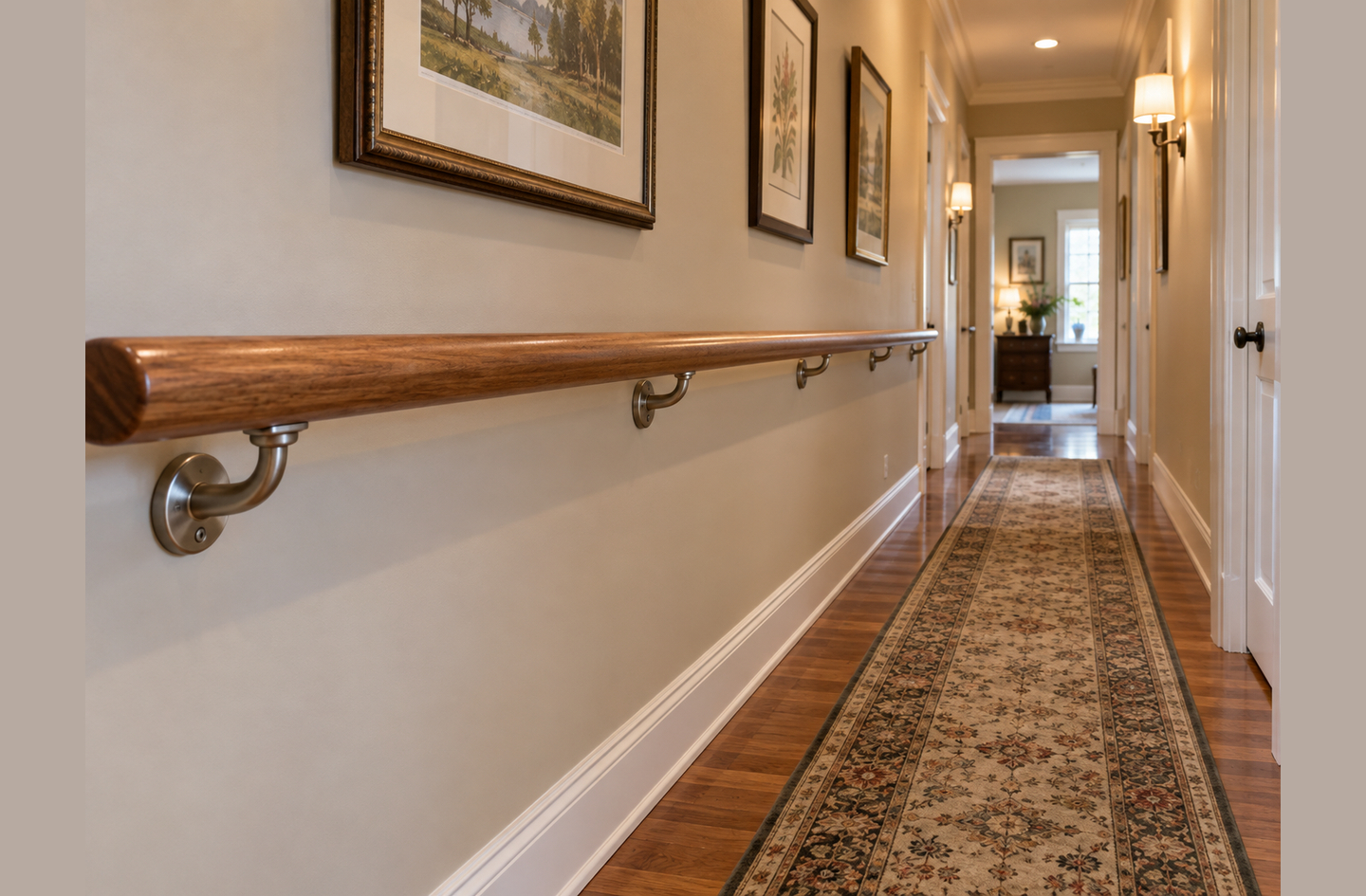
By the end of this step, the senior can walk a daily route and name its friction points without prompting. Observation, not renovation, is the method:
- Walk the most-used routes together: bedroom to bathroom, kitchen to seating area, and entry to the main living space.
- Mark every point where someone grips furniture, turns sharply, hesitates, reaches, or changes level.
- Repeat the bedroom-to-bathroom walk with only the night lighting on.
- Sort each point into “fix this week” (loose rugs, cords, clutter) or “ask a professional” (rails, steps, lighting circuits).
A structured list helps the eye during the walk. The room-by-room safety checklist covers what to look for in each space. For deciding which spots deserve attention first, the guide to high-risk areas first ranks rooms and transition points by fall exposure.
Kitchens deserve their own walk, because carrying, reaching, and wet floors combine there. The kitchen burn and fall guide covers reach zones and carrying near hot surfaces.
Verification: the senior leads a route walk and names at least three friction points before the partner points any out.
The goal of this lesson is a trained eye, not a finished house; a person who can spot the next hazard is protected after the list runs out.
Step 4: Teach the Medication Review Question
The fourth lesson is a question to ask, not a change to make alone. In a New Zealand trial of 93 adults taking psychotropic medication, gradual withdrawal under medical supervision produced a relative hazard for falls of 0.34 after 44 weeks.7 Psychotropic medicines include sleeping pills, sedatives, and antidepressants, all of which act on the brain.
“Withdrawal of psychotropic medication significantly reduced the risk of falling, but permanent withdrawal is very difficult to achieve.”
A. John Campbell and colleagues, Dunedin School of Medicine, University of Otago7
Deprescribing is the planned, supervised process of reducing or stopping a medicine when its risks have come to outweigh its benefits. It belongs to a physician or pharmacist, because stopping some medicines abruptly can cause harm of its own. The teaching goal is narrower: the senior learns to ask the question and to notice the signals.
By the end of this step, the senior has a current medication list and one clear question for their next appointment.
- List every medicine, including sleep aids, allergy tablets, and supplements bought off the shelf.
- Ask the physician or pharmacist: “Could any of these make me dizzy, drowsy, or unsteady on my feet?”
- Note any new dizziness or unsteadiness in the days after a new prescription or dose change.
- Never stop or cut a prescribed medicine without that professional’s guidance.
Partners can carry the list to appointments and write down the answers. That support keeps the senior in charge of the decision while making the follow-up easier.
Verification: the list exists, it matches the bottles in the cabinet, and the review is booked.
The trial result shows how much medicines can matter, and its own authors show why the change has to run through a prescriber rather than a kitchen-table decision.
Step 5: Teach Balance and Strength as Daily Practice
Exercise comes fifth because it takes weeks to build, not because it matters less. A Cochrane review of 108 randomized trials with 23,407 participants found that exercise reduces the rate of falls in community-dwelling older people by 23%.1 Programs combining several exercise types, most often balance and functional work plus resistance training, probably reduce the rate of falls by 34%.1
Balance and functional exercise refers to practicing everyday movements such as standing up, stepping, and turning in ways that gradually challenge balance. In the same review, this category alone reduced the rate of falls by 24%, and Tai Chi may reduce it by 19%.1 Reported adverse events were mostly minor and musculoskeletal.1
By the end of this step, the senior has a short program from a qualified leader and a daily time to do it.
- Ask a physical therapist or a recognized community class for a balance program matched to current ability.
- Practice beside a kitchen counter or other fixed support, never a chair on wheels.
- Tie the practice to an existing routine, such as the morning kettle or the evening news.
- Log sessions on a calendar so progress is visible to both senior and partner.
Support before strain is the rule. Movements should feel challenging but controlled, and any new pain, chest discomfort, or dizziness means stopping and calling a clinician.
Verification: the calendar shows practice on most days for two weeks, and the senior can demonstrate two exercises from the program.
Exercise is the lesson with the strongest evidence and the slowest payoff, so it belongs after the quick wins rather than in place of them.
Step 6: Check Every Lesson With Teach-Back and Follow-Up
The sixth step is what turns information into practice. In the hospital trial, education materials without trained follow-up left cognitively intact patients falling at 8.18 per 1,000 patient-days, while the full program with follow-up brought it to 4.01.4 The difference was the person who came back and checked.
The same principle applies at home. After each lesson, ask the senior to show or explain it again a few days later, without notes. Where the explanation is shaky, reteach that one piece rather than the whole lesson. Then revisit the full sequence after any fall, any near miss, a hospital stay, a new medicine, or a move of furniture.
Some changes need a professional rather than a refresher. Bring in a physician for new dizziness or any fall with injury, and an occupational therapist for a home assessment. A licensed contractor handles rails, steps, and wiring. Prepare the questions before hiring the professional: bring the route notes, the medication list, and the friction points already marked. To decide which of those projects to fund first, the priority-based home plan lays out a sequence for physical changes.
Verification: every lesson has passed a teach-back check at least once, and a date for the next review is on the calendar.
Follow-up is the active ingredient the trials point to, so schedule the checks before the first lesson, not after the last one.
Common Teaching Mistakes to Avoid
The most common teaching mistake is treating fall prevention as a conversation instead of a practice. The hospital trial showed that, among cognitively intact patients, education materials alone did little, with falls at 8.18 per 1,000 patient-days against 8.72 under usual care.4 Four related mistakes follow from the same root.
Teaching everything in one sitting
A single long session covering shoes, rugs, pills, and exercise leaves the learner with a general worry and no specific habit. One lesson per session, checked before the next, keeps each skill distinct and gives the senior a clear win to build on.
Talking to the partner instead of the senior
When a clinician or family member addresses the adult child while the senior sits nearby, the person who has to change the habit hears it second. Speak to the senior first, ask for their view of each route, and let the partner add observations afterward.
Handing over a pamphlet and stopping
A pamphlet can support a lesson, but it is not the lesson. The trial evidence points to trained follow-up as the piece that changed outcomes, so treat printed material as a reminder of something already practiced.
Teaching fear instead of skills
Warnings about what could go wrong tend to shrink a person’s activity, and less movement erodes the strength and balance that protect them. Frame every lesson around a skill the senior can perform, and keep the language calm and specific.
Each of these mistakes swaps a rehearsed skill for a message, which is the exact trade the trial evidence warns against.
What Success Looks Like After the Sequence
Success is visible in the home rather than in a quiz score. In the hazard removal trial, 44% of participants reported making additional changes to their homes or routines by the six-month booster.6 That kind of self-directed follow-through is the target for a home teaching sequence too.
- The phone or alarm is on the person, not on a counter.
- Indoor shoes sit by the bed every night.
- The bedroom-to-bathroom route is clear and lit, and the senior keeps it that way.
- A current medication list exists and has been reviewed by a physician or pharmacist.
- Balance practice appears on the calendar on most days.
- The senior can describe the getting-up sequence without notes.
A useful next step is a second route walk with an occupational therapist, who can judge rails, transfers, and lighting for the specific person and home.
If the habits hold for a month without reminders, the teaching has worked, whatever anyone remembers about the original session.
Frequently Asked Questions
What is the first thing to teach about preventing falls at home?
Teach how to get up from the floor and how to reach help. In a cohort of people over 90, 30% of those who fell had lain on the floor for an hour or more.2 A physical therapist can teach a getting-up sequence suited to the person.
Does fall prevention education alone reduce falls?
Not reliably. In a trial of 382 older adults, tailored education before hospital discharge left home fall rates at 5.9 per 1,000 patient-days in both groups.3 Education works better when lessons are practiced at home and checked by someone afterward.
What shoes should older adults wear at home to lower fall risk?
Closed-back shoes with firm, textured soles, similar to athletic or canvas shoes. In a case-control study of adults 65 and older, going barefoot or in stocking feet carried an adjusted odds ratio of 11.2 for a fall.5 Keep the shoes by the bed for night trips.
How much can exercise reduce falls in older adults?
A Cochrane review found exercise reduces the rate of falls by 23% in community-dwelling older people.1 Balance and functional exercises carried the strongest evidence. A physical therapist or recognized class can match a program to current ability.
Should older adults stop medicines to lower their fall risk?
Not on their own. Supervised withdrawal of psychotropic medicines produced a relative hazard for falls of 0.34 in one trial, yet its authors noted permanent withdrawal is very difficult.7 Ask a physician or pharmacist whether any medicine could cause dizziness or unsteadiness.
Limitations and Edge Cases
- The education trials enrolled cognitively able adults, and the in-hospital benefit appeared only among cognitively intact patients; with memory loss, teaching shifts toward the household and the care team.4
- The trials ran in Australia, New Zealand, the United Kingdom, and the United States, mostly with adults leaving hospital or living independently, so results can differ in other settings.
- This sequence covers what to teach and in what order, not which physical changes to fund first; that budget decision follows its own ranking by frequency, consequence, and effort.
References
Methodology: every figure in this article comes from an independent published source, each link was checked live and matched to the sentence that states the figure on October 10, 2026, and the article was written and reviewed by Home Age Fit’s founder.
- PubMed – Sherrington C, Fairhall NJ, Wallbank GK, et al. Exercise for preventing falls in older people living in the community. Cochrane Database of Systematic Reviews, January 2019.
- PubMed Central – Fleming J, Brayne C. Inability to get up after falling, subsequent time on floor, and summoning help: prospective cohort study in people over 90. BMJ, November 2008.
- PubMed – Hill AM, McPhail SM, Haines TP, et al. Falls After Hospital Discharge: A Randomized Clinical Trial of Individualized Multimodal Falls Prevention Education. Journals of Gerontology Series A, August 2019.
- PubMed – Haines TP, Hill AM, Hill KD, et al. Patient education to prevent falls among older hospital inpatients: a randomized controlled trial. Archives of Internal Medicine, March 2011.
- PubMed – Koepsell TD, Wolf ME, Buchner DM, et al. Footwear style and risk of falls in older adults. Journal of the American Geriatrics Society, September 2004.
- PubMed Central – Stark S, Keglovits M, Somerville E, et al. Home Hazard Removal to Reduce Falls Among Community-Dwelling Older Adults: A Randomized Clinical Trial. JAMA Network Open, August 2021.
- PubMed – Campbell AJ, Robertson MC, Gardner MM, Norton RN, Buchner DM. Psychotropic medication withdrawal and a home-based exercise program to prevent falls: a randomized, controlled trial. Journal of the American Geriatrics Society, July 1999.
- World Health Organization – Falls, fact sheet, April 26, 2021.
Conclusion
Fall prevention education at home works when it is taught as a sequence of practiced skills. The order runs from getting up and reaching help, through footwear and route observation, to the medication question and daily balance work. Each lesson ends with a teach-back check, because follow-up is what separated the trial that cut falls from the one that did not. Plan before the crisis, and let the senior lead.
For how these lessons fit the wider ranking of home safety work, see the fall-prevention priorities overview. Bring the route notes and medication list to an occupational therapist or physician when a decision depends on the specific person or home.