Cabinet access for seniors is mostly a question of where things sit and how they move toward the hand. In a UK interview study, 54% of older participants said reaching, bending, or standing for long periods limited how they used appliances, cupboards, and the kitchen.1 This article is one focused angle under our accessible kitchen design overview, which summarizes how to make daily cooking easier. Here the angle is storage: pull-down shelves, drawers, pulls, corner units, and reach ranges, compared side by side.
Quick Answer
What is the best way to improve cabinet access for seniors?
Move daily items into the band between hip and shoulder height first, then change the hardware that moves storage to the hand. The ADA reach range runs from 15 to 48 inches above the floor.6 Deep base drawers usually beat fixed shelves, pull-down shelves beat step stools for upper cabinets, and D-shaped pulls beat small knobs.
Key Takeaways
- Storage is the hardest kitchen job for many older adults: in a 2024 survey, getting items from upper cabinets ranked first in difficulty and lower cabinets ranked second.2
- Hand strength changes the hardware choice. Median grip strength falls from 31 kg at age 30 to 19 kg at age 80 in women.4
- Symptomatic hand osteoarthritis affected 26.2% of women and 13.4% of men aged 71 to 100 in the Framingham Study.5
- Step stools are the common workaround for high shelves, yet 75% of older step ladder users in one survey climbed with items in their hands.8
- The cheapest fix comes first: reorganizing by frequency of use costs nothing and removes most daily overhead reaching.
Why Cabinet Access for Seniors Is a Storage Problem First
Cabinet access is the effort it takes to see, reach, grasp, and lift whatever is stored in a kitchen cabinet. In a 2024 survey of older cooks in China, getting items from upper cabinets ranked as harder than stir-frying, washing dishes, or cutting vegetables.2 Getting items from lower cabinets ranked second.2
“This indicates that storage tasks are more challenging than daily tasks such as washing, cutting, cooking, and cleaning, and the difficulty of retrieving items from lower cabinets increases with age.”
Chengmin Zhou and colleagues, College of Furnishings and Industrial Design, Nanjing Forestry University, in Scientific Reports2
A UK study reached the same place from a different direction. Researchers at Loughborough University and The Open University interviewed 48 older people about their own kitchens.1 Reaching, bending, or standing for long periods limited 26 of them, or 54%.1 Limits on hand strength and dexterity affected 19 people, or 40%, and arthritis was a frequent cause.1
Those findings point to a useful way to break the problem down. Every cabinet puts four demands on the person using it: height, depth, grip, and load. Height decides whether you stretch up or stoop down. Depth decides how far you lean in. Grip decides how hard the door, drawer, or knob is to work. Load decides how heavy the thing is once it is in your hands.
Each storage product in this comparison removes one or two of those demands, and none removes all four. A pull-down shelf solves height but adds a handle to pull. A drawer solves depth but adds weight on the slides. Seeing the problem as four demands makes the trade-offs visible before anything is bought.
Before choosing any hardware, find out which of the four demands causes the hesitation, because the right product depends on that answer, not on the cabinet.
Quick Comparison of Reachable Storage Solutions
The fastest way to compare kitchen storage for older adults is by the motion each option removes. The table scores eight common solutions against the four demands of height, depth, grip, and load, plus the effort needed to install them.
| Solution | Storage zone | Motion it removes | Grip and force demand | Install effort | Best for |
|---|---|---|---|---|---|
| Reorganize by frequency of use | All cabinets | Daily overhead reaching and deep bending | None added | None: an afternoon of sorting | Everyone, as the first step |
| Pull-down wall shelf | Upper cabinets | Overhead reach and step stool use | Pull a handle down and forward | Moderate: fits inside an existing wall cabinet | Plates, mugs, and spices used daily |
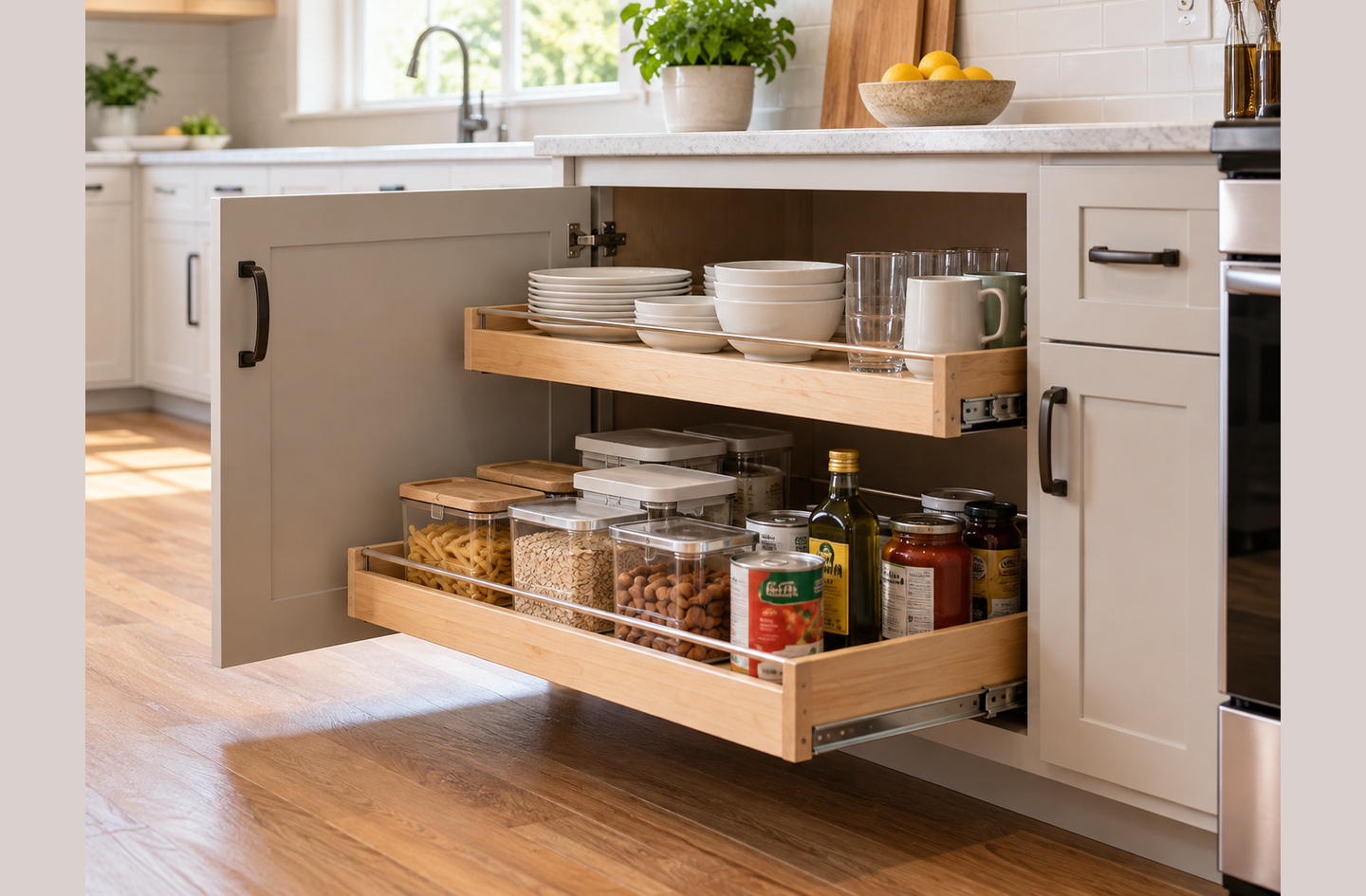
| Deep base drawers | Base cabinets | Kneeling and reaching to the back | One pull; heavy loads need full-extension slides | Moderate to high: new boxes or retrofit kits | Pots, pans, and stacked plates |
| Pull-out shelves behind doors | Base cabinets | Reaching to the back of a shelf | Two motions: open the door, then pull | Low to moderate: retrofit kits | Keeping existing doors and boxes |
| Lazy Susan | Corner base cabinet | Reaching into a corner | Light push to rotate | Low to moderate | Light and mid-weight items |
| Blind-corner pull-out | Corner base cabinet | Reaching into a blind corner | Pull and swing; heavier hardware | Moderate | Heavy pans in a blind corner |
| Pull-out pantry | Tall cabinet | Reaching past front rows | One long pull; heavy when fully loaded | Moderate to high | Cans and dry goods |
| D-shaped or bar pulls | All doors and drawers | Pinch grip and wrist twist | Whole-hand hook grip | Low: a screwdriver swap | Arthritis or reduced grip |
Options that move storage toward the person remove the most motion. The cheapest options, reorganizing and swapping pulls, still address the two most common limits in the UK interviews: reaching and grip.1
Start with the free and cheap rows of the table, then spend money only where a real friction point remains after a week of use.
Reach Ranges: Where Each Storage Zone Should Sit
The most useful single number in cabinet planning is the reach range. The ADA sets it at 15 inches minimum and 48 inches maximum above the floor for an unobstructed forward or side reach.6 Over an obstruction deeper than 20 inches, such as a standard counter, the high forward reach drops to 44 inches.6
Reach range is the band of heights a person can reach without stretching overhead, stooping low, or lifting their heels. The ADA figures were written around a seated reach, so they suit a wheelchair user and anyone who prefers to sit while cooking. The counter height and knee space guide covers the seated side in more detail. Standing older adults reach higher, but not as high as standard wall cabinets assume.
A 2024 laboratory study measured exactly that. It tested older adults taking items from a wall cabinet. The best height for the bottom shelf was 120 to 150 cm, roughly 47 to 59 inches.3 The same study set the best cabinet depth at 30 to 35 cm.3 For people shorter than 150 cm, the bottom shelf had to sit below 180 cm for normal retrieval.3
Real kitchens can sit at or above the top of that band. In the UK interviews, researchers measured wall cupboards in eight kitchens. The highest bottom shelf stood at 151.5 cm, about 5 feet, in the kitchen of a woman who was 157.5 cm tall.1 That shelf sat at roughly her eye line.
Put side by side, the seated ceiling of 48 inches6 and the standing band that starts near 47 inches3 share only about one inch. A fixed shelf height cannot serve both well. That matters in a household where one person sits and another stands. It also matters for a person whose reach changes from a good day to a stiff one.
The practical answer is to divide each cabinet run into zones:
- Prime zone: between hip and shoulder height, for anything used every day.
- Low zone: below the hip, for heavy items, but only in drawers or pull-outs that bring them forward.
- High zone: above the shoulder, for light, seldom-used items, or for storage that comes down to the hand.
When the two bands do not overlap, storage that moves, such as a drawer or a pull-down shelf, is worth more than any single shelf height.
Upper Cabinets: Pull-Down Shelves vs Step Stools
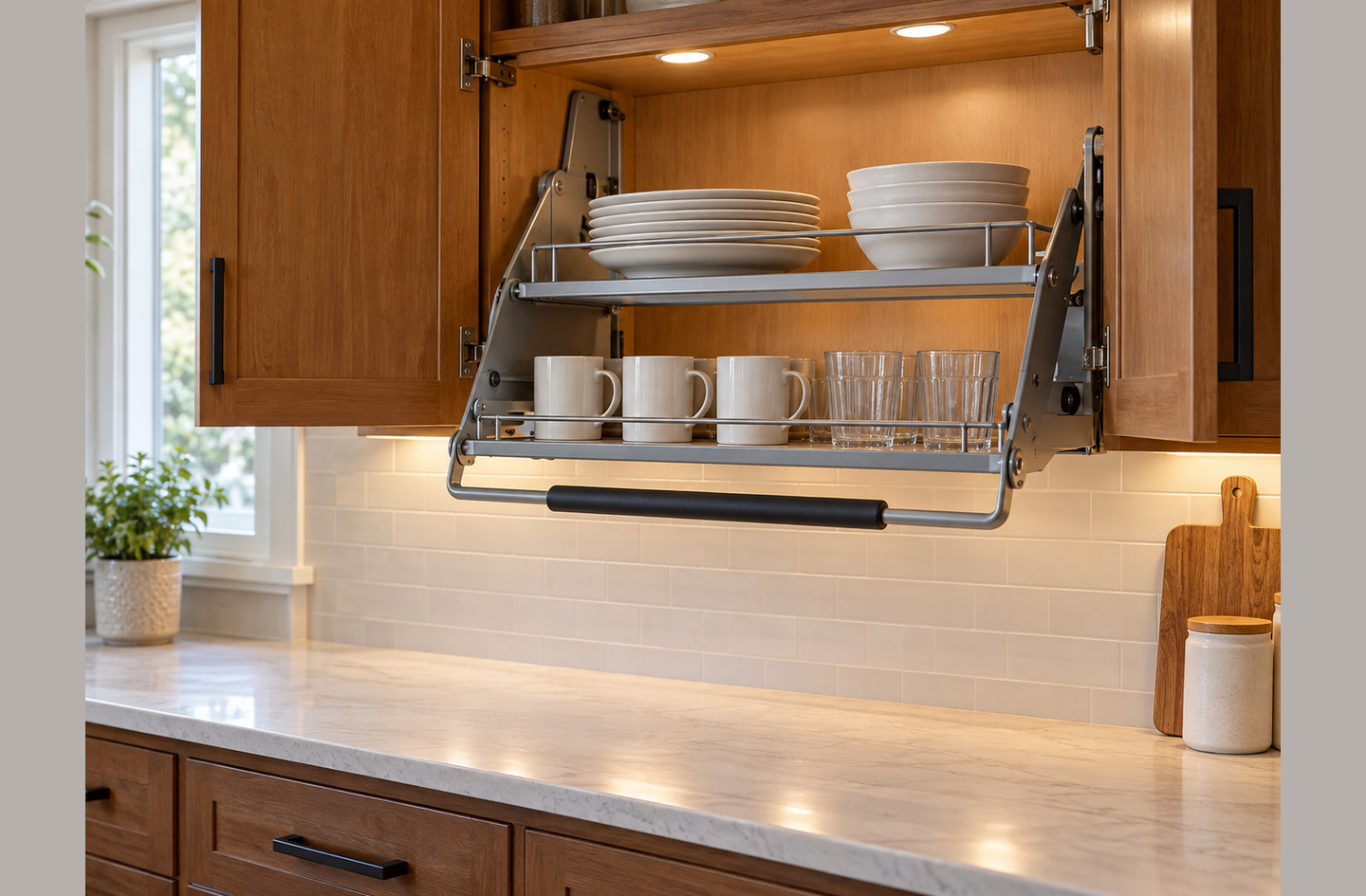
For upper cabinets, a pull-down shelf wins over a step stool. It brings the load down to the person instead of lifting the person up to the load. Step stools are the usual workaround: in an Australian survey of 102 people aged 65 and older, 61% used a step ladder at least monthly.8
A pull-down shelf is a wire or wood rack mounted on hinged arms inside a wall cabinet. A spring or gas assist helps it swing down and forward to sit near counter height. The user pulls a front handle, takes what they need, and pushes the rack back up.
The UK researchers named this option directly when they listed design responses to reaching problems.
“Adjustable wall cupboards are also available that can be pulled down and forward to more easily reach items.”
Martin Maguire and colleagues, Loughborough University and The Open University, in the International Journal of Design1
The step stool looks cheaper, but the survey shows how it is used in practice. Among step ladder users, 75% said they climbed with items in their hands.8 Overreaching while on a ladder was reported by 34%.8 Both habits fit the kitchen exactly: a stack of plates comes down from a high shelf with both hands full.
The physics explains why that pairing matters. A person on a step has a smaller base of support and a higher center of mass. Hands full of plates cannot hold a rail or the counter edge, so there is no third point of contact. Reaching sideways moves the center of mass toward the edge of the step. A pull-down shelf removes the climb, the full hands, and the reach in one change.
Pull-down shelves do have limits. They take up part of the cabinet’s interior, so they hold less than the fixed shelves they replace. Each unit has a rated load, which belongs on the label and should be checked before heavy dishes go on it. The handle still needs a firm pull, which matters for weak grip. Some cabinets are too shallow or too narrow for the mechanism.
A second option sits between the two. In the UK interviews, one participant had new wall cupboards hung lower than standard, and the researchers noted that existing cupboards could be lowered too.1 Lowering a cabinet run is a carpentry job and reduces counter workspace under it, so it suits a full remodel better than a quick fix.
Verdict: a pull-down shelf wins for daily items stored up high; a stable step with a handrail remains acceptable only for light items used a few times a year.
If someone already climbs a stool to reach daily dishes, move those dishes first and buy hardware second; the move costs nothing and removes the climb today.
Base Cabinets: Deep Drawers vs Pull-Out Shelves
For base cabinets, deep drawers win because one pull brings the whole contents into view and within reach. Fixed shelves behind doors force the opposite motion: kneeling or folding at the waist, then reaching into the dark. The 2024 Chinese study notes that retrieving items from low cabinets means frequent bending and kneeling, which loads the lower back and knees.2
The UK researchers listed drawers among their design responses. They pointed to deeper drawers that can carry the weight of plates, pans, and bowls, and to larder units with open sides that pull out.1 Most homes have not made that change. In the 2011 American Housing Survey, 15.8% of US homes had wheelchair accessible kitchen cabinets, against 51.0% with wheelchair accessible countertops.7
Full-extension slides are drawer runners that let a drawer open to its full depth, so the back row clears the cabinet face. Without them, the last few inches of a drawer stay hidden under the counter, and the person reaches in anyway. For a drawer that holds pots, full extension and a high load rating matter more than the drawer front’s style.
Pull-out shelves are the retrofit alternative. A pull-out shelf is a tray on runners that sits behind an existing cabinet door. It keeps the original boxes and doors, and kits screw into place without new cabinetry. The cost is a second motion: open the door, then pull the tray, often while bending to see the handle.
A full drawer of cast iron takes real force to pull. Put the heaviest items in the drawer closest to hip height, not the bottom one. Keep the bottom drawer for light, bulky things like baking trays. For a seated cook, the wheelchair kitchen design guide explains how drawers fit next to knee clearance.
Verdict: deep drawers on full-extension slides win for heavy daily items; pull-out shelves win when the budget or a rental agreement rules out new cabinet boxes.
The bottom drawer is still a bend, so the drawer that sits at hip height should hold whatever is used every day.
Corner Cabinets: Lazy Susan vs Blind-Corner Pull-Out
For most corner base cabinets, a lazy Susan wins because a light push brings items from the back to the front. Corners are common: in the 2024 survey, 58.06% of kitchens had an L-shaped layout and 29.03% a U-shaped layout, and both create at least one corner.2
A blind corner cabinet is a base cabinet where one side runs behind the neighboring cabinet. That leaves a deep space that cannot be seen or reached from the door. It is the hardest storage in the kitchen to use well. Without hardware, the back of it fills with things nobody can reach.
A lazy Susan, also called a carousel, is a set of round or kidney-shaped trays that rotate on a central post. The UK study pictured a carousel shelf as one way to give easier access to stored items.1 It needs very little grip, and it shows the whole contents in one turn. Trays with a raised rim stop items from falling off the back.
A blind-corner pull-out is a set of baskets that swing and slide out of the blind section, in two stages. It reaches deeper into an awkward corner than a carousel. It also asks more of the user: two pulls, more hardware weight, and a door that must open fully first.
The cheapest corner fix is to stop using the corner for daily items. Store roasting pans, holiday dishes, and spare supplies there, and keep daily pans in a drawer.
Verdict: a lazy Susan wins for light and mid-weight items; a blind-corner pull-out wins only when heavy pans must live in the corner.
A corner holding only seldom-used items needs no hardware at all, so check what lives there before buying a mechanism for it.
Handles and Pulls: Easy-Grip Hardware vs Knobs
D-shaped and bar pulls win over small knobs because they open with a hooked hand instead of a pinch and a twist. The ADA asks that operable parts work with one hand, without tight grasping, pinching, or twisting of the wrist, at no more than 5 pounds of force.6
Grip strength is the maximum force a hand can squeeze, measured with a dynamometer. It changes a great deal across adult life. In normative data pooled from twelve British studies, median grip in men fell from 51 kg at age 30 to 32 kg at age 80.4 In women it fell from 31 kg to 19 kg over the same span.4
Weak grip, defined as at least 2.5 standard deviations below the young adult peak, reached 23% of men and 27% of women by age 80.4 Joint pain adds to that. In the Framingham Study, symptomatic hand osteoarthritis affected 26.2% of women and 13.4% of men aged 71 to 100.5 People with the condition had 10% lower maximal grip and more difficulty handling small objects, with an odds ratio of 3.4.5
A small round knob is a small object. Opening a door with one means pinching it between the fingertips and pulling against the hinge or the drawer’s friction. A D-shaped pull with room for four fingers lets the hand hook through and pull with the forearm. A long bar pull goes further: it can be opened with the side of the hand or a wrist when the fingers are sore.
Other hardware choices follow the same rule. Push-to-open latches remove the pull entirely but need a firm press in the right spot. Soft-close hinges and slides lower the force needed to shut a heavy drawer. Pulls in a color that contrasts with the cabinet face are easier to find in low light.
Verdict: long D-shaped or bar pulls win on nearly every cabinet; knobs are acceptable only on light doors that are seldom opened.
Swapping knobs for pulls is the one storage upgrade that helps every cabinet at once, which makes it the best value in this comparison.
Cost and Installation Effort Compared
For a typical kitchen, the cheapest improvements are also the ones that touch the most cabinets: reorganizing costs nothing, and new pulls need only a screwdriver. Hardware that moves storage sits in the middle. Replacing cabinet boxes or lowering wall cabinets costs the most and needs a contractor.
Prices vary too much by region and brand to quote, so these tiers rank effort and disruption instead.
- No cost: move daily items into the prime zone between hip and shoulder height, and move seldom-used items up high or into corners.
- Low cost, do-it-yourself: swap knobs for D-shaped pulls, add a lazy Susan, and screw pull-out shelf kits into existing base cabinets.
- Moderate cost, handy person or installer: fit pull-down shelf units inside wall cabinets, add a blind-corner pull-out, or convert one base cabinet to drawers with a retrofit kit.
- High cost, contractor: replace base cabinets with drawer units, add a pull-out pantry, or rehang wall cabinets lower.
Hidden costs appear in the details. A pull-down unit needs a cabinet with enough interior width and depth, so measure before ordering. A retrofit drawer kit needs a face frame that clears the drawer box. Lowering wall cabinets reduces the clear height above the counter, which can block a coffee maker or a mixer.
The work also needs the right people. An occupational therapist can assess reach, grip, and balance for a specific person and suggest which zones to change first. A licensed contractor should handle any work that moves cabinets, walls, or wiring. The accessible remodel checklist helps gather those decisions before a contractor visits.
Verdict: the no-cost and low-cost tiers deliver most of the benefit; spend on moderate and high tiers only where a specific friction point remains.
A pull-down unit in a cabinet that only holds spare platters buys almost nothing, so match the spend to how often the cabinet is opened.
Who Should Choose What
The simplest rule: if the problem is height, choose storage that comes down or forward; if the problem is grip, change the hardware first. Most kitchens need a little of both. These four situations cover the common cases.
- Planning ahead while fully independent: reorganize by frequency now, swap to D-shaped pulls, and specify deep drawers in base cabinets at the next remodel. This is the cheapest point to plan, because the cabinets are being replaced anyway.
- Helping a parent who climbs a stool for dishes: ask them to show you their daily routine before suggesting anything, then move daily dishes down together. A pull-down shelf can follow for the items that must stay up high. The decision stays theirs.
- Living with arthritis or a weaker grip: start with long bar pulls and soft-close hardware, keep loaded pull-outs light, and store heavy pans in a drawer at hip height.
- Cooking from a seated position: keep daily storage inside the 15 to 48 inch reach range and favor drawers over wall cabinets.6 The guide to key accessible kitchen measurements sets out the reach and clearance numbers side by side.
Renters have fewer options but not none. Pulls, lazy Susans, and freestanding pull-out kits can be removed at move-out, which a landlord is more likely to accept. Put the plan in writing before installing anything.
The right answer depends on who opens the cabinets and how, so the best first step is watching a normal day in the kitchen: observation, not renovation.
Verdict: Category Winners for Cabinet Access
Across the six categories compared, storage that moves toward the person beats fixed storage. Hardware that suits a hooked hand beats hardware that needs a pinch. Reorganizing by frequency of use comes first because it costs nothing.
| Category | Winner | Runner-up or exception |
|---|---|---|
| Where storage sits | Daily items between hip and shoulder | Seated cooks: within the ADA 15 to 48 in range |
| Upper cabinets | Pull-down shelf | Lowered wall cabinets in a remodel |
| Base cabinets | Deep drawers on full-extension slides | Pull-out shelves for rentals and tight budgets |
| Corner cabinets | Lazy Susan with rimmed trays | Blind-corner pull-out for heavy pans |
| Handles and pulls | Long D-shaped or bar pulls | Push-to-open latches for some users |
| Cost and effort | Reorganizing and swapping pulls | Drawer conversions where bending remains |
| Overall | Reorganize, then pulls, then drawers and pull-downs | Order changes when one demand dominates |
The order matters more than any one product: free changes first, hardware second, cabinet replacement only where friction points remain.
Frequently Asked Questions
What height should kitchen cabinets be for seniors?
Daily items belong between hip and shoulder height. For a seated user, the ADA reach range runs from 15 to 48 inches above the floor.6 For standing older adults, a 2024 study put the best wall-shelf height at 120 to 150 cm.3
Are pull-down shelves worth it for older adults?
For daily items kept in wall cabinets, yes. They replace the step stool, and in one survey 75% of older step ladder users climbed with items in their hands.8 Check the unit’s rated load and the cabinet’s interior size before ordering.
What cabinet hardware is easiest to use with arthritis?
Long D-shaped or bar pulls are easiest, because they open with a hooked hand rather than a pinch. Symptomatic hand osteoarthritis affected 26.2% of women aged 71 to 100 in the Framingham Study.5 Soft-close slides lower the force needed further.
Are drawers better than shelves in base cabinets?
Usually, yes. A drawer brings the whole contents forward in one pull, while a shelf behind a door means kneeling and reaching in. Older cooks in a 2024 survey ranked lower-cabinet retrieval as their second hardest kitchen task.2
References
Methodology: every figure in this article comes from an independent published source, each link was checked live and matched to the sentence that states the figure on October 11, 2026, and the comparison was written and reviewed by Home Age Fit’s founder.
- International Journal of Design – Maguire M, Peace S, Nicolle C, Marshall R, Sims R, Percival J, Lawton C. Kitchen Living in Later Life: Exploring Ergonomic Problems, Coping Strategies and Design Solutions. Vol 8, No 1, 2014.
- PubMed Central – Zhou C, Yu R, Kaner J, and colleagues. Evaluating functional ability in older adults’ object retrieval behavior from kitchen furniture using OpenPose and REBA. Scientific Reports, October 2024.
- PubMed Central – Zhou C, Xu X, Huang T, Kaner J. Effect of different postures and loads on joint motion and muscle activity in older adults during overhead retrieval. Frontiers in Physiology, January 2024.
- PubMed Central – Dodds RM, Syddall HE, Cooper R, and colleagues. Grip Strength across the Life Course: Normative Data from Twelve British Studies. PLoS ONE, December 2014.
- PubMed – Zhang Y, Niu J, Kelly-Hayes M, Chaisson CE, Aliabadi P, Felson DT. Prevalence of symptomatic hand osteoarthritis and its impact on functional status among the elderly: The Framingham Study. American Journal of Epidemiology, December 2002.
- U.S. Access Board – ADA Accessibility Standards (2010 ADA Standards for Accessible Design), sections 308, 309 and 811.
- HUD Office of Policy Development and Research – Bo’sher L, Chan S, Ellen IG, Karfunkel B, Liao HL. Accessibility of America’s Housing Stock: Analysis of the 2011 American Housing Survey. March 2015.
- PubMed Central – Hicks C, Pliner EM, Lord SR, Sturnieks DL. Ladder Use in Older People: Type, Frequency, Tasks and Predictors of Risk Behaviours. International Journal of Environmental Research and Public Health, September 2021.
Conclusion
Cabinet access for seniors improves fastest when storage follows use: daily items between hip and shoulder, heavy items in drawers, and high items on shelves that come down. Long pulls make every one of those cabinets easier to open. The figures here describe groups, not one person, so an occupational therapist’s view of the actual reach and grip is worth having before larger work. Prepare the questions before hiring the professional.
For how storage fits the wider goal of easier daily cooking, see the accessible kitchen design overview.