
The height difference between a standard and a comfort height toilet runs 2 to 4 inches. That gap matters more than it first sounds. This article compares both heights on the specific demands of a toilet transfer. For context on bathroom transfer safety as a whole, see the toilet transfer safety overview. For anyone using a grab bar, walker, or wheelchair, those inches shift the angle at the hip, the load on the knee, and the effort of the push-up. Among all nonfatal bathroom injuries treated in U.S. emergency departments, an estimated 14.1% involve the toilet specifically, covering sitting, standing, and using it3.
Quick Answer
Which toilet height better supports transfers?
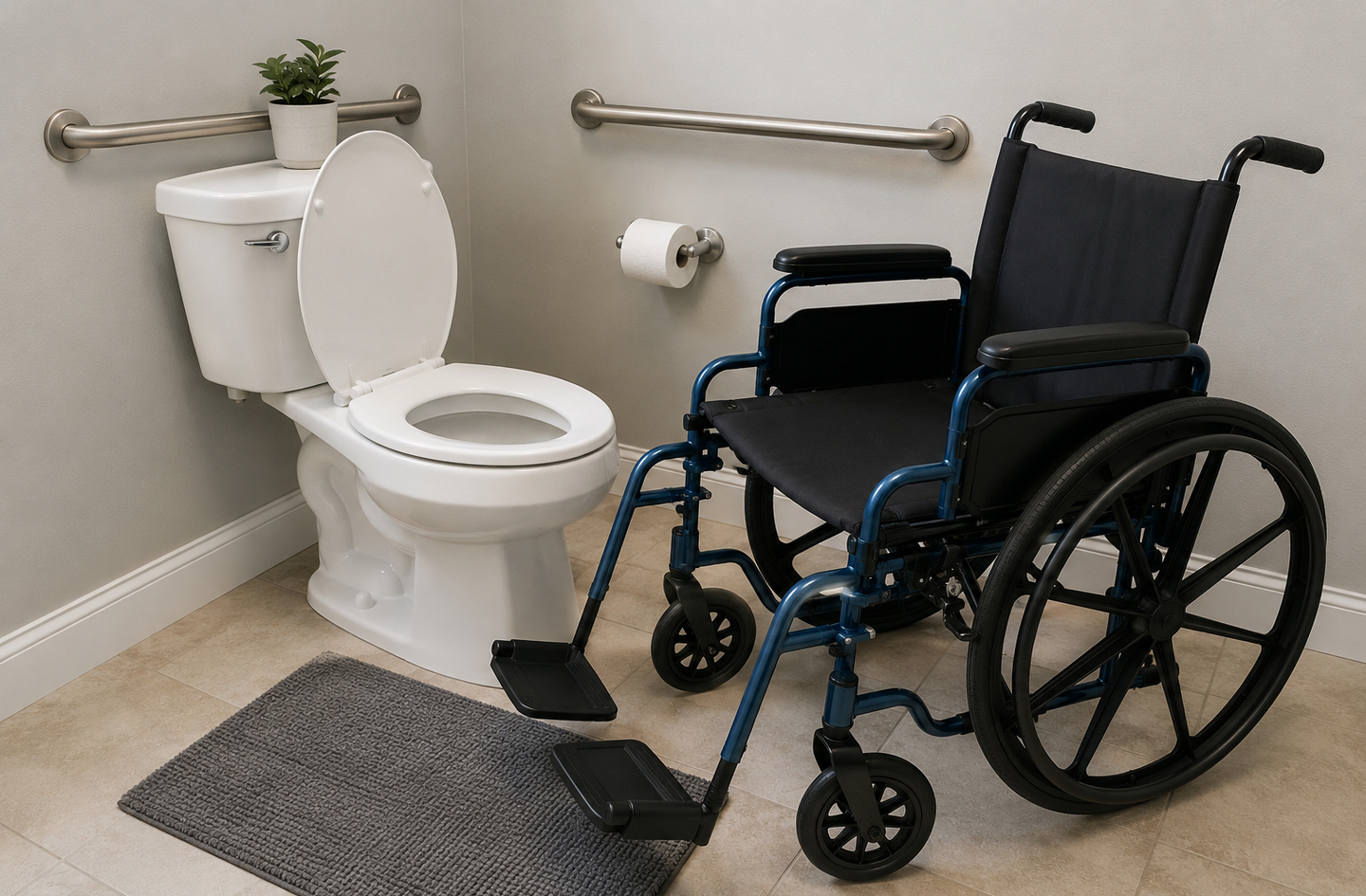
For most adults who rely on a grab bar, walker, or wheelchair for part of the transfer, comfort height (17-19 inches) reduces the depth of the sit-to-stand movement, lowers hip and knee joint loading compared to standard height, and aligns with the ADA’s 17-19 inch range for typical wheelchair seat height12. Standard height (15-16 inches) is a better fit for shorter adults and provides a seated position where both feet rest fully flat on the floor. The right choice depends on the person’s height, transfer method, and whether a wheelchair is part of the setup.
Key Takeaways
- ADA-compliant comfort height toilets measure 17-19 inches from floor to seat top. Standard residential models measure 15-16 inches1.
- Comfort height aligns with the ADA’s 17-19 inch characterization of typical wheelchair seat height, which reduces the height drop during lateral transfers2.
- A 2014 biomechanics study found peak hip and knee joint moments are 1.7 times higher at 40 cm (15.7 in) seat height than at 60 cm (23.6 in), confirming a measurable mechanical benefit of added height4.
- For adults roughly under 5’4″, a comfort height seat may hold the knees above hip level when seated, making the push-up harder rather than easier.
- A raised toilet seat riser (2-6 inches) fitted to a standard toilet can reach the same effective height without replacing the fixture.
Comfort Height vs Standard: Quick Comparison
The table below compares the two heights across the categories that matter most for a toilet transfer. Values are based on ADA standards and peer-reviewed biomechanics research.
| Category | Standard Height (15-16 in) | Comfort Height (17-19 in) |
|---|---|---|
| Seat Height from Floor | 15-16 inches (38-41 cm) | 17-19 inches (43-48 cm) |
| ADA Compliance | No | Yes (when 17-19 in) |
| Wheelchair Seat Alignment | 1-4 in below typical wheelchair | Level or near-level with typical wheelchair |
| Hip and Knee Joint Load (rising) | Higher | Lower |
| Foot Contact (average adult, 5’4″-5’10”) | Both feet fully flat | Both feet fully flat |
| Foot Contact (under 5’3″) | Both feet flat, solid grounding | Toes or ball of foot only (partial contact) |
| Seated Knee/Hip Angle | Knees near hip level or below (deeper sit) | Knees near hip level (shallower sit) |
| Lateral Transfer Direction | Downhill onto seat, uphill to return | Level or near-level both ways |
| Best For | Shorter adults, strong sit-to-stand ability | Ambulatory adults with limited knee/hip range, wheelchair users |
Height Dimensions and What They Mean
Standard residential toilets typically measure 15 to 16 inches from the finished floor to the top of the seat. This figure is an industry manufacturing convention, not a code-mandated minimum for non-accessible installations. Comfort height toilets, sold under names like “chair height” or “ADA height,” measure 17 to 19 inches, as required by Section 604.4 of the 2010 ADA Standards for Accessible Design1. The practical gap between the two ranges is 1 to 4 inches, depending on which models you compare.
What the seat height number actually measures
Manufacturers quote toilet rim height, which is the distance from the floor to the top of the porcelain bowl before the seat is installed. The seat itself adds roughly 1 to 1.5 inches. A comfort height toilet advertised at 16.5 inches of rim height will sit at approximately 17.5 to 18 inches once the seat is on. Always measure the full seated height in place, not just the bowl dimension on the packaging.
The bowl shape affects sitting position but not seat height. Elongated bowls add 1 to 2 inches of front-to-back length compared to round bowls, which changes how far forward the user sits. That is a separate dimension from height and does not affect the sit-to-stand mechanics covered in this article.
Why the ADA chose 17-19 inches
The ADA did not arrive at 17-19 inches arbitrarily. The standards team modeled seat height against the typical seated height of a wheelchair user during transfer and against the force demands of the sit-to-stand transition for people with limited hip, knee, and ankle range of motion. The result was a floor of 17 inches (enough to reduce transfer strain for most wheelchair users) and a ceiling of 19 inches (past which shorter ambulatory users begin losing foot contact).
Standard height toilets at 15-16 inches were designed for the average ambulatory user with no particular mobility constraint. They serve that use case well. They were not designed with wheelchair transfers or limited joint range in mind, and the height difference shows up clearly in biomechanics research.
Measuring your actual toilet before deciding
If you are weighing a toilet replacement against a riser accessory, measure the seated height of your current toilet with its seat installed. Place a level board across the seat and measure from the floor to the board. That number is your baseline. If it is 15 inches and you want to reach 17 inches, a 2-inch riser does the job without a renovation. If the current height is 13 inches (some older low-profile models), you need at least a 4-inch riser or a replacement to reach the ADA floor.
Sit-to-Stand Mechanics and Joint Load
A toilet transfer involves two phases with different demands on the body. Lowering to sit requires controlled deceleration against gravity. Rising to stand requires generating enough force at the hip and knee to push the body weight upward and forward. The rising phase is where seat height matters most for people with limited joint capacity.
What the biomechanics research shows
A 2014 study published in BioMedical Engineering OnLine by Yoshioka and colleagues directly measured peak hip and knee joint moments across multiple seat heights. At 40 cm (roughly 15.7 inches, close to standard height), peak joint moments were 1.7 times higher than at 60 cm (roughly 23.6 inches, a high seat)4. The study also found that within the range of standard to low height (10 to 40 cm), moment differences were not statistically significant, meaning the main mechanical advantage appears in the transition from standard height upward toward higher seating.
This places the comfort height range (17-19 inches, roughly 43-48 cm) in the zone where each added inch delivers a measurable reduction in the joint work required to stand. The benefit is not large in absolute terms for a healthy adult. For a person managing limited knee flexion, hip replacement recovery, or reduced lower-limb strength, it changes the difficulty level of every single transfer.
Muscle activation at raised seat height
A 2025 study in Medicine (Baltimore) by Noroozi and colleagues measured surface electromyography (EMG) during toilet sit-to-stand transfers in older adults. They compared standard seat height against a raised seat condition and a bar-assisted condition. The results showed a clear pattern:
“Raising the seat reduced EMG activity in VM, TA, and calf muscles.”
Noroozi S et al., Medicine (Baltimore), 20255
VM refers to the vastus medialis (part of the quadriceps). TA is the tibialis anterior (the shin muscle that stabilizes the ankle and foot during the push-up). Lower activation in these groups means the body is working measurably less hard. For a person who also grips a grab bar or walker arm for partial support, this reduced muscle demand can represent the gap between a controlled transfer and one that requires full upper-body compensation for a depth the legs cannot manage on their own.
The lowering phase: a different demand
Rising from a comfort height toilet requires less joint force. Lowering to a comfort height toilet, however, means controlling the body over a greater vertical distance than lowering to standard height. For a person with poor balance or asymmetric leg strength, the longer controlled-lowering distance from comfort height can feel less stable, not more.
This is where grab bars serve a role the toilet height itself cannot. A well-positioned bar lets the person use upper-body support to control the descent while the lower body handles less of the eccentric load. Seat height reduces the load at the bottom of the transfer. A grab bar manages the controlled descent from the top. Both matter and they work together.
Foot Contact, Seated Angle, and Body Position
The ability to push up from a toilet seat depends partly on where the feet are when the push begins. Full-foot contact with the floor gives the body a stable platform to push from. Partial contact (toes only, or ball of foot) reduces that platform and shifts more of the work to the upper body and grab bar.
Who keeps full-foot contact on comfort height
For adults of average height (roughly 5’4″ and taller), a comfort height seat of 17 to 19 inches allows both feet to rest fully flat on the floor. The knees sit close to or at hip level, which is a mechanically favorable starting position for standing. The push-up angle is direct, and no excessive hip flexion needs to be cleared before the body can move forward and upward.
For adults around 5’0″ to 5’2″, the picture changes. On a 19-inch comfort height seat, only the toes or ball of the foot may reach the floor. The heel is suspended. This reduces the push-off base and can make rising feel less controlled, not more. A shorter person on a comfort height toilet may actually find it harder to stand than on a standard height seat, even though the standard height requires more joint range of motion at the hip and knee.
Standard height and the deeper seated angle
Standard height (15-16 inches) places most adults with both feet flat and knees bent past 90 degrees. The thighs slope downward toward the floor. This deeper seated angle demands more hip and knee extension to stand from, which is why it is harder for people with limited joint range or reduced lower-limb strength.
The advantage of the deeper angle: it provides a stronger pre-load position for people with intact strength. Some people find they push up more powerfully from a lower seat because the leg muscles begin in a more stretched, force-generating position. For an ambulatory adult with good strength and no mobility limitation, standard height often feels perfectly natural and may even feel more stable due to the deeper foot-to-floor contact.
The step stool fix for shared setups
When a household installs a comfort height toilet for someone who needs it, shorter household members can use a small step stool to restore full-foot contact. A 2-inch stool under the feet on a 19-inch seat brings the effective seated angle closer to standard height while keeping the toilet at comfort height for the person who benefits from it. This is one of the cleaner solutions for mixed-height households, though the stool must be positioned reliably and not create a trip hazard during the transfer itself.
Wheelchair-to-Toilet Lateral Transfers
For a wheelchair user, the toilet transfer is typically a lateral slide rather than a seated-to-standing movement. The mechanics of a lateral transfer depend heavily on the height difference between the two surfaces being transferred between.
Why height alignment matters for lateral transfers
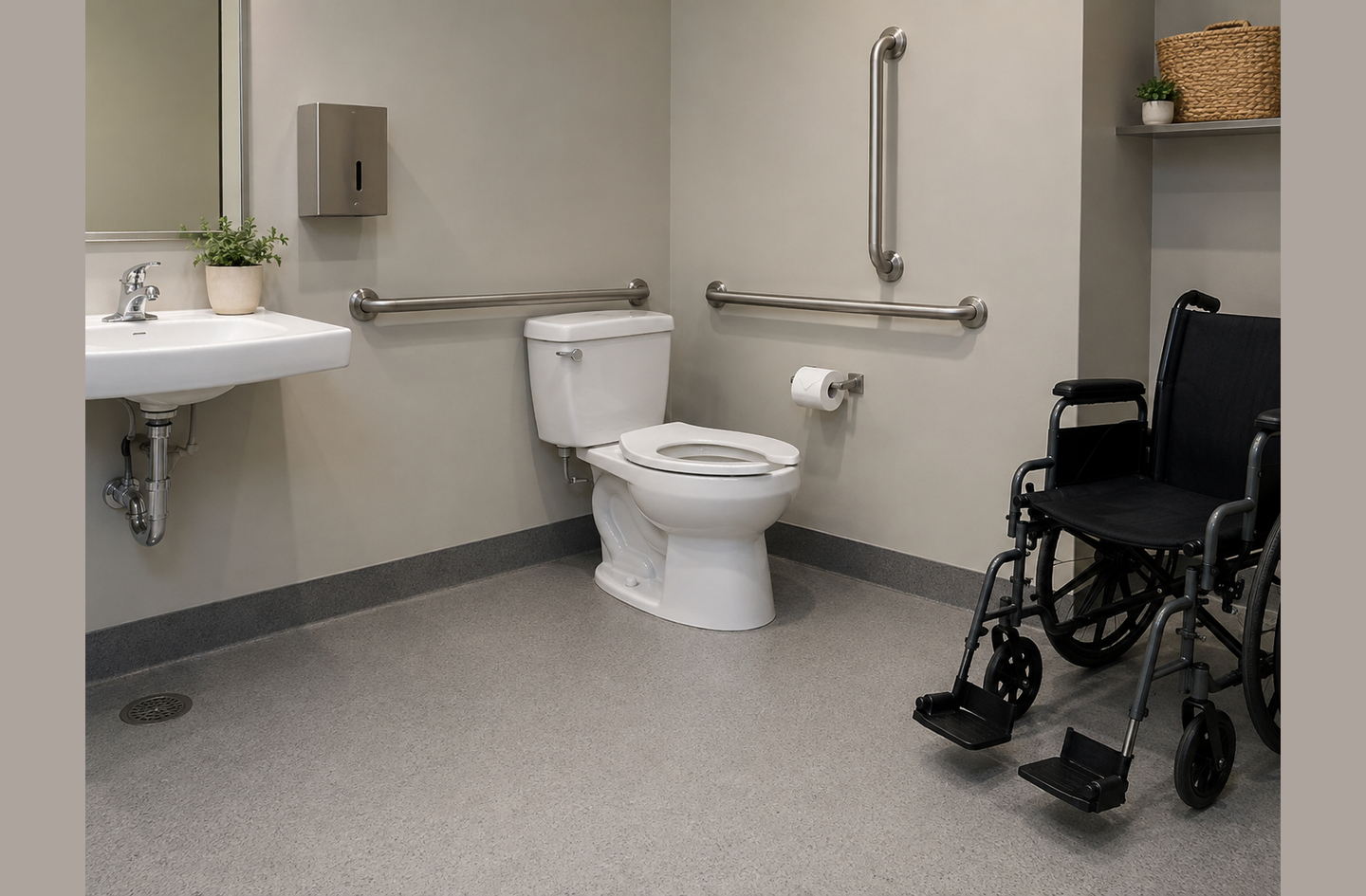
The U.S. Access Board describes the typical wheelchair seat height as 17 to 19 inches from the floor, the same range it uses to set the ADA toilet seat height requirement2. This alignment is deliberate. When both surfaces sit at roughly the same height, a lateral transfer can proceed along a near-level plane. The person slides sideways with minimal uphill or downhill component to the movement.
A standard toilet at 15-16 inches sits 1 to 4 inches below a typical wheelchair seat. Transferring onto a lower surface means sliding downhill and then pushing back uphill on the return. The uphill return is the harder direction. It requires sustained arm and shoulder strength against gravity, and it increases the window of instability during the move. A comfort height toilet at 17-19 inches closes or eliminates that height gap for most standard manual wheelchair users.
Other factors that determine a safe wheelchair transfer
Seat height is one factor in a working transfer setup. Three others matter equally: floor clearance on the transfer side (roughly 18 inches for the wheelchair to pull alongside), the grab bar configuration (a fold-down bar on the transfer side gives a grip point after removing the wheelchair arm), and the toilet’s position relative to the wall. A comfort height toilet in a bathroom with inadequate clearance is less useful than a well-configured standard height toilet. An occupational therapist can assess your specific bathroom and wheelchair combination.
Power wheelchairs and non-standard seat heights
Standard manual wheelchairs typically land within or near the 17-19 inch range. Power wheelchairs, tilt-in-space chairs, and custom seating systems can sit above that range, sometimes at 21 inches or higher. When the wheelchair seat is above 19 inches, the toilet is now the lower surface and the return transfer goes uphill. In those cases, a riser set to match the wheelchair seat height is more useful than a fixed comfort height toilet. A certified seating specialist who measures both surfaces can identify the most level configuration.
Shared Household Use
Most homes have one toilet per bathroom. When that toilet must serve multiple people with different heights and mobility needs, height becomes a trade-off rather than a clean optimization. The question is which user’s need is greater.
When the needs point in opposite directions
A common household scenario: one adult needs supported transfers and benefits from comfort height; another adult is shorter (say, 5’2″) and has no mobility limitation. The shorter person can use a comfort height toilet without difficulty. They will not fall or be unable to use it. But foot contact may be partial, and the seated angle may feel slightly unnatural.
The reverse is a harder problem. A standard height toilet that works well for the shorter adult forces the person with limited mobility into the more demanding seated depth every time they use it. The cost of standard height falls entirely on the person with the greater physical challenge.
For households where one person has a genuine transfer need, the practical direction is: install comfort height, add a step stool for shorter household members who want full-foot contact, and confirm the grab bar configuration supports the person who needs it. The step stool is a minor adjustment. The transfer difficulty is not.
When everyone is shorter
If all household members are roughly under 5’3″ and none has a wheelchair or limited joint range, standard height may serve the household better. The deeper seated angle is easier from that height for people with good leg strength. Adding a raised toilet seat or frame as a specific person’s needs change is a reasonable incremental step, and it is reversible without any renovation.
The chair-stand impairment rate among U.S. adults aged 65-69 is 42.4%, based on nationally representative data from the 2024 National Health and Aging Trends Study6. Chair stand impairment is not unique to people who currently use wheelchairs or walkers. It is common in the general older adult population, which means the question of toilet height often becomes more relevant for people who do not yet think of themselves as needing it.
Adjustable Alternatives to a Permanent Replacement
Replacing a toilet is a permanent decision, a real renovation cost, and a physical change that affects everyone in the household. Two accessory options can approximate the comfort height effect without replacing the fixture, and both are worth understanding before committing to a new toilet.
Raised toilet seat risers
Raised toilet seat risers clamp to or sit on top of the existing toilet and add 2 to 6 inches of height. A 2-inch riser on a 15-inch standard toilet brings the total to 17 inches, the ADA floor. A 3-inch riser on a 16-inch standard toilet reaches 19 inches, the ADA ceiling. Most risers are tool-free and removable, which makes them reversible and transferable between bathrooms.
The limitations of a riser: it adds height without changing the toilet’s other dimensions, so the seat may feel narrower or the front edge may shift slightly. Some risers fit loosely on the bowl and can shift under load if not tightened properly. Models with integrated padded armrests on either side add a gripping surface during the push-up, which is useful when wall-mounted grab bars are not yet installed. When choosing a riser, confirm it is compatible with the bowl shape (round versus elongated) and that the attachment mechanism locks securely for the user’s weight.
Toilet safety frames
A toilet safety frame is a freestanding structure that wraps around the toilet and provides gripping arms at roughly armrest height. It does not change the seat height but gives the user a push-off surface during sit-to-stand. For a person whose main challenge is gripping something solid during the push-up, a safety frame on a standard height toilet can be more useful than a comfort height toilet with no gripping surface nearby.
Floor-based safety frames with four legs are more stable than models that attach only to the toilet bolts. Height concern: use a riser. Gripping concern: use a frame. Both: use a riser with integrated arms. Contractor labor for a toilet replacement typically runs $150 to $400, so the accessory route is worth testing first when the underlying fixture is otherwise sound.
When replacement is the better answer
A full replacement makes sense when the existing fixture is nearing end of life, when the riser height needed exceeds 5-6 inches (past which most risers feel less stable), or when the bathroom is being renovated and setting the correct permanent height costs no extra work.
Who Should Choose Which Height
If you are managing limited knee or hip range of motion, comfort height reduces the depth of the seated position and the joint load of the push-up. If you are shorter than 5’3″ and live alone with good mobility, standard height likely serves you better.
Below are four profiles that cover most of the common scenarios.
Ambulatory adult with limited knee or hip range
Choose comfort height. The shallower seated position reduces the range of motion demanded at the hip and knee, and the shorter travel distance to standing lowers peak joint load on every transfer. Without grab bars yet installed, pair the comfort height toilet with a riser that has integrated arms.
Wheelchair user doing lateral transfers
Comfort height is the starting point, but the exact height depends on the wheelchair’s actual seat height, not on the ADA range alone. Measure the wheelchair seat height from the floor to the top of the cushion. Set the toilet (or riser) to match that number as closely as possible. A level surface in both directions is the goal. If the wheelchair seat is above 19 inches, a riser or adjustable toilet is more useful than a fixed comfort height fixture. Have an occupational therapist or certified seating specialist confirm the configuration before finalizing.
Shorter adult (under 5’3″) living alone, no mobility limitation
Standard height is likely the better fit. Full-foot contact on the floor gives you a more solid push-off base, and the deeper seated angle is manageable for someone with good lower-limb strength. When your needs change, a 2-4 inch riser brings a standard toilet to comfort height territory without a renovation. Plan for that adjustment before you need it; adding a riser later is easy, and removing one is just as easy.
Mixed-height household where one person has a transfer need
Install comfort height and add a step stool for shorter household members. The person with the transfer need benefits from the higher seat on every use. The shorter household member manages fine on comfort height and can use a 2-inch stool to restore full-foot contact if the angle feels awkward. Prioritize the setup that reduces risk for the person with the greater physical challenge; the inconvenience cost for a non-impaired user adjusting to comfort height is minor.
Frequently Asked Questions
Is a comfort height toilet better for seniors?
For most adults with limited knee or hip range of motion, yes. Comfort height (17-19 inches) reduces the depth of the seated position and lowers joint load on the push-up4. For shorter seniors (under 5’3″ or so), standard height may produce a more natural angle with better foot contact. The right choice depends on the person’s height, mobility status, and whether a wheelchair is involved.
What is the ideal toilet height for wheelchair users?
The ADA Standards set 17-19 inches as the accessible toilet seat height range, based in part on the typical wheelchair seat height of 17-19 inches described in ADA advisory guidance12. The ideal is a toilet seat that matches the specific wheelchair seat height as closely as possible so the lateral transfer can proceed on a level plane. Measure the actual wheelchair seat height from the floor to the top of the cushion before choosing a toilet height.
Can a shorter adult use a comfort height toilet comfortably?
Yes, with an adjustment. Adults under 5’3″ may have only partial foot contact on a 19-inch seat. A 2-inch step stool restores full-foot contact and brings the seated angle closer to standard height. Most shorter adults adapt without difficulty. The position is slightly less deep, and the reduced joint range required makes the push-up mechanically easier.
Does a raised toilet seat achieve the same effect as a comfort height toilet?
For height, yes. A 2-inch riser on a 15-inch toilet reaches 17 inches (ADA minimum). A 3-inch riser on a 16-inch toilet reaches 19 inches (ADA ceiling). A riser adds height but not seat width, and some models shift slightly under load. For a long-term installation, a comfort height toilet is more stable. For a reversible interim, a quality riser with a locking clamp works well.
How much does toilet height affect hip and knee strain during transfers?
The difference is measurable. Research published in BioMedical Engineering OnLine found peak hip and knee joint moments at standard seat height (roughly 40 cm / 15.7 in) were 1.7 times higher than at an elevated seat height of 60 cm (23.6 in)4. The comfort height range (17-19 in / 43-48 cm) sits between those two reference points, in a zone where each added inch reduces joint loading. For people with already-stressed knees or hips, that reduction is meaningful across the dozens of transfers that happen each week.
Limitations and Edge Cases
- The biomechanics data in this article comes from laboratory sit-to-stand studies using chairs or simulated toilet conditions, conducted with specific age and weight ranges. Individual results vary based on lower-limb strength, balance, and assistive device use. An occupational therapist can evaluate the specific transfer for a specific person.
- Wheelchair seat heights vary widely. The 17-19 inch ADA advisory range covers standard manual wheelchairs. Power chairs, tilt chairs, and custom seating systems can sit above or below that range, changing the height math for lateral transfers entirely.
- This article covers seat height only. Grab bar placement, floor clearance for wheelchair approach, and toilet position relative to the wall are equally important transfer factors and are addressed in the toilet transfer safety overview.
References
- U.S. Access Board – 2010 ADA Standards for Accessible Design, Section 604.4: Seats. Water closet seat height shall be 17 inches (430 mm) minimum and 19 inches (485 mm) maximum above the finished floor, measured to the top of the seat. Effective March 15, 2012.
- U.S. Access Board – ADA Guide, Chapter 8: Special Rooms, Spaces, and Elements. Advisory Section 803.1 characterizes typical wheelchair seat height as 17 inches (430 mm) to 19 inches (485 mm). Current edition.
- Centers for Disease Control and Prevention (CDC) – Morbidity and Mortality Weekly Report, Vol. 60, No. 22, June 10, 2011. “Nonfatal Bathroom Injuries Among Persons Aged 15 Years – United States, 2008.” Reports 14.1% of bathroom injuries involved standing up from, sitting down on, or using the toilet.
- BioMed Central – BioMedical Engineering OnLine – Yoshioka S, Nagano A, Hay DC, Fukashiro S. “Peak hip and knee joint moments during a sit-to-stand movement are invariant to the change of seat height within the range of low to normal seat height.” BioMedical Engineering OnLine. 2014;13:27.
- Wolters Kluwer – Medicine (Baltimore) – Noroozi S, Weyand S, Smart R, Jakobi JM. “Impact of seat height and grab bars on postural stability and muscle activity of older females standing from a toilet.” Medicine (Baltimore). 2025 Mar 14. DOI: 10.1097/MD.0000000000041856.
- PubMed Central – “Population Prevalence of Motor Function Impairments in US Older Adults.” National Health and Aging Trends Study, Round 12, 2024. Reports chair stand impairment in 42.4% of adults aged 65-69 years. PMC11690251.
Conclusion
Comfort height (17-19 inches) and standard height (15-16 inches) are not universally interchangeable. For a person with limited knee or hip range of motion, comfort height reduces joint load on every transfer and aligns the seat with the typical wheelchair height for lateral slides. For a shorter adult with full mobility and good leg strength, standard height may produce a more natural seated angle with better foot contact. Neither height is the correct choice for all users, which is why measuring the person and the wheelchair (when relevant) before deciding matters more than choosing a category.
For the full picture of what makes a toilet transfer safer, including grab bar placement, floor clearance, and approach angles, see the toilet transfer safety overview for the full picture.