Quick Answer
When should an older adult stop using stairs?
Stopping is a decision for a personal functional evaluation, not for an article or a birthday. The trigger for that evaluation is a repeating pattern: slowing at the same step, changing the method of climbing, resting partway, or a fall or near miss. Self-reported difficulty climbing both up and down stairs was tied to more than six times the odds of activity limitations in one study2. Before giving up a floor, compare three levers with a professional: fewer trips, essentials moved to the entry level, and specialist-assessed access options.
There is no age at which a staircase stops being usable, so the search “when should seniors stop using stairs” is answered by a pattern, not a birthday. The useful signals are recurring hesitation, changes in how the stairs are climbed, fatigue, near misses and falls. In one cohort of women aged 70 to 80, changing how a task was done meant three- to fourfold higher odds of later difficulty climbing stairs1. This spoke sits under the aging in place stair safety overview and turns those signals into an ordered plan.
Key Takeaways
- Changing how a task is done comes before difficulty: women who modified a task had odds of later stair difficulty about 3.84 times higher1.
- Going up and going down are separate signals: of 310 older adults without disability, 140 reported difficulty climbing up and 83 reported difficulty climbing down2.
- Stopping abruptly is not a neutral choice, because severe activity restriction from fear of falling predicted faster loss of lower-limb performance over three years4.
- Many homes can support a one-floor routine. In 2011 survey data covering all US housing units, 76.3% had a bedroom on the entry level and 87.7% had a full bathroom there5.
- The common misconception is that the choice is “stairs or no stairs.” Fewer trips, relocated essentials and assessed access options sit between those two ends.
- This is engineering-informed education, not medical or occupational therapy advice; the decision for a specific person belongs with a physician or occupational therapist.
Before You Begin: When Should Seniors Stop Using Stairs, and Who Decides?
The person who uses the stairs makes the decision, with a clinician’s evaluation behind it. A family member can observe, record and ask good questions, but cannot see balance, strength or blood pressure from the hallway. Stairs place combined demands on muscles, the heart, vision, balance and the sense of where the feet are. A 2000 review reported stair falls as more than 10% of fatal fall accidents7. That combination is why a staircase deserves a plan instead of a guess.
A functional evaluation is an in-person assessment of how a specific person performs real tasks, such as climbing a flight, carrying a load or turning on a landing. A physician, physical therapist or occupational therapist performs it. This framework does not replace that visit. It prepares for it, so the visit starts with two weeks of evidence instead of a vague worry.
What to have ready before starting:
- A notebook or a phone note kept near the stairs, used for two weeks.
- Agreement on who leads: the older adult records their own trips, and a caregiver adds observations only with their consent.
- A rough floor plan showing where the bedroom, full bathroom, laundry and kitchen sit relative to the stairs.
- A list of current health providers, so the evaluation request goes to the right person.
When memory or orientation is changing, the questions shift toward supervision, night routes and exit paths. Those are covered in the dementia stair safety guide, and this framework assumes the person can take part in the decision.
The order matters more than any single answer: observe first, evaluate second, and change the house third, so each step rests on evidence from the one before it.
Step 1: Notice the Signs Stairs Are Too Difficult
The earliest sign that stairs are becoming too difficult is usually a change in method, not a fall. In a Baltimore cohort, 11.7% of women with no mobility difficulty at the start reported new difficulty climbing ten steps within eighteen months1. The women who had already changed how they did a task were far more likely to be in that group.
Task modification is a change in the way a person does an activity while still reporting no difficulty. Leading with the same leg every time, or pulling hard on the rail, are typical examples. For climbing stairs, that self-reported modification carried an odds ratio of 3.84 for later difficulty1. It is the signal a family most easily dismisses, because the person still gets to the top.
| Signal | What it looks like on the stairs | Why it is worth recording |
|---|---|---|
| Recurring hesitation | Pausing at the same step, landing or turn on most trips | A fixed location points to a home factor or a specific movement |
| Changed method | One step at a time, sideways descent, two hands on one rail | Task modification predicted later stair difficulty |
| Fatigue | Resting partway, breathlessness at the top, fewer trips late in the day | Climbing uses a large share of available leg strength |
| Falls and near misses | A missed step, a catch on the rail, a slide on the last tread | Any fall is a reason to ask for a falls risk assessment |
| Transfer limits | Trouble with the turn at the top, or with carrying while holding on | Shows which access options would or would not fit later |
Going up and going down are different tasks, so record them separately. Among 310 adults with a mean age near 80, 140 reported difficulty climbing up and 83 reported difficulty climbing down, while 59 had both2. People with difficulty going down had more falls in that study. Descent problems deserve the closer look, even when they seem less common.
Relative effort is the share of a person’s maximum muscle strength that an everyday task uses. In a laboratory study, healthy adults with a mean age of 74 used about 78% of their maximum knee capacity to climb stairs and 88% to descend. Young adults used 54% and 42%3. That small reserve explains why fatigue late in the day can turn a routine trip into a hard one.
If the main pattern is a struggle on the way down, the stair descent home factors checklist helps separate lighting and step problems from changes in strength.
A single hard day is noise; the same hesitation on the same step, repeated across the log, is a signal worth taking to a professional.
Step 2: Keep a Two-Week Stair Log
A two-week stair log turns impressions into a record a clinician can use. It answers three questions that memory answers badly: how many trips happen, when they happen, and what is carried. The log also protects the senior’s voice, because it is their own account of their own routine.
For each trip, record five things in a few words:
- Direction and time of day, such as “down, before breakfast.”
- Purpose: laundry, bathroom, bedroom, mail, a forgotten item.
- What was carried, and whether one hand stayed free for the rail.
- Where on the flight the person slowed, stopped or reached for support.
- How the person felt at the top: fine, winded, shaky or needing a rest.
The log usually shows that trips cluster around a few purposes. Count the round trips, then group them by purpose. Each round trip is two flights, one up and one down, and in laboratory measurements the descent used a higher share of knee strength3. A home with eight round trips a day asks for sixteen flights. If staging items in a basket by the stairs cuts that to three round trips, ten flights disappear without any construction.
If you are the one using the stairs, the log is your evidence, and it keeps the conversation about your routine on your terms. Caregivers can help by noting what they see during visits, with permission, and by leaving the interpretation to the evaluation. A parent who says they are fine while holding the wall is giving two pieces of information, and both belong in the log.
The log is the cheapest intervention in this framework, because it often shows that most stair trips serve two or three purposes that can be moved.
Step 3: Get a Personal Functional Evaluation
The World Guidelines for Falls Prevention recommend that older adults at high risk of falling be offered a multifactorial falls risk assessment, with personalized interventions designed together with them8. A recorded fall, repeated near misses or a clear change in method are reasons to ask a physician for that assessment. An occupational therapist adds the home side: how this person moves on this particular stair.
A multifactorial falls risk assessment is a structured review of several causes at once, such as strength, balance, medications, vision, blood pressure and the home itself. It matters for stairs because a single cause rarely explains a hard flight. A medication change can explain dizziness at the top, while a weak knee explains the slow descent.
“Difficulty in both climbing up and down stairs should be separately assessed to better capture clinical and functional status in older adults.”
Verghese J, Wang C, Xue X and Holtzer R, Department of Neurology, Albert Einstein College of Medicine, Archives of Physical Medicine and Rehabilitation2
Bring the two-week log, the floor plan and a short list of questions to the appointment. Useful questions include: Is the difficulty mainly strength, balance, vision, breathing or pain? Is it likely to improve with treatment or exercise? Which trips are reasonable to keep, and which should be reduced? Is the turn at the top a concern for any future seated option?
The clinician may recommend exercise, a medication review, a vision check or a home visit. None of these is a verdict on the stairs by itself. Each is a reason to revisit the log after the change and see whether the pattern moves.
The evaluation should decide whether the stairs stay part of the routine; the home changes in the next three steps decide how much of the routine still needs them.
Step 4: Reduce Stair Travel Before Removing It
Reducing the number of stair trips lowers daily exposure while keeping the second floor, and the exercise of climbing, in the routine. Avoiding stairs while aging in place works best as a gradual, planned change. Stopping overnight, out of fear, carries a documented risk.
In an Italian cohort of 673 older adults with a fear of falling, 59.6% restricted or avoided fewer than three activities and 14.9% restricted or avoided three or more4. Severe restriction independently predicted worsening daily-living disability and faster loss of lower-limb performance over three years. That study measured activity restriction in general rather than stair use, but it is a reason to plan any reduction instead of stopping abruptly. The same global guidelines advise all older adults on physical activity as well as falls prevention8.
“Locomotion on stairs is among the most challenging and hazardous activities of daily living for older individuals.”
Startzell JK, Owens DA, Mulfinger LM and Cavanagh PR, Center for Locomotion Studies, Penn State University, Journal of the American Geriatrics Society7
That tension is the reason for trimming trips rather than ending them. Practical ways to cut flights per day, matched to the trip purposes in the log:
- Keep a staging basket at the foot and the top of the stairs, and move items in one planned trip instead of several.
- Duplicate small daily items on each floor: glasses, a phone charger, toiletries, a water glass and a notepad.
- Schedule the necessary trips for the time of day the log shows the most energy, which for many people is the morning.
- Carry only what leaves one hand free for the rail, and send heavy loads such as laundry up with a visitor.
- Keep a phone on each floor, so no one hurries up or down to answer it.
Repeat the log for a week after these changes. A drop in flights per day, with the hesitation points unchanged, tells the evaluation team that the trouble is the stair itself rather than the volume.
Fewer, better-planned trips keep the stairs as a choice rather than a daily obligation, which protects both strength and confidence.
Step 5: Relocate Essentials to the Entry Level
Moving the daily essentials to the entry level is often the highest-impact lever, and national housing data suggest it is frequently possible. In a 2015 HUD analysis of 2011 survey data, 76.3% of all housing units had a bedroom on the entry level and 87.7% had a full bathroom there5. Among owner-occupied homes, the shares were 73.5% and 88.8%. Those figures include single-level homes and do not report the two features together, so check the actual floor plan.
The entry level is the floor reached from the main entrance, which in a two-story house is usually the ground floor with the kitchen. When the bedroom and a full bathroom both sit on that floor, a person can live a whole day without the stairs and climb them only by choice.
A den or dining room turned into a bedroom has to work for getting in and out of bed, not just for sleeping. Bed height, a firm edge to sit on and a stable support point beside the bed decide how hard each sit-to-stand transfer is. A bed that adjusts in height can match a specific person’s transfer, and an occupational therapist can say which height and support suit them.
Relocate in the order the log suggests, starting with the trips that happen most often or at night:
- Sleeping: a den, dining room or office can become a bedroom, with a clear, lit route to the bathroom.
- Bathing and toileting: a full bathroom on the entry level is the anchor of a one-floor routine.
- Laundry: a stacked or compact unit on the entry level removes the heaviest carry in most homes.
- Medications and daily clothing: both drive early-morning trips that the log often flags.
For the senior, relocating essentials is not giving up the house. The upstairs stays available for guests, hobbies or a weekend visit, and the decision can be reviewed. For the family, it is often the change that lowers worry the most, because night trips to the bathroom stop involving a staircase.
If the entry level already holds a full bathroom, moving the bedroom is usually a furniture project, not a renovation, so it deserves to be priced before any device.
Step 6: Compare Specialist-Assessed Access Options
When the stairs must stay in the routine, the access options range from a second handrail to a stair lift to a home elevator. Each one needs a specialist to assess both the house and the person. The table compares them by what they change and who should assess them.
| Option | What it changes | Who assesses it | Key question to ask |
|---|---|---|---|
| Second handrail | Support on both sides, for both directions of travel | Licensed contractor; occupational therapist for grip and height | Can the wall framing carry a continuous rail along the full flight? |
| Stair lift | Replaces climbing with a seated ride | Occupational therapist for the transfer; installer and electrician for the stair | Is the seated transfer at the top and bottom manageable for this person? |
| Home elevator or platform lift | Removes the stair from the route entirely | Structural engineer, licensed contractor, local permit office | Is there a stacked space and the budget for structural work? |
| Relocated essentials | Removes the need for daily trips | Occupational therapist for room setup; contractor for plumbing | Can the entry level hold sleeping, bathing and laundry? |
A stair lift changes the task from climbing to transferring. The transfer is where the specialist assessment earns its cost. A UK trauma registry study covered 651 patients injured in stair lift falls, with a mean age of 82. Patients with the most severe injuries were 18 times more likely to have been hurt getting off the lift than in any other kind of fall from it6. The top landing, the swivel seat and the space to stand up belong in the occupational therapist’s review before purchase.
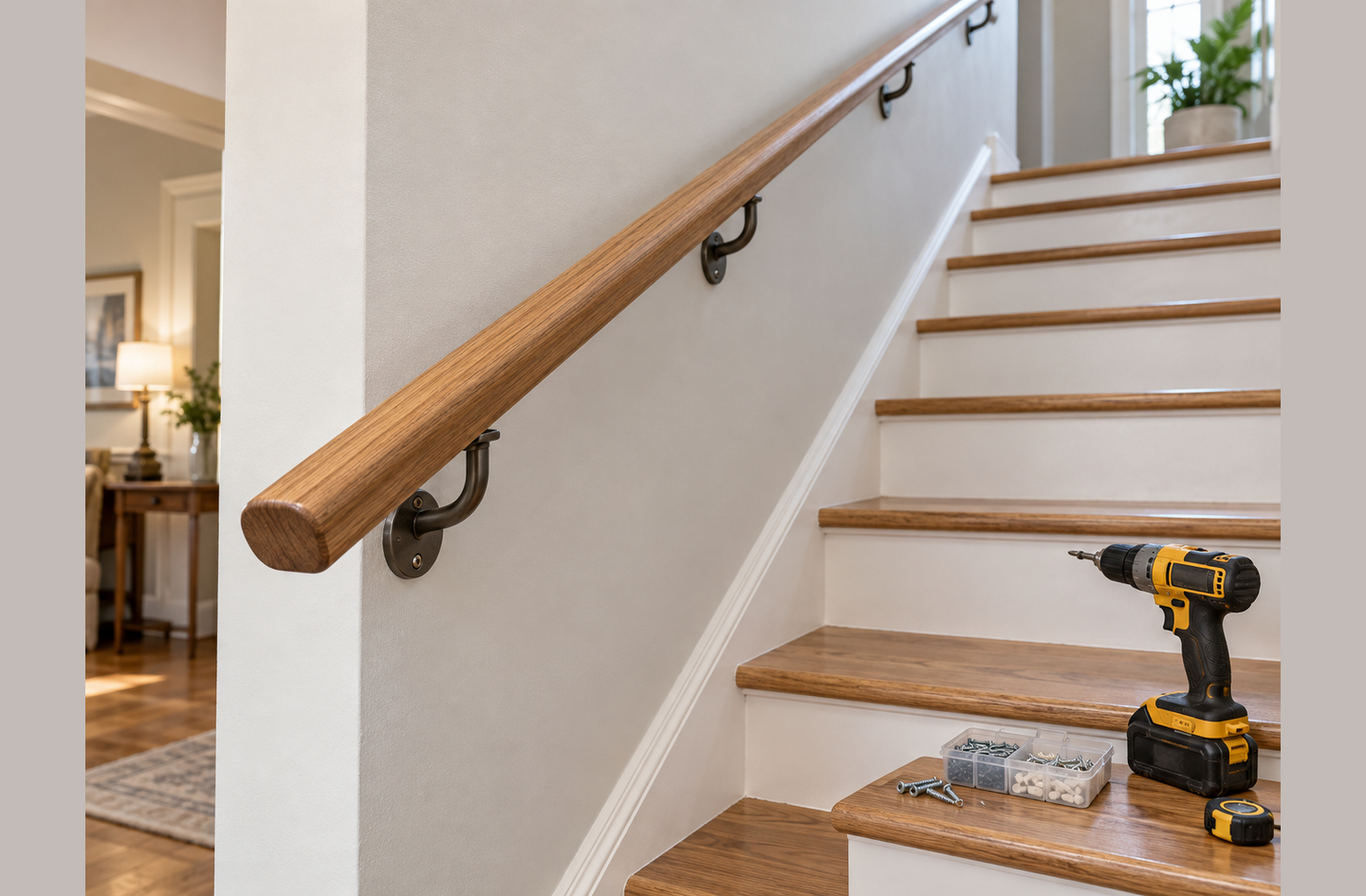
A second handrail is the least invasive option and works in both directions. It lets a person hold on with the stronger hand going up and going down. It does not reduce the effort of the climb itself, which matters when the log shows fatigue rather than unsteadiness. Rail height, diameter and the wall blocking behind it are questions for a licensed contractor.
A home elevator removes the stair from the route, but it is rare and structural. The same housing survey found elevators in just 0.4% of homes5. Its feasibility depends on stacked space, framing and permits, which are questions for a structural engineer and a licensed contractor.
Match the option to the signal in the log: unsteadiness points toward support, fatigue toward a seated option or fewer trips, and a transfer limit toward relocation.
Results: A Stair Plan You Can Review With Professionals
A finished plan fits on one page and answers four questions: what the log showed, what the evaluation found, which trips remain, and which home changes are being priced. It is a working document, not a verdict, and the older adult signs off on it.
- The log summary: flights per day before and after trimming, and the steps or landings where hesitation repeats.
- The evaluation outcome: the main cause the clinician identified, and any treatment or exercise to try first.
- A trip budget: which stair trips stay, at which time of day, and what gets staged instead.
- The relocation list: which essentials move to the entry level, and in what order.
- The options shortlist: each access option with the specialist who will assess it.
- A review date: after any fall, hospital stay or medication change, and at least once a year.
Success looks like a routine the person chooses rather than one the staircase dictates. The stairs become an option on a good day, not a requirement on a bad night.
A plan with a review date protects against two errors at once: stopping the stairs too early and continuing them too long.
Common Mistakes When a Parent Can No Longer Climb Stairs
The most common mistake is waiting for a fall to start planning. Signals such as a changed method appear well before difficulty, which gives the family and the senior time to decide together. Five mistakes come up repeatedly.
Waiting for a crisis: a hospital discharge forces rushed choices about bedrooms and devices. Starting the log while the person is independent keeps them in charge of the plan.
Stopping all stair use overnight: unless a clinician advises it, for example after surgery, a sudden ban removes exercise as well as risk. Trim trips first, then decide with the evaluation team whether any should stay.
Moving the bedroom but not the bathing route: a one-floor routine fails if showering still means a trip upstairs. When the entry-level bathroom has only a tub or no shower, a walk-in shower is a plumbing and waterproofing project for a licensed contractor.
Buying a device before the evaluation: a stair lift that suits the staircase may not suit the person’s transfer. Ask the occupational therapist first, then the installer.
Deciding for the parent rather than with them: plans imposed from outside tend to be ignored. Use the senior’s own log as the shared evidence; the older adult then chooses among the options the professionals consider suitable.
Frequently Asked Questions
When are stairs unsafe for seniors?
No single age or test score makes stairs unsafe for everyone. The warning sign is a repeating pattern, and difficulty going down deserves the closest attention. In a study of 310 older adults, those reporting trouble climbing down had more falls2. A physician or occupational therapist judges what that pattern means for one person.
Should a parent who can no longer climb stairs move to a one-story home?
Not necessarily. A HUD analysis of 2011 survey data found a bedroom on the entry level in 76.3% of all US housing units, single-level homes included5. Relocating essentials within the current home is worth pricing first. Moving house is a personal decision that the parent leads.
Is a stair lift better than moving the bedroom downstairs?
It depends on the person’s transfer, not only on the staircase. In a UK trauma registry, the most severe stair lift injuries were 18 times more likely to occur while getting off the lift6. An occupational therapist can test that transfer before anyone compares a lift with relocation.
Will avoiding stairs make an older adult weaker?
Avoiding activity out of fear has a cost. Among older adults with a fear of falling, 14.9% restricted three or more activities, and that severe restriction predicted faster loss of lower-limb performance4. That study covered activity in general, so planned trips and prescribed exercise are the safer-feeling path while exposure drops.
How often should a stair plan be reviewed?
Review the plan after any fall, hospital stay or medication change, and at least once a year otherwise. Repeat the two-week stair log before each review, so the comparison rests on a fresh record rather than memory. The older adult leads the review, with the clinician who did the original evaluation.
Conclusion
The right time to stop using stairs is decided by a repeating pattern and a personal evaluation, never by age alone. Log the trips, bring the record to a clinician, then work through the levers in order: fewer trips, essentials on the entry level, and assessed access options. Prepare the questions before hiring the professional, and keep the older adult in charge of the plan.
For how this decision fits the wider topic of stairs at home, return to the aging in place stair safety overview.
References
Methodology: every figure in this article comes from an independent peer-reviewed study or a government housing analysis and links to the page that carries it, and the article was written and checked against those sources by the founder.
- Journals of Gerontology – Fried LP, Bandeen-Roche K, Chaves PH, Johnson BA. Preclinical mobility disability predicts incident mobility disability in older women. Series A, 55(1):M43-52, January 2000.
- Archives of Physical Medicine and Rehabilitation – Verghese J, Wang C, Xue X, Holtzer R. Self-reported difficulty in climbing up or down stairs in nondisabled elderly. 89(1):100-104, January 2008.
- Journals of Gerontology – Hortobagyi T, Mizelle C, Beam S, DeVita P. Old adults perform activities of daily living near their maximal capabilities. Series A, 58(5):M453-60, May 2003.
- Journal of the American Geriatrics Society – Deshpande N, Metter EJ, Lauretani F, Bandinelli S, Guralnik J, Ferrucci L. Activity restriction induced by fear of falling and objective and subjective measures of physical function: a prospective cohort study. 56(4):615-620, April 2008.
- U.S. Department of Housing and Urban Development – Bo’sher L, Chan S, Ellen IG, Karfunkel B, Liao H (NYU Furman Center). Accessibility of America’s Housing Stock: Analysis of the 2011 American Housing Survey. March 2015.
- Injury – O’Malley O, Ryan O, Wilson G, Islam M, Smith TO, Hing CB. Mortality and morbidity of stairlift injuries: Analysis of the UK TARN database. 51(6):1306-1311, June 2020.
- Journal of the American Geriatrics Society – Startzell JK, Owens DA, Mulfinger LM, Cavanagh PR. Stair negotiation in older people: a review. 48(5):567-580, May 2000.
- Age and Ageing – Montero-Odasso M, van der Velde N, Martin FC, et al. World guidelines for falls prevention and management for older adults: a global initiative. 51(9):afac205, September 2022.