Stair safety for dementia is a planning problem before it is a hardware problem. A staircase asks the person on it to see each edge, choose a direction, move at a steady pace and, in an emergency, get out. Dementia can change all four. For the wider topic of safer stair routes, see the overview in aging in place stair safety. In one UK clinic study, where half the dementia group had Lewy body or Parkinson’s disease dementia, falls ran nearly 8 times higher than in healthy controls1. This guide shows how a family and the person living with dementia can plan visibility, supervision and exit routes together, with professionals reviewing each decision.
Quick Answer
How do you plan stair safety for someone living with dementia?
Start by watching how the stairs are used now. Then make every edge visible, light the night route, add continuous handrails and protect the way out. Dementia and mild cognitive impairment double the risk of falls2, so an occupational therapist and the person’s physician should review the plan. Never block a staircase without professional review, because it may be the only exit from an upper floor.
- Observe how the stairs are used today.
- Make every edge and handrail easy to see.
- Plan the night route from bed to bathroom.
- Add support for quick or unplanned movement.
- Choose supervision before barriers.
- Protect the emergency exit route.
- Bring the plan to the right professionals.
Key Takeaways
- Dementia and mild cognitive impairment double the risk of falls and fall-related injuries, according to the 2022 World Falls Guidelines2.
- In 2015 US emergency data, 79.2% of older adults’ fall-related visits came from falls at home, and stairs were among the most common home locations3.
- Night matters: 26% of people with dementia living at home had symptoms of sleep disturbance in a 2023 meta-analysis6.
- A stair is also an exit. Adults 65 and older had 2.5 times the general population’s risk of dying in a fire in 20237. Blocking stair access is a professional decision, not a purchase.
Before You Begin: What Stair Safety for Dementia Has to Cover
Stair safety for dementia covers four changes that a staircase is unusually sensitive to: disorientation, impulsive movement, night navigation and changing recognition of edges and objects. A level hallway forgives a wrong turn or a missed cue. A stair does not, because every step is a change of level that has to be seen, judged and controlled. In the 2022 World Falls Guidelines, dementia and mild cognitive impairment double the risk of falls and of fall-related injuries such as hip fractures and head injuries2.
The size of that gap depends on the group studied. A UK study followed 179 adults over 65 from outpatient clinics for a year with fall diaries. Half of the 140 participants with dementia had Lewy body or Parkinson’s disease dementia. Those with dementia had 9,118 falls per 1,000 person-years, against 1,023 for healthy controls1. A history of falls in the previous year raised the hazard of falling again (hazard ratio 2.52)1. These are clinic figures, not a forecast for one person, but they explain why the stair deserves its own plan.
Each of the four changes puts a different demand on the stair:
- Disorientation: the person may head for the stairs while looking for the bathroom, or lose track of which way leads down.
- Impulsive or hurried movement: standing up and walking off quickly, often at night, before balance and blood pressure settle.
- Night navigation: waking in a dark house, sometimes confused about time and place, with the stair near the bedroom door.
- Changing recognition: step edges, handrails and even doors can become harder to pick out, especially in low contrast.
Keep a simple notebook by the stairs for one week of observation. Sketch the floor plan, marking bedrooms, bathrooms, the stair and every exit door. List current medications for the physician to review. Most of all, ask the person living with dementia what feels hard and what they want to keep doing. This is caregiver planning with the person, not around them.
A stair plan for dementia has to answer four questions at once, and a fix that solves one (a gate, a lock) can quietly make another worse.
Step 1: Observe How the Stairs Are Used Today
By the end of this step you will have a week of notes showing when, why and how the stairs are used. Observation comes first because it turns a general worry into specific friction points. In 2015 US emergency department data, 79.2% of older adults’ fall-related visits came from falls at home3. The same study found the most common home locations were the bedroom, bathroom and stairs3. Those three locations often sit on one night route.
For each stair trip you notice, write down a few facts:
- The time of day, and whether lights were on.
- The direction (up or down) and what the person was trying to reach.
- Whether they paused at the top step, gripped the rail, rushed or turned back.
- What they carried, and what they wore on their feet.
- Who was nearby, and whether the person asked for help or turned it down.
Patterns usually appear within days. A person who uses the stairs confidently by day but stops at the top step at night is telling you about lighting and orientation. Someone who heads downstairs at night when the bathroom is upstairs is telling you about wayfinding. A sudden rush toward the stairs after standing up points to the support and medical questions in Step 4. Many of the same checks appear in a guide to home factors on the stairs, which separates the stair itself from changes in balance or strength.
Observation also means listening. If you are the person living with dementia, your own account of where the stairs feel uncertain is part of the evidence. If you are helping a parent, share the notes with them rather than keeping a private file. The World Falls Guidelines make this a formal recommendation:
“When creating falls prevention care plans for older adults with cognitive impairment, both the older adults’ and their caregivers’ perspectives should be included as it improves adherence to interventions and outcomes.”
Montero-Odasso M and colleagues, World Guidelines for Falls Prevention and Management for Older Adults, Age and Ageing2
A week of notes is worth more to an occupational therapist than any product list. It shows where on the stair, and when, the plan has to work.
Step 2: Make Every Edge and Handrail Easy to See
By the end of this step, each tread edge, the top and bottom steps and the handrails should stand out clearly from their background. Visibility comes before any other change, because a step that cannot be seen cannot be judged. Contrast sensitivity is the ability to tell an object from its background when the two are close in brightness. One study tested contrast sensitivity with frequency doubling technology. It found deficits in people with Alzheimer’s disease (10 participants) and mild cognitive impairment (28 participants), compared with 29 healthy controls4.
On a stair, low contrast is the normal state. Carpet runs over tread and riser in one color. A beige rail disappears against a beige wall. For someone whose contrast sensitivity has changed, the steps may be harder to read as separate edges. These changes help each edge read as an edge:
- Mark each tread edge with a continuous, matte strip in a color that differs strongly in brightness from the tread. It should be flush, slip-resistant and firmly fixed.
- Mark the top and bottom steps most clearly, since the change from flat floor to stair is where misjudgment starts.
- Make the handrail contrast with the wall, so the hand and eye find it before the first step.
- Choose plain surfaces on the stair. A busy pattern adds visual noise exactly where the eye needs a clean edge.
- Reduce glare from glossy finishes and bare bulbs, which can hide an edge as well as darkness can.
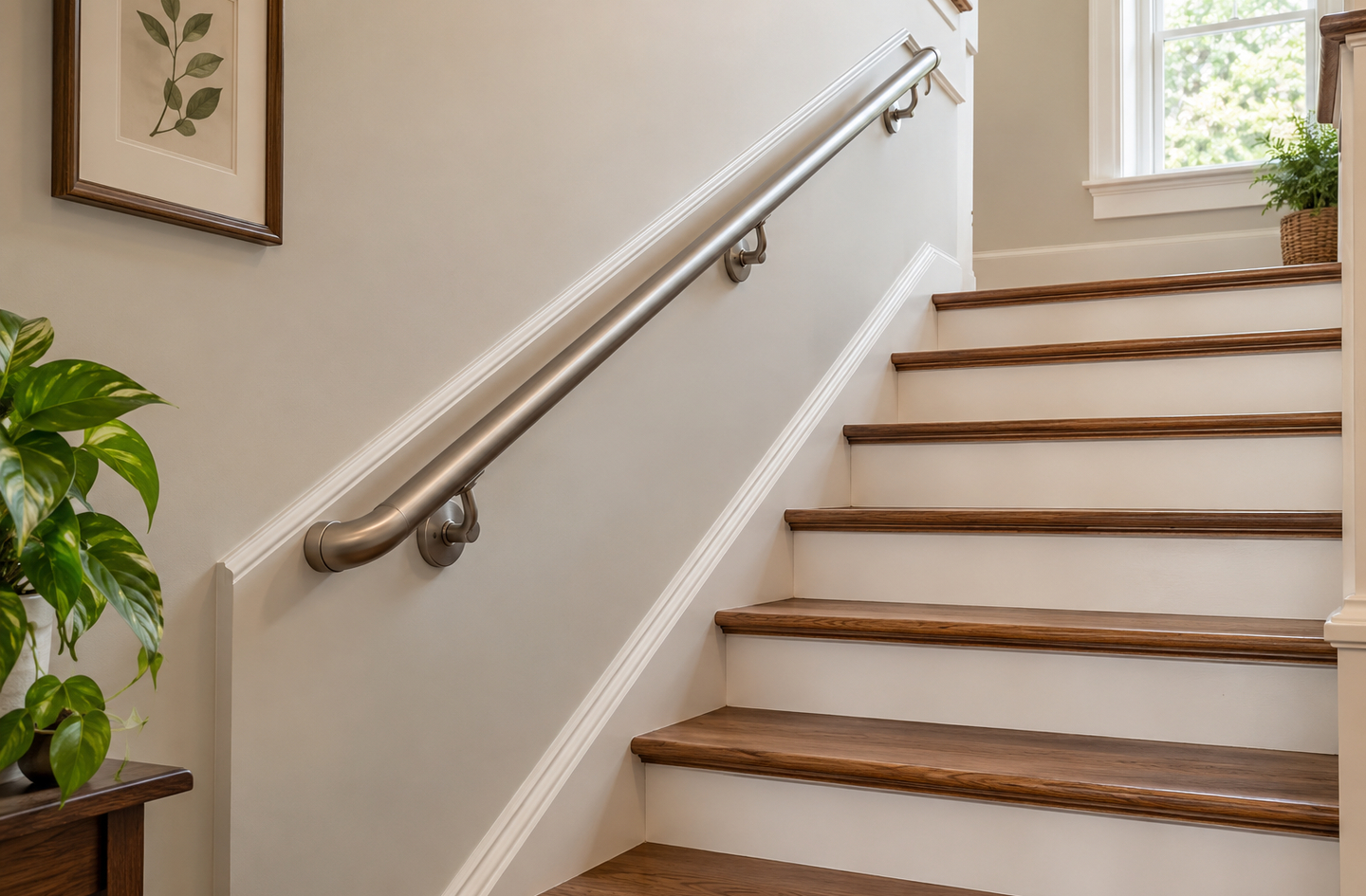
Light levels matter as much as color. The Alzheimer’s Association notes that changes in light level can be disorienting, and it advises adding lights in entries, between rooms and on stairways5. In practice that means light switches at both the top and bottom of the stair. It also means no dark pool at the landing, where the eye has to adapt mid-step.
Visibility work is low-disruption and reversible, so it can start while bigger decisions wait. An eye examination belongs in the plan too, since glasses and cataracts also affect contrast.
Visibility before confidence: when the edges and the rail are easy to see, the stair asks less of memory and judgment on every trip.
Step 3: Plan the Night Route From Bed to Bathroom
The route from the bed to the bathroom should be lit, short and hard to confuse with the route to the stairs. Night is where disorientation and stairs most often meet. A 2023 meta-analysis of people with dementia living in the community found that 26% had symptoms of sleep disturbance, and 19% had clinically significant sleep disturbance6.
The type of dementia changes the picture. Dementia with Lewy bodies is a form of dementia that often brings changes in alertness, visual perception and movement. In the same meta-analysis, sleep disturbance symptoms were reported in 49% of people with Lewy body dementia, against 24% of people with Alzheimer’s disease6. A diagnosis is worth knowing when you plan the night, and the treating physician can explain what it means for this person.
Plan the route, not just the stair:
- Keep the bedroom and bathroom on the same floor where the home allows, so the night trip never needs the stairs.
- Light the path automatically with low-level, motion-activated lights from the bedside to the bathroom door.
- Make the destination obvious. A lit bathroom with the door open gives the person a clear target to walk toward.
- Light the top of the stair separately, so the first step is visible before anyone reaches it.
- Keep the bedroom door direction in mind. If the bedroom door opens straight onto the top step, that layout belongs on the list for your occupational therapist.
The Alzheimer’s Association recommends night lights in hallways, bedrooms and bathrooms5. Night lighting supports the person who is awake and moving. It does not tell anyone else that they are moving, which is where supervision comes in.
Some families add a bed or motion sensor that alerts a caregiver when the person gets up. An alert is a supervision tool, not a barrier: it lets someone help without locking anything. Discuss it with the person first.
The safer-feeling night route is one the person never has to think about: lit, short and leading somewhere other than the top step.
Step 4: Add Support for Quick or Unplanned Movement
The aim here is something firm to hold from the moment the person reaches the stair until they step off it. Support matters most when movement is hurried. Orthostatic hypotension is a drop in blood pressure on standing that can cause dizziness or a faint. In the UK clinic study, symptomatic orthostatic hypotension was a significant, potentially modifiable predictor of falling in people with dementia (hazard ratio 2.13)1.
Picture the sequence. Someone wakes, stands quickly, feels light-headed and walks toward the nearest doorway, which opens onto the landing. The stair is a few steps from the bed, and the body has not caught up with the decision to move. Two kinds of response help here. The medical side (blood pressure, medications, hydration) belongs with the physician. The home side is about support points and space.
- Handrails on both sides, so either hand has a rail going up or down, and a weaker side is never left without one.
- Continuous rails that run the full flight without gaps, so the grip never has to let go and find the rail again.
- Rails that extend past the top and bottom steps, so the hand is already holding before the first step down.
- A clear landing at the top, with no furniture, baskets or items waiting to be carried down.
- Nothing stored on the steps, because a person who is hurrying will not step around clutter reliably.
Rail height, the grip shape and how the rail is anchored into the wall are installation questions. A stair rail carries the full load of a stumble, so the fixings matter more than the finish. A licensed contractor should confirm the wall can take the load and that the rail suits the stair. An occupational therapist can advise on which side, how high and what grip suits this person’s hands and gait.
Support before strain: a continuous rail on both sides gives a hurried or unsteady moment a place to land before it becomes a fall.
Step 5: Choose Supervision Before Barriers
By the end of this step, you should have a supervision plan that matches how the stairs are actually used, and a clear rule about barriers. Blocking stair access is a frequent piece of unqualified advice on this topic. A gate or lock at the top of the stair can look like the obvious answer to night walking. It changes the risk rather than removing it.
A barrier at the top of a stair creates three new questions. First, a determined adult can lean on a gate, try to climb it or misjudge it in the dark, right at the top of a drop. Second, a gate that has to be opened in a hurry slows everyone in the house in an emergency. Third, a barrier can feel like confinement to the person living with dementia, which can raise distress rather than lower it. None of these makes a barrier always wrong. They make it a decision for an occupational therapist, the local fire department and the household together, never a quick purchase.
Start with supervision that leaves the stair open:
- Timed help at the moments the notes from Step 1 flagged, such as the first trip downstairs in the morning.
- Scheduled bathroom trips before bed, so the night trip is shorter or not needed.
- Alerts that call a person, such as a bed sensor or door chime, rather than devices that stop movement.
Then consider the route itself. “Routes before rooms” applies strongly here: moving the bedroom to the ground floor, next to a bathroom, can remove the night stair trip entirely. The person’s own wishes should lead that change.
A stair lift is a route decision as much as a product decision. For someone living with dementia, the questions go beyond the stair’s shape and the power supply. Can the person learn and remember the controls? Will they wait for the seat to stop? Can they transfer at the top landing without turning toward the drop? Those are questions for an occupational therapist, and installation is a question for the installer and a licensed contractor.
The goal of supervision is to lower the risk of each stair trip while the person keeps using the stair. Any barrier also has to pass an exit test.
Step 6: Protect the Emergency Exit Route
By the end of this step, everyone in the home should be able to get from every bedroom to an outside door quickly, even at night. Emergency egress is the route and the time a person needs to leave a building when something goes wrong. In an upper-floor bedroom, the stair is usually part of that route. US Fire Administration data show that in 2023 adults 65 and older had 2.5 times the general population’s risk of dying in a fire7.
The risk rises with age. Adults aged 65 to 74 had 2.2 times the general population’s risk, and adults aged 75 to 84 had 2.9 times7. Dementia can add to that, because hearing an alarm, choosing a direction and moving quickly rely on the abilities the stair already tests.
Protect the exit route with a few clear rules:
- Keep the stair clear at all times. It is a walkway by day and an escape route by night.
- Avoid locks that need a key from inside on exit doors or any stair gate, unless the local fire department has reviewed the exit plan.
- Check interior door locks. The Alzheimer’s Association advises removing locks on interior doors so the person cannot lock themselves in5.
- Test smoke and carbon monoxide alarms, which the Alzheimer’s Association advises inspecting regularly5, and plan who helps whom at night.
Your local fire department is the right reviewer for door hardware, gates and alarms on the exit route.
A change that makes the stair harder to fall down but also harder to escape down has not finished its job. The fire department should see it before it stays.
Step 7: Bring the Plan to the Right Professionals
Each part of the plan should end up with a named professional who has reviewed it. Home changes work best when they fit the person and are actually used. One pilot trial randomized 22 people with mild dementia and their carers, and 11 received a home hazard and exercise program. All participants implemented some home safety recommendations (range 19% to 80%), and half implemented 50% or more8.
The same trial concluded that home safety recommendations should put more weight on changing the environment than on changing behavior8. For stairs, that favors edges, light and rails over instructions the person has to remember. The trial was small, so treat it as a lesson in what households tend to adopt, not as proof of an outcome.
Match each question to the right person:
- Occupational therapist: how the person uses the stair, rail side and height, supervision, gates, alerts and whether a stair lift suits them.
- Physician: dizziness on standing, medications, sleep, and what the type of dementia means for falls.
- Eye care professional: glasses, cataracts and changes in contrast or depth judgment.
- Licensed contractor or electrician: rail anchoring, stair repairs, new lighting circuits and switches.
- Local fire department: exit routes, alarms, door locks and any barrier across the stair.
The medical side deserves weight. The UK clinic study’s authors put it this way:
“The management of symptomatic orthostatic hypotension, autonomic symptoms and depression, and the encouragement of physical activity may provide the core elements for the most fruitful strategy to reduce falls in people with dementia.”
Louise M. Allan and colleagues, Institute for Ageing and Health, Newcastle upon Tyne, PLoS ONE1
Prepare the questions before hiring the professional: a week of notes, a floor plan and this list turn one appointment into a real review.
Results: A Stair Plan to Review With Professionals
If the seven steps went well, you now have a plan for each stair-related change. It names what the change does on the stair, the home response and who reviews it. Print the table, add your notes from Step 1 and bring it to the occupational therapist and physician.
| Change | What it does on a stair | Home response to discuss | Who reviews it |
|---|---|---|---|
| Disorientation | Heads for the stair instead of the bathroom; loses track of up and down | Same-floor bedroom and bathroom, lit destination, separate light at the top step | Occupational therapist |
| Impulsive or hurried movement | Reaches the top step before balance and blood pressure settle | Rails on both sides, continuous and extended, clear landing | Physician, occupational therapist, licensed contractor |
| Night navigation | Uses the stair in the dark, half awake | Motion lighting on the route, caregiver alerts, bathroom trip before bed | Occupational therapist, physician |
| Changing recognition | Misreads edges, rails or the drop itself | High-contrast matte edge strips, contrasting rail, glare control | Eye care professional, occupational therapist |
| Emergency exit | A gate or lock can slow escape from an upper floor | Clear stair, no key-from-inside locks, tested alarms, night walk-through | Local fire department |
Success is not a stair that nobody uses. It is a stair the person can keep using with less hesitation, plus a household that knows what to watch for. Recheck the plan whenever something changes: a new diagnosis, a fall, a medication change or a move of the bedroom.
Common Mistakes When Planning Stairs for Dementia
Blocking the stair without a review. A gate or lock feels decisive, which makes it a frequent quick fix. The person may climb or lean on it, and it can slow an escape. Bring any barrier to the occupational therapist and the fire department first.
Lighting the stair but not the route. A bright staircase helps little if the bedroom and hallway stay dark. Light the whole path from bed to destination, with the top step lit before anyone reaches it.
Planning around the person instead of with them. Changes made without the person’s input are less likely to be used and can feel like a loss of control. Ask what feels hard, explain each change and keep familiar routines where you can.
Treating the plan as finished. Needs change as dementia progresses. Repeat the one-week observation every few months, and after any fall or health change, so the plan keeps up with the person.
Frequently Asked Questions
Should I put a gate at the top of the stairs for someone with dementia?
Not without professional review. Dementia and mild cognitive impairment double fall risk2. Yet a gate at the top of a drop can be climbed, leaned on or misjudged, and it can slow an exit. An occupational therapist and your local fire department should review any barrier against the whole exit plan.
Why do people with dementia have trouble seeing stairs?
Contrast sensitivity can change. One study found contrast sensitivity deficits in people with Alzheimer’s disease and mild cognitive impairment, compared with 29 healthy controls4. On stairs that are one color, edges can blur together. High-contrast matte edge strips, a contrasting rail and even lighting help each step stand out.
How common are sleep problems in dementia?
Common enough to plan for, since disturbed sleep can mean more trips out of bed in the dark. A 2023 meta-analysis found sleep disturbance symptoms in 26% of people with dementia living at home, and in 49% of those with Lewy body dementia6. Plan a lit, short route from bed to bathroom that does not pass the top step.
Is a stair lift a good idea for someone living with dementia?
It depends on the person. A lift lowers the effort of the climb, but the person must use the controls and transfer at the top landing reliably. Dizziness on standing also matters, since symptomatic orthostatic hypotension predicted falls in dementia (hazard ratio 2.13)1. An occupational therapist should assess fit first.
References
Methodology: every figure in this article comes from an independent published source and was read at that source in October 2026; no stair or person was measured or tested for this article. This is engineering-informed education, not medical, occupational therapy or fire safety advice for a specific home. Oded Feigin holds editorial responsibility for this page.
- PLOS ONE – Allan LM, Ballard CG, Rowan EN, Kenny RA. Incidence and Prediction of Falls in Dementia: A Prospective Study in Older People. 2009;4(5):e5521.
- Age and Ageing – Montero-Odasso M, van der Velde N, Martin FC, Petrovic M, Tan MP, Ryg J, et al. World guidelines for falls prevention and management for older adults: a global initiative. 2022;51(9):afac205.
- American Journal of Lifestyle Medicine – Moreland BL, Kakara R, Haddad YK, Shakya I, Bergen G. A Descriptive Analysis of Location of Older Adult Falls That Resulted in Emergency Department Visits in the United States, 2015. 2021;15(6):590-597, published online August 2020.
- Neurobiology of Aging – Risacher SL, WuDunn D, Pepin SM, MaGee TR, McDonald BC, Flashman LA, et al. Visual contrast sensitivity in AD, MCI, and older adults with cognitive complaints. 2013;34:1133, published online October 2012.
- Alzheimer’s Association – Home Safety, caregiving guidance, accessed October 2026.
- Ageing Research Reviews – Koren T, Fisher E, Webster L, Livingston G, Rapaport P. Prevalence of sleep disturbances in people with dementia living in the community: A systematic review and meta-analysis. 2023;83:101782.
- U.S. Fire Administration – Older Adult Fire Death Risk (2014-2023), FEMA, 2023 data.
- BMC Geriatrics – Wesson J, Clemson L, Brodaty H, Lord S, Taylor M, Gitlin L, et al. A feasibility study and pilot randomised trial of a tailored prevention program to reduce falls in older people with mild dementia. 2013;13:89.
Conclusion
Stair safety for dementia works best as a system. Observe first, make edges and rails visible and light the night route. Then add continuous support, choose supervision before barriers and keep the exit open. Each change should leave the stair easier to use and no harder to escape. When the stair has to stay part of daily life, firm, continuous rails that the person can find and trust are a practical place to start.
The specific decisions belong with the person, the family and the professionals who can see the home. For how this angle fits safer stair routes more broadly, see the overview of aging in place stair safety.