Difficulty going down stairs in older adults is rarely one problem. It is usually a home factor and a body factor meeting on the same step. For the wider topic of safer stair routes, see the overview in Aging in Place Stair Safety. In 2015 emergency department data, stairs accounted for 22.9% of injurious falls in or around the home among adults aged 65 and older1. This guide shows how to check the stair itself, what to write down, and when a clinician should take over.
Quick Answer
What should you check when going down stairs gets harder?
Check the stair before judging the person. Look at tread visibility, lighting, step consistency and handrails, then record when the hesitation happens. In one lab study, relative knee effort in descent was 88% for older adults; for young adults it was 42%2. Home fixes lower the visual and support demands of the stair, while balance and strength changes belong with a clinician.
- Record when and where descent feels hard.
- Check tread visibility and lighting.
- Check whether the steps are consistent.
- Check the handrails and support points.
- Separate home factors from balance or strength changes.
- Decide when a clinician or occupational therapist should evaluate.
Key Takeaways
- Stairs ranked second among places in or around the home where older adults had injurious falls (22.9% in 2015 data)1, behind the bedroom.
- Going down asks more of aging knees than going up: relative knee effort was 88% in descent and 78% in ascent for older adults2.
- Visibility is a visible home factor. A flush, high-contrast edge strip cut accidental foot contacts from 15% to 3% among young adults wearing glasses that simulated cataract4.
- The 2010 ADA Standards call for uniform risers and treads and handrails on both sides7, which makes a useful benchmark for a home stair.
- A record of where, when and how the hesitation happens is more useful to a clinician or occupational therapist than a general worry.
Why Difficulty Going Down Stairs Is Common in Older Adults
Difficulty going down stairs is common in older adults because descent loads the knees close to their limit while the eyes judge each edge. Stair descent is the controlled lowering of body weight from one step to the next, with the front leg braking the drop. In lab studies, older participants worked closer to their knee limit on that braking work than on the climb2.
Why Going Downstairs Feels Harder Than Upstairs
Relative effort is the share of a person’s maximum muscle capacity that a task uses. In a laboratory study of 14 older adults with a mean age of 74, Hortobágyi and colleagues measured knee effort on stairs2. For the older group, relative effort in descent was 88% of maximum, and relative effort in ascent was 78%2. For young adults the pattern reversed: relative effort in descent was 42% and in ascent was 54%2.
| Task | Young adults | Older adults |
|---|---|---|
| Stair ascent | 54% | 78% |
| Stair descent | 42% | 88% |
The practical reading is simple. When going downstairs feels harder than upstairs, that matches the mechanics rather than signalling a sudden problem. A change that began suddenly is different, and a reason to see a doctor. It also means small home details carry extra weight on the way down, because the knees are already working closer to their limit on the way down.
This guide does not teach a way of walking. It shows how to check the stair, how to record what happens, and how to hand both to the right professional.
If descent is the hard direction, start every check from the top step looking down, because that is the view and the load the person actually meets.
Step 1: Record When and Where Descent Feels Hard
The first step produces a short written record of when descent feels hard, which separates a stair problem from a person problem better than memory does. Write it over a week or two of ordinary use, not during a single tense moment. If you are checking your own stair, the same log works, and you know better than anyone where you slow down.
- Note which staircase, which step and which direction. A record often points to a specific spot, such as the top step or the last two treads.
- Note the time of day and the light: daylight, lamp light, or a switch that sits out of reach.
- Note what the person carried, what they wore on their feet, and which glasses they had on.
- Note which hand reached for support, and whether a rail existed on that side.
- Note any dizziness, knee pain or a near-miss, with the date.
Hesitation at the Top of Stairs
Hesitation at the top of stairs is a useful signal because it shows where confidence breaks before any stumble happens. A pause that occurs only at night, or only on one staircase, points toward the home. A pause that occurs on every stair, in good light, with a rail in hand, points toward balance, strength or vision.
Speed is something clinicians measure. In a study of 513 community-dwelling adults aged 70 and older, Oh-Park and colleagues timed a three-step descent6. People who reported stair difficulty averaged 3.60 seconds, against 2.43 seconds for those without difficulty6. The authors called stair times “simple, quick, and valid clinical measures”6. That is a reason to leave timing to a clinician rather than turn the stair into a test at home.
A record that names the step, the light and the hand on the rail turns a vague worry into a question a professional can answer.
Step 2: Check Tread Visibility and Lighting
Tread visibility decides whether the eye can find each step edge on the way down, and it is the home factor most often missed. Stand at the top in the light the person really uses and look at the edges, not the treads.
A tread is the horizontal surface of a step that the foot lands on. The nosing refers to the front edge of the tread, the line the foot must clear and the eye must find. On a carpeted or uniformly colored stair, the nosings can blur into one surface when viewed from above.
An edge highlighter is a contrasting strip placed along the nosing so the edge stands out. In a University of Bradford study, a flush high-contrast strip cut accidental foot contacts from 15% to 3% for young adults wearing glasses that simulated cataract4. Setting the strip 30 mm back from the edge made things worse than a flush strip did for older adults4. Low foot clearances rose from 2% to 17%4.
The ADA Standards make the same point in an advisory note, suggesting visual contrast on tread nosings for people with low vision7. Lighting works with contrast. Check whether a switch sits at both the top and the bottom and whether the bulb reaches full brightness quickly. Then check whether window glare hides the first edge.
Age changes where this matters most. For adults aged 65 to 74, stairs were the most common place at home for an injurious fall (30.0%)1. Moreland and colleagues drew a plain conclusion from that pattern.
“Making sure stairs have rails and appropriate lighting may be especially important for this age group compared to modifications in other areas of the home.”
Moreland et al., American Journal of Lifestyle Medicine1
If the edges disappear from the top step in evening light, treat that as a home factor to fix before drawing any conclusion about the person’s balance.
Step 3: Check Whether the Steps Are Consistent
Step consistency matters because people settle into a rhythm after the first few steps and expect every step to match. One odd step breaks that rhythm without warning. A riser is the vertical face between two treads, and its height sets how far the body drops on each step.
The 2010 ADA Standards require uniform riser heights and uniform tread depths on every step of a flight7. They set risers between 4 and 7 inches high and treads at least 11 inches deep7. Those figures come from public-building rules, not a residential code, so treat them as a benchmark rather than a pass mark.
- Measure each riser with a tape and write the heights in order, top to bottom.
- Measure each tread depth from nosing to the riser behind it.
- Mark any step that differs from the rest, especially the top and bottom steps, where floor finishes change.
- Check for open risers, worn nosings, loose carpet and runners that shift underfoot.
The ADA Standards also limit how far a nosing may project, to 1.5 inches over the tread below7. A deep, square nosing can catch the heel on the way down, so note its shape alongside its size.
A single riser that differs from its neighbors is worth more attention than a flight that is steep but even. The body can plan for steepness, but not for surprise.
Step 4: Check the Handrails and Support Points
Handrails are the main support point on a stair. The check is whether a hand can reach, grip and follow the rail from the first step to the last. A rail on only one side means one direction of travel always puts it on the other hand.
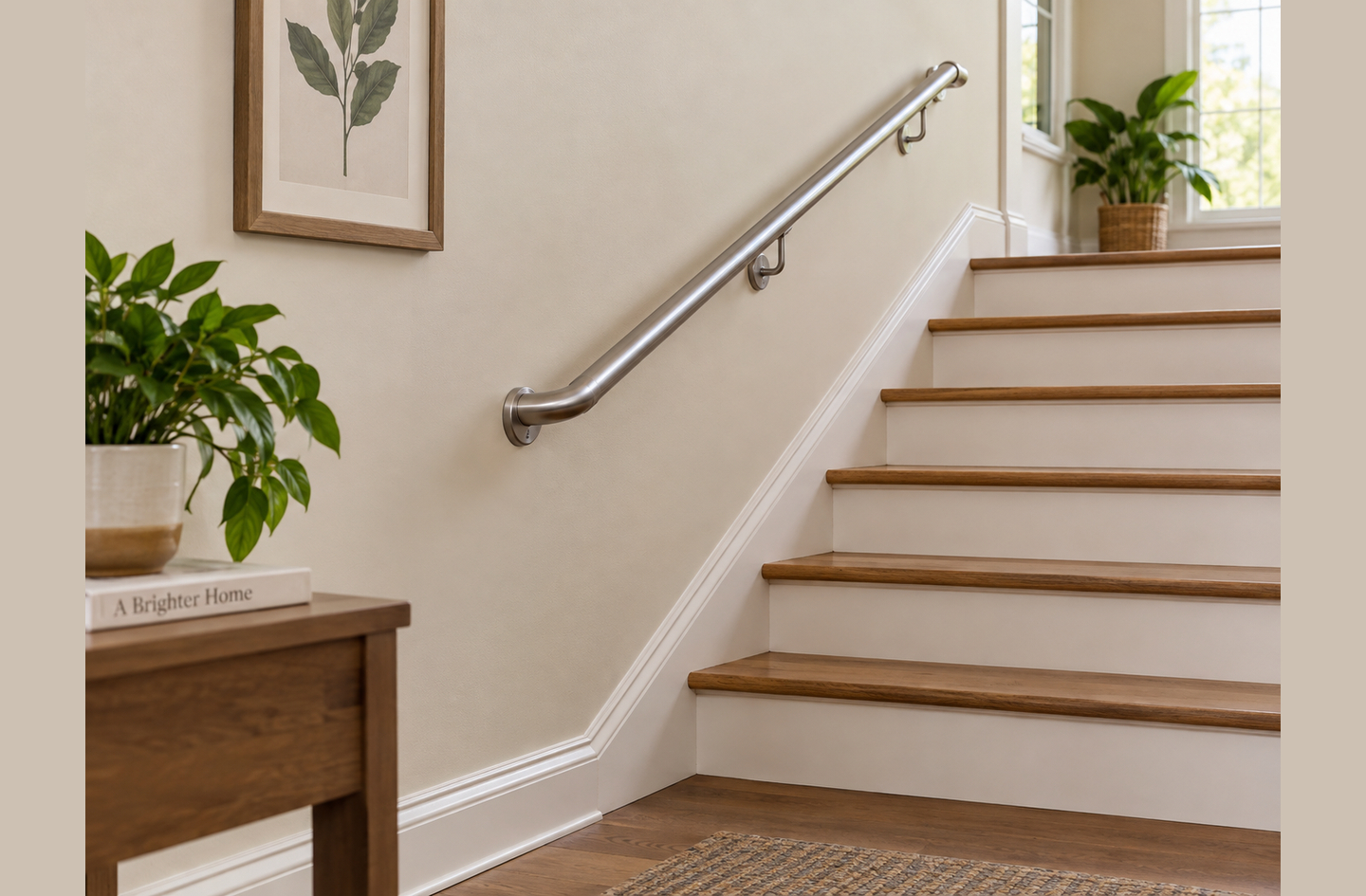
The 2010 ADA Standards call for handrails on both sides of stairs7. The top of the gripping surface sits 34 to 38 inches above the stair nosings7. The rail should stand at least 1.5 inches clear of the wall, so a whole hand can wrap around it7.
Extensions matter most on the way down. At the top of a flight, the ADA rail runs at least 12 inches past the first nosing7. That gives a hand something to hold before the first step down, which is where a pause at the top happens.
“People with disabilities, older people, and others benefit from continuous gripping surfaces that permit users to reach the fingers outward or downward to grasp the handrail, particularly as the user senses a loss of equilibrium or begins to fall.”
U.S. Access Board, 2010 ADA Standards advisory 505.67
Check that the rail does not rotate in its brackets, that brackets do not interrupt a sliding hand, and that the rail runs the full flight. Note any spot where a person grips a newel post, a door frame or furniture instead.
If a person reaches for the wall or a banister post at the top step, the missing support point is a home factor, whatever their balance is like.
Step 5: Separate Home Factors From Balance or Strength Changes
Sorting the record into home factors and person factors is the step that decides who acts next. The World Guidelines for Falls Prevention describe environmental risk as the interaction between a person’s exposure to hazards, their risk-taking behavior and their physical capacity8. The same stair can be fine for one person and hard for another.
Balance Problems Descending Stairs
Part of what feels like a balance problem on the way down can be a strength-reserve limit rather than the stair. Hortobágyi and colleagues found that relative knee effort in descent was 88% for older adults; for young adults it was 42%2.
Reeves and colleagues measured the same pattern another way. Participants walked down a four-step staircase, and maximum knee capacity was measured separately on a dynamometer3. Older adults operated at 42% of their maximal knee capacity, against 30% for young adults3.
Vision sits between the two categories. In an Australian cohort of older community-dwelling people, 55.8% were regular wearers of multifocal glasses5. Multifocal wearers were more than twice as likely to fall over the follow-up year5. They were also more likely to fall when walking up or down stairs5. Looking through the lower lens segments impaired their depth perception and edge-contrast sensitivity at a distance5. The glasses are worn by the person, but the record should still note them.
Fear of Going Down Stairs
Fear of going down stairs is a real factor in its own right, not just a reaction to a weak knee or a dark landing. In the Oh-Park cohort, 34% reported fear of falling at baseline6. The world guidelines recommend that an assessment include concern about falling8. Record it plainly, without judgment, alongside the physical notes.
If the trouble follows the stair, fix the stair; if it follows the person to every stair, the record belongs with a clinician.
Step 6: Decide When a Clinician or Occupational Therapist Should Evaluate
A clinician or occupational therapist should evaluate stair use when the record points to the person rather than the stair, or when anyone has already fallen. An occupational therapist is a licensed clinician who assesses how a person performs daily tasks in their own setting and adapts the task or the setting.
The world falls guidelines suggest a short set of screening questions for older adults8. They ask whether you have fallen in the past year, whether you feel unsteady when standing or walking, and whether you worry about falling. A yes to any of them is worth raising with a doctor. If you are the one finding the stairs harder, raising it early keeps the decisions in your hands. The guidelines also name gait speed below 0.8 m/s as a cut-off clinicians use to stratify risk8.
Moreland and colleagues noted that occupational therapist recommendations, including painting the edge of steps and installing stair rails, have been shown to reduce falls1. An in-home visit lets a therapist judge the stair and the person together.
Ask a physician to review stair difficulty when it appears suddenly, comes with dizziness, pain or a fall, or follows a new medication or new glasses. Simple lighting and contrast changes can come first. Rail installation and any riser or tread change belong with a licensed contractor, ideally after an occupational or physical therapist has watched the person on their own stair.
Bring the written record and the measurements from Steps 2 to 4 to that appointment, so the professional spends the visit on judgment rather than discovery.
Results: A Stair Record You Can Hand to a Professional
A finished check gives you two things: a log of when descent feels hard, and a stair measured against a published benchmark. The cross-walk below maps each 2010 ADA stair and handrail requirement onto what to look for on a home stair and what to write down. A private house is not bound by these figures, but they give the conversation with a contractor or therapist a shared reference.
| What to check | 2010 ADA benchmark | What to record at home |
|---|---|---|
| Riser heights | Uniform on every step, 4 to 7 inches high | Each riser height, top to bottom |
| Tread depths | Uniform, 11 inches deep minimum | Each tread depth and any worn edge |
| Nosing shape | Projection 1.5 inches maximum, edge radius 0.5 inch maximum | Square, rounded or worn nosings |
| Open risers | Not permitted | Any gap a toe could slide into |
| Edge visibility | Advisory: visual contrast on tread nosings | Whether edges show from the top step at night |
| Handrail sides | Both sides of the stair | Which sides have a rail |
| Handrail height | 34 to 38 inches above the nosings, consistent | Height at the top, middle and bottom |
| Handrail continuity | Continuous for the full flight | Posts, gaps or brackets that stop the hand |
| Top extension | 12 inches minimum past the first nosing | Whether a hand can hold the rail before the first step down |
| Bottom extension | One tread depth past the last nosing | Whether the rail ends before the floor is reached |
| Wall clearance | 1.5 inches minimum | Whether knuckles rub the wall |
If most rows check out and descent is still hard, the record points toward the person, and Step 6 applies. If several rows fail, start with lighting and edge contrast, then record again, because the change itself will show how much was the stair. Riser, tread and rail work belongs with a licensed contractor.
The cross-walk does not grade a home; it shows which questions to bring to a licensed contractor and which to bring to a clinician.
Common Mistakes When Checking a Stair
The most common mistake is deciding the cause before looking at the stair, which sends the conversation straight to the person’s body. Four others follow close behind.
Checking in daylight only: stair trouble can be worse in low light, so walk the check in the light the person really uses, including the trip from bed.
Adding a strip in the wrong place: a contrast strip set back from the nosing can mislead the eye about the real edge. The Bradford study found this for older adults4. Keep any strip flush with the edge.
Treating one rail as enough: a single rail serves one hand on the way up and the other on the way down. Note which hand the person trusts before deciding which side to prioritize.
Turning the stair into a test: staged or timed trials on a stair add pressure to a task that already asks a lot of the knees. Leave measured tests to a clinician.
A good stair check looks at the house first and the person second, so nobody is asked to adapt to problems the stair can solve.
Frequently Asked Questions
Why is going downstairs harder than upstairs for older adults?
Descent makes the front knee brake the full body weight on each step, and older muscles have less spare capacity for that braking. One lab study put older adults’ knee effort at 88% of maximum in descent and 78% in ascent2. Reading each edge from above adds a visual task as well.
What causes fear of going down stairs in seniors?
Fear can follow a past fall or near-miss, a feeling of being less steady, or a stair that is hard to read from the top. In a cohort of adults 70 and older, 34% reported fear of falling6. Light and a reachable rail ease the stair side; a clinician addresses the rest.
Is hesitation at the top of the stairs a balance problem or a home problem?
It can be either, and the pattern decides. A pause tied to darkness, one particular staircase, or a rail that starts late suggests the house. A pause that appears on every staircase, in bright light and with a good rail, suggests balance, strength or eyesight, which a doctor or therapist should look at.
When should someone see a doctor about trouble going down stairs?
Tell a doctor about any fall, even one without pain, and about stair trouble that starts suddenly or arrives with dizziness, knee pain or new glasses. The world falls guidelines also treat feeling unsteady and worrying about falling as reasons for a fuller falls assessment8.
Can an occupational therapist assess stairs at home?
Yes. The world falls guidelines say a trained clinician, such as an occupational therapist, should assess home hazards together with the person’s abilities and habits8. A home visit lets the therapist watch the actual stair in use and suggest changes that fit both the house and the person.
Limitations and Edge Cases
- This article is engineering-informed education, not medical or occupational therapy advice, and it does not replace an in-person evaluation of a specific person or stair.
- The knee-effort figures come from small laboratory samples of healthy volunteers in 2003 and 2008, so they describe a pattern rather than any one person.
- The ADA figures are written for public and commercial buildings; a private home follows its local residential code, which a licensed contractor can confirm.
- Stair lifts, ramps and moving a bedroom downstairs are separate decisions that sit outside this check.
References
Methodology: figures were gathered from peer-reviewed studies, an international clinical guideline and the 2010 ADA Standards, each read at its source in October 2026; no stair was measured or tested for this article. Oded Feigin holds editorial responsibility for this page.
- American Journal of Lifestyle Medicine – Moreland BL, Kakara R, Haddad YK, Shakya I, Bergen G. A Descriptive Analysis of Location of Older Adult Falls That Resulted in Emergency Department Visits in the United States, 2015. Published online 2020.
- The Journals of Gerontology, Series A – Hortobágyi T, Mizelle C, Beam S, DeVita P. Old adults perform activities of daily living near their maximal capabilities. 2003;58(5):M453-60, PubMed abstract.
- Journal of Electromyography and Kinesiology – Reeves ND, Spanjaard M, Mohagheghi AA, Baltzopoulos V, Maganaris CN. The demands of stair descent relative to maximum capacities in elderly and young adults. 2008;18(2):218-27, PubMed abstract.
- Experimental Gerontology – Foster RJ, Hotchkiss J, Buckley JG, Elliott DB. Safety on stairs: influence of a tread edge highlighter and its position. University of Bradford, 2014, PubMed abstract.
- Journal of the American Geriatrics Society – Lord SR, Dayhew J, Howland A. Multifocal glasses impair edge-contrast sensitivity and depth perception and increase the risk of falls in older people. 2002, PubMed abstract.
- Archives of Physical Medicine and Rehabilitation – Oh-Park M, Wang C, Verghese J. Stair Negotiation Time in Community Dwelling Older Adults: Normative Values and Association with Functional Decline. 2011.
- U.S. Access Board – 2010 ADA Standards for Accessible Design, sections 504 Stairways and 505 Handrails.
- Age and Ageing – Montero-Odasso M, van der Velde N, Martin FC, et al. World guidelines for falls prevention and management for older adults: a global initiative. 2022.
Conclusion
Difficulty going down stairs in older adults is best read as a stair and a person meeting at the same edge. Check visibility, consistency and support first, and write down when the hesitation happens. Hand the record to a clinician when the trouble follows the person rather than the stair. Observation, not renovation, comes first.
See the overview in Aging in Place Stair Safety for how stair checks fit into wider decisions about multi-level living.