
Bed steps for elderly adults appear on a lot of shopping lists when a mattress sits too high for a safe transfer. The reasoning is direct: add a step, reduce the height the foot must clear, make getting in and out easier. But bed steps also place a raised object on the bedroom floor, often in a route used in low light at night. The bedroom is already the single most common indoor fall location for older adults, accounting for 25 percent of at-home falls that result in emergency visits.3 Our Bedroom Safety Planning overview explains how transfers and nighttime routes fit into a full room-by-room review. This article focuses on the specific decision: when do bed steps help, and when is the floor safer without them?
Quick Answer
When do bed steps for seniors actually help, and when do they increase risk?
Bed steps help when a mattress is genuinely outside the safe transfer height range (roughly 20 to 23 inches from the floor to the top of the mattress) and the user has steady balance, enough lower-body strength to step reliably, and a placement that keeps the step out of the nighttime walking path.5 They add risk when they sit in a dim path, when the user has balance or vision problems, or when a simpler fix such as lowering the bed frame would solve the height problem without placing anything on the floor.
Key Takeaways
- The bedroom is the single most common indoor fall location for older adults. For adults 85 and older, it accounts for 31.6 percent of at-home emergency visits for falls.3
- About 34.4 percent of bed-related falls occur during transfers into and out of bed – exactly when a bed step is in use.2
- A safe transfer height generally means the mattress top sits 20 to 23 inches from the floor, with both feet flat and knees at roughly 90 degrees when seated on the edge.5
- Alternatives such as lowering the frame, removing the box spring, or adding a transfer rail often correct the height problem without leaving an obstacle on the floor.
Quick Comparison: Bed Steps vs. Common Alternatives
Before examining each factor in depth, this table shows how bed steps compare to the most practical height-correction alternatives on the criteria that matter most for bedroom safety.
| Factor | Bed Steps | Lower the Frame | Low-Profile Base or Mattress | Bed Rail or Transfer Pole |
|---|---|---|---|---|
| Adds an object to the walking path | Yes, placed at bedside | No | No | Rail can fold flat; pole stands at bedside |
| Reduces overall bed height | No (user still descends the same distance) | Yes, permanently | Lowers sleep surface height | No |
| Requires balance on a raised surface | Yes, during each use | No | No | No |
| Provides a handhold during transfer | Some models only | No | No | Yes, purpose-built for grip |
| Typical cost range | $30 to $150 | Often $0 to $60 for leg swap on adjustable frames | $100 to $600 and up | $30 to $200 |
| Fully reversible without a new purchase | Yes | Usually | No (new component required) | Yes |
| Best fit | Steady-footed user, frame not adjustable, step fits away from the nighttime route | Adjustable or platform frames with removable legs | Full mattress or base replacement cycle | Transfer support needed regardless of height |
When a Bed Is Too High: The Problem Bed Steps Are Meant to Solve
A bed outside the safe transfer height range creates real physical difficulty. When the seat is too high, the knees start less flexed, which reduces the mechanical advantage of the quadriceps during the push-up phase. When it is too low, the knees flex past 90 degrees, demanding more quad force. A bed that is significantly too high is the problem that bed steps are built to address.
How to check your mattress height for transfer safety
Sit on the edge of the mattress with shoes off and feet resting flat on the floor. If your knees are at roughly 90 degrees and both feet make full contact without reaching or dangling, the height is near optimal. The NCOA recommends the top of the mattress sit 20 to 23 inches from the floor for most adults, describing the target as a position where feet are flat with knees bent at about 90 degrees.5 Clinical research puts the optimal transfer height at approximately 120 percent of the user’s lower-leg length, measured from the floor to the back of the knee while seated.6 A bed consistently above that threshold creates a longer, less controlled descent on exit and demands more eccentric quad work on every transfer.
Measure from the floor to the sleeping surface, not to the frame rail. Mattress heights vary more than most people expect. A queen-size memory foam mattress with a thick euro-top can sit three to five inches higher than a basic innerspring at the same label thickness, because dense foam compresses slowly and the nominal measurement reflects the uncompressed state. When stacked on a standard box spring and frame, the total height can reach 28 to 32 inches, well above the NCOA-recommended range for most adults.
Signs the height is actually the problem
Height is the issue when the user reaches for a wall, doorframe, or piece of furniture to get up from the mattress edge, or when lowering from sitting to lying requires a controlled drop rather than a gradual descent. Feet that dangle when seated on the mattress edge are a clear height signal: solid floor contact is necessary to generate the push-up force safely.
If the user can sit with feet flat but still struggles during the push-up or lowering phase, a different problem may be the primary one. Reduced upper-body strength, hip pain, or proprioceptive changes can make transfers difficult even at a correctly matched bed height. In that case, height correction alone – whether by steps or by lowering the bed – will not resolve the issue. An occupational therapist can assess transfer mechanics for a specific person and mobility history, which is worth arranging before committing to a product-based fix.
What to Look for in Bed Steps for Elderly Adults
Bed steps are genuinely useful in a specific situation: a bed that is too high, a frame that cannot be lowered, and a user with stable balance and enough lower-body strength to step reliably. Within that situation, the product’s individual features determine whether it works safely or creates a new set of friction points.
Step height and the number of tiers
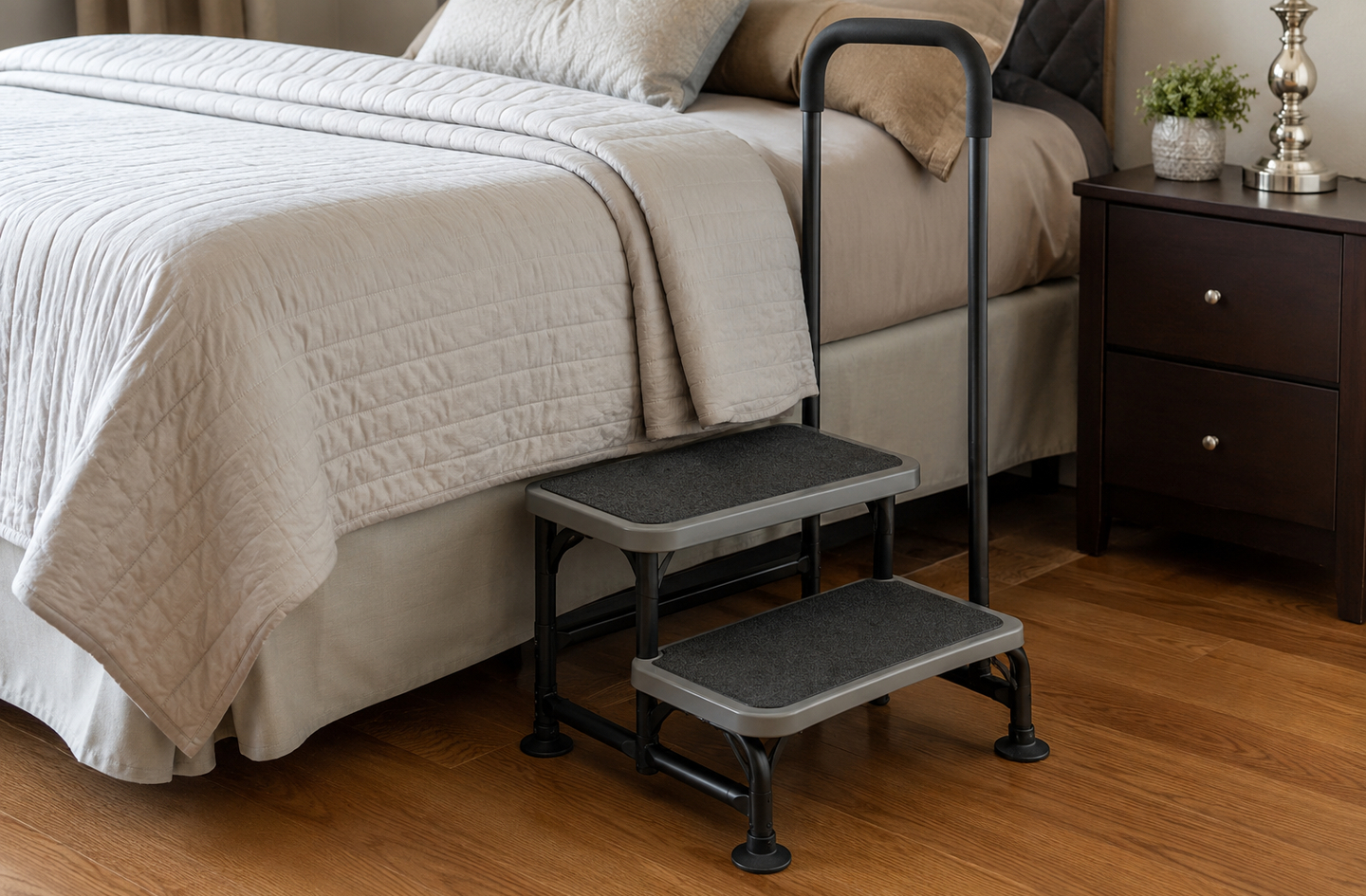
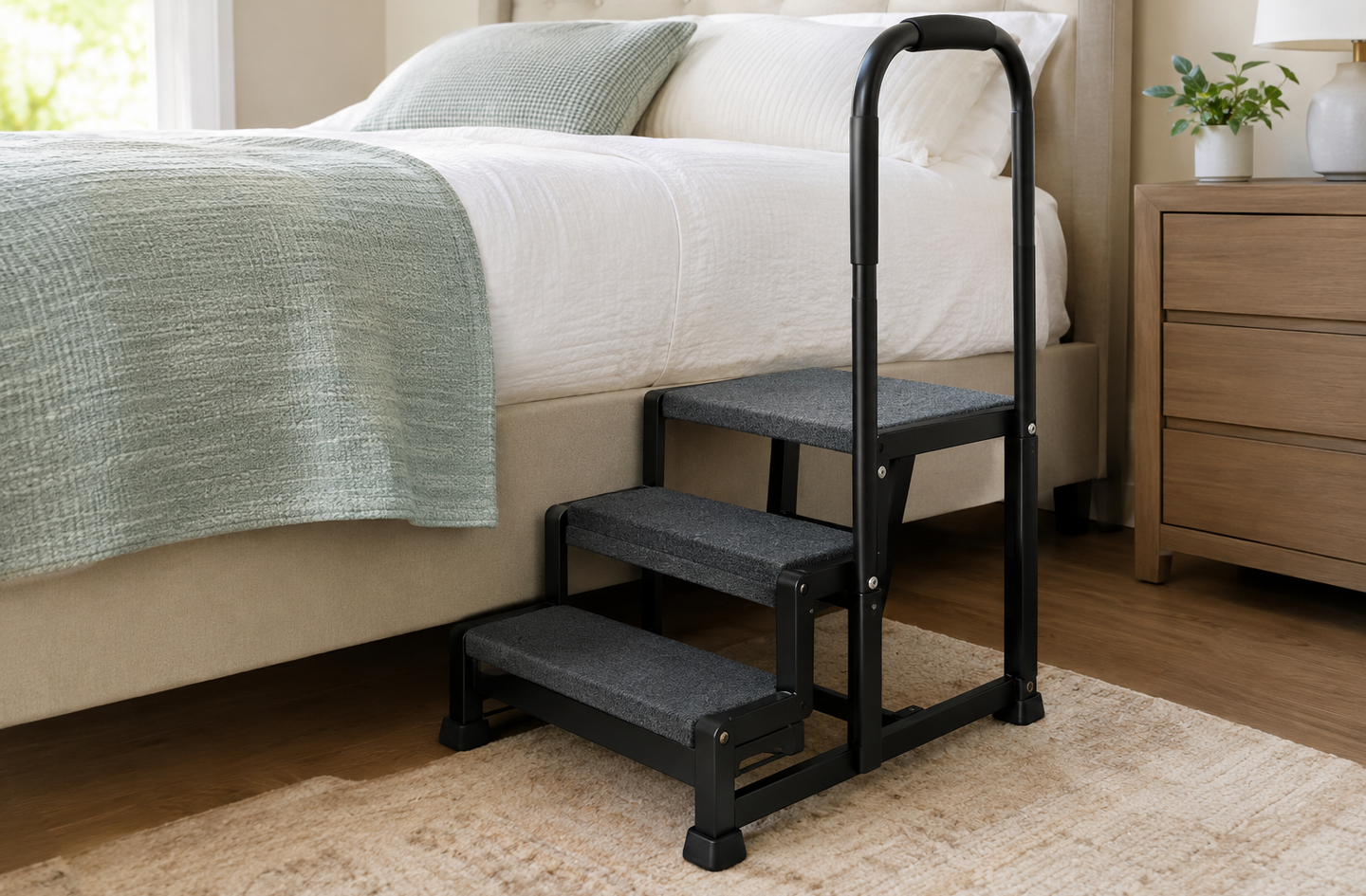
The most common designs use one or two tiers. A single-tier model raises the user’s foot six to eight inches; a two-tier model breaks that same total height into two smaller increments of four to five inches each. The right number of tiers depends on how far above safe transfer height the bed sits. If the bed is only four to six inches too high, a single step may cover the gap. If the height difference is larger, two tiers distribute the transition into smaller, more manageable lifts.
The distance from the floor to the first step platform is the measurement that matters most. A first step that is itself too high recreates the original problem in miniature – the user must still lift the foot a significant distance before reaching the benefit. Evaluate the first-step height against the user’s comfortable step-up ability. A standard interior stair step is typically seven inches; a bed step that matches or falls below that range is more accessible for most adults. Steps marketed at eight or nine inches for the first tier can be challenging for someone with hip or knee limitations.
Platform depth matters as well. A step that is too shallow front-to-back forces the user onto a partial footfall, shifting their center of mass and reducing stability during the transition. Accessible stair design guidance generally calls for a tread depth of at least 11 inches. Bed step products vary widely on this dimension, and it is rarely featured prominently in product listings. Measure before purchasing.
Platform size and nonslip surface
A useful platform supports the full foot, not just the forefoot. When the platform is too narrow front-to-back, the heel may hang off during the mid-step pause, which shifts the user’s weight rearward and increases the chance of a backward loss of balance. A platform that accommodates the user’s full foot length – typically at least 11 to 12 inches for most adults – reduces that risk.
Nonslip surfaces matter most in the footwear most likely to be worn during a bedside transfer: socks or soft-soled slippers. Look for textured rubber or rubberized foam treads rather than smooth plastic. Some models apply grip tape to a smooth surface; that tape can peel at the edges over time, creating a curled edge that is itself a trip hazard, so inspect it periodically. On hard floors, rubber feet provide adequate grip when the surface is dry. On carpet, a wider base footprint holds position better than narrow rubber tips. Test lateral stability before finalizing placement by pressing gently to the side under load.
Handholds and grip support
Some bed step models include a vertical handle that extends above the platform, typically rising to around waist or chest height when standing. A handle changes the safety calculus considerably. Without one, the user relies entirely on their own balance and lower-body strength through the step transition. With a well-positioned handle, they have a bracing reference at the moment of maximum instability: the single-leg stance mid-step.
Handle position matters as much as handle presence. A grip placed too low offers little during the upward phase. A grip too high requires shoulder elevation and can shift the user’s center of mass before the step is complete. For most adults, a handle at roughly hip-to-waist height while standing on the first step provides the most useful bracing geometry. Models that include an adjustable-height handle are preferable when multiple household members use the step.
A floor-to-ceiling transfer pole provides a sturdier and more versatile handhold at the bedside without the step platform itself. See the guide on transfer poles beside the bed for how pole placement and load requirements differ from a step-mounted handle.
Where Bed Steps Add Risk
The same features that make bed steps useful during a planned, daytime transfer become liabilities in the context most likely to cause a fall: a nighttime trip to the bathroom, in low light, in a half-awake state. An estimated 320,751 bed-related injuries reach U.S. emergency departments each year, with 34.4 percent occurring during transfers.2 Among older adults who fell from beds in one clinical study, 87 percent required hospital admission and 41 percent were discharged to a skilled nursing facility rather than home.9 Hip fractures, one of the most serious consequences of a fall, affect approximately 319,000 older adults annually in the United States, and 88 percent of those cases stem from falls.7
“It’s a fact that older adults are far more likely to experience a significant injury, or fatality, from the hidden hazards associated with consumer products in their homes than other age groups.”
Alex Hoehn-Saric, Chair, U.S. Consumer Product Safety Commission8
The nighttime floor obstacle problem
A bed step occupies floor space that is part of the nighttime route from the bed to the bathroom. Waking to use the bathroom is common, and frequency increases with age. Nocturia three or more times per night is associated with a 28 percent higher risk of a fall within three years, based on a prospective cohort study of 692 community-dwelling older adults followed over 36 months.4 Adding a raised obstacle to that path – even a small, well-intentioned one – increases the risk during the highest-frequency, lowest-alertness moments of the day.
The problem compounds when the step drifts even a few inches away from the bed frame. Steps not anchored to the bed or floor can shift during use, making their position unpredictable for the next trip. Folding or removable designs partially address this: the step can be stored after the morning transfer. In practice, that requires a consistent routine that may not hold when fatigue or an unplanned nighttime waking interrupts the habit.
Balance demand on the step
Stepping up and stepping down both require at least one moment of single-leg stance: the foot lifts to the platform while the other foot remains on the floor, or the stepping foot lands on the floor while the other foot is still on the platform. During that transition, the entire body weight is on one leg. For a person with reduced proprioception, lower-limb weakness, or any degree of vestibular impairment, that single-leg phase is the highest-risk point of the sequence.
The physical demand differs from walking on flat ground. A misstep on a level floor triggers a reactive correction. A misstep on a step in the downward direction means a fall from an elevated surface. A bed rail designed for transfer support can provide grip during the same transition without requiring the user to navigate a raised platform. The bed rail selection guide explains the compatibility considerations that determine whether a given rail works with a specific bed and mattress.
Visibility and placement in low light
A bed step is most useful when the user can see it clearly and approach it deliberately. At 2 a.m., in a dark room, after waking from sleep, the step transitions from a purposeful aid to an object in the path. Standard step colors – black, white, or dark brown frames – have low contrast against most bedroom flooring in low light. A user who is not thinking specifically about the step may contact it unexpectedly and lose their footing.
Night lighting at bed level reduces this risk but introduces a dependency. If the light fails or the bulb burns out, the step reverts to an invisible obstacle. A well-placed, motion-activated night light at floor level is better than a fixed plug-in that leaves shadows at the step edge. Our article on bedside commode placement addresses similar nighttime-route tradeoffs for users who also have a commode in the room – a setup that compounds the number of floor obstacles to navigate at night.
Safer Alternatives to Consider First
Before placing a step on the bedroom floor, it is worth asking whether the bed height problem can be solved without adding any new floor obstacle. Several alternatives address the same root cause while leaving the walking path clear.
“Taking a few minutes to identify areas to increase support can help prevent accidents.”
Emily Nabors, Associate Director of Innovation, NCOA Center for Healthy Aging5
Lower the bed frame
Many platform and adjustable bed frames have legs that unscrew or slot into height-adjustable inserts. A bed that is two to four inches too high for a safe transfer can sometimes be brought into range by shortening or swapping the legs without purchasing anything else. Check whether the legs detach, whether the bed sits on a height-adjustable rail, or whether the slat system is bolted to an adjustable-height bracket. This is the lowest-cost, lowest-risk correction for frames that allow it.
For frames with fixed-height legs, shorter replacement legs are available for most standard thread patterns and typically cost less than a quality bed step. Measure leg diameter and thread pitch carefully before ordering. If the frame uses a solid welded base, the frame itself may need to be replaced, at which point a low-profile platform frame is worth pricing.
Remove the box spring or change to a low-profile base
A traditional box spring adds eight to nine inches to the overall mattress height. Replacing it with a low-profile box spring (three to four inches) or a solid wood platform eliminates that extra height entirely. This is one of the single most effective height corrections for beds with a conventional mattress-and-box-spring setup. It costs less than a quality bed step and leaves nothing on the floor.
If the frame requires a box spring for structural support, a bunkie board or solid platform insert substitutes while providing the necessary base. A thick memory foam mattress can sit three to five inches higher than a standard innerspring at the same nominal height, because dense foam compresses slowly and the label reflects the uncompressed measurement. Replacing a worn mattress with a lower-profile model addresses both the mattress and the height problem at the same time.
Use a transfer aid rather than a step
If the difficulty during transfer is not height but rather the effort of the push-to-stand motion, a transfer aid may solve the issue more directly. A bed rail with a solid handhold reduces the upper-body effort required to push up from the mattress edge. A floor-to-ceiling transfer pole provides a vertical grip for pulling and steadying without requiring the user to step onto a raised platform. Neither of these places an elevated surface in the walking path, and both provide continuous grip access throughout the transfer – not just at the step moment.
The transfer pole guide covers placement, grip height, and load requirements in detail. The guide on bed rails for transfer support explains the difference between a rail used as a handhold and one used as a repositioning barrier, and works through compatibility considerations by bed and mattress type. Both aids address the grip deficit that makes transfers difficult without adding a step to the floor.
Who Should and Should Not Use Bed Steps
Bed steps are not universally helpful or universally harmful. The decision comes down to four conditions that should all be true at the same time: the bed is genuinely outside the safe height range, the user has the balance and strength to use a step reliably, no simpler correction is available for this specific bed, and the step can be placed without entering the nighttime walking path.
Each year, more than 14 million older adults aged 65 and older report falling at least once.1 The bedroom accounts for a disproportionate share of those falls, and the transfer moment is the highest-risk point in the room. That context argues for the most obstacle-free solution available. When a simpler fix exists, it is generally worth pursuing first.
Bed steps are a reasonable option when all of the following apply:
- The mattress top sits above 23 to 24 inches from the floor, and the frame cannot be meaningfully lowered.
- The user has stable bilateral balance on flat ground, no significant lower-extremity weakness, and no diagnosed vestibular disorder or severe visual impairment.
- The step can be placed flush against the bed frame, outside the direct nighttime path to the door or bathroom.
- The step unit includes a handle at a useful grip height, or a separate transfer rail or pole provides the handhold at that same bedside position.
- The floor beneath the step is flat and stable, with no rug edge, carpet-to-hard-floor transition, or loose mat in the immediate area.
Bed steps are likely to add more risk than they resolve when any of the following apply:
- The user wakes frequently at night and navigates the bedroom in dim or no light.
- Balance, coordination, or lower-limb strength has changed to the point where single-leg stance on a raised surface is not reliable.
- A simpler correction – shorter frame legs, a thinner base, or a transfer rail – would address the height or push-up problem without a floor object.
- The bedroom layout leaves no placement for the step that is both accessible for transfer and clear of the nighttime route.
- The user already uses a walker or rollator, which may catch the step edge or require a repositioning stop before the transfer.
When a bed step is the selected approach, it works best alongside adequate nighttime lighting along the route, a clear floor from the bed to the door, and a grab surface – a rail, a pole, or a stable nightstand edge – to assist the final push to standing. The step solves the height gap. The other elements address the nighttime-route and transfer-strength issues that exist alongside it.
Frequently Asked Questions
How high should a bed be for safe transfers for older adults?
The NCOA recommends the top of the mattress sit 20 to 23 inches from the floor, with both feet resting flat and knees at roughly 90 degrees when seated on the edge.5 Clinical research places the optimal transfer height at approximately 120 percent of the user’s lower-leg length.6 Measure from the floor to the sleeping surface rather than to the frame rail, since mattress thickness and base height vary significantly by product.
Are bed steps safe for seniors with balance problems?
Not generally. Bed steps require single-leg stance during the step-up and step-down, which is the highest-risk moment in the sequence. A person with reduced balance, vestibular impairment, or lower-limb weakness is more likely to benefit from a transfer rail or floor-to-ceiling pole that provides continuous grip support, rather than a raised platform that adds a balance challenge on top of the height challenge. An occupational therapist can evaluate which aid fits a specific person’s situation.
What is the difference between a bed step and a bed rail?
A bed step raises the user’s foot toward the mattress level and is used as a platform during entry and exit. A bed rail attaches to the bed frame and provides a handhold grip but does not change the approach height. Many users need grip support but not a height bridge; for them, a rail addresses the actual problem without adding a raised surface to the floor. Some bed step models include a built-in handle that functions similarly to a rail grip during the step movement, but the rail itself sits beside the bed rather than on the floor.
When is lowering the bed better than adding steps?
Lowering the bed is better whenever it is structurally possible. It solves the height problem permanently without placing a new object on the floor or requiring the user to develop a new balance skill. On platform and adjustable frames with removable legs, the correction often costs nothing or very little. On beds with a conventional mattress and box spring, replacing the box spring with a low-profile version (three to four inches rather than eight to nine) is usually the highest-value, lowest-disruption correction available.
What floor surfaces are safest under a bed step?
Hard floors with a clean, dry surface are generally the most stable for bed steps with rubber feet. On carpet, a step with a wider base footprint holds position better than narrow rubber tips, which can sink or pivot in pile. Never place a bed step on a loose rug or over a rug edge: the step base can catch the edge and tip, or the rug can slide under the step. If the available floor surface is carpeted and the pile is thick, test lateral stability before each use by pressing gently to the side under load before committing weight.
Limitations and Edge Cases
- This article covers standard freestanding bed step units. It does not address motorized adjustable bed bases that change height electronically, which resolve the height problem through a different mechanism entirely.
- The 20 to 23 inch height range is a general guideline for typical adult proportions. Taller or shorter individuals may have a different optimal transfer height based on lower-leg length, and an occupational therapist can measure this precisely for a specific person.
- Users who transfer laterally into a wheelchair rather than standing vertically face a different set of requirements. For that scenario, the spoke on bed rails for transfer support covers compatible rail types for lateral sliding transfers.
References
- NCOA – Get the Facts on Falls Prevention. National Council on Aging, May 2025.
- PMC / National Institutes of Health – Trends and Risk Factors for the Hospitalization of Older Adults Presenting to Emergency Departments After a Bed-Related Fall. 2025; NEISS data 2014-2023.
- PMC / American Journal of Lifestyle Medicine – A Descriptive Analysis of Location of Older Adult Falls That Resulted in Emergency Department Visits in the United States, 2015. Published August 2020; n=38,654.
- PMC / National Institutes of Health – The Association of Nocturia with Incident Falls in an Elderly Community-Dwelling Cohort. PMC3222329; prospective cohort, n=692, 36-month follow-up. 2011.
- NCOA – Bedroom Safety for Older Adults: How to Prevent Falls at Home. National Council on Aging, updated August 2026.
- PubMed / National Library of Medicine – Bed and Toilet Height as Potential Environmental Risk Factors for Falls in Older Adults. Journal of Nursing Scholarship, 2008. PMID 18184978.
- CDC – Preventing Falls and Hip Fractures. Centers for Disease Control and Prevention, 2024.
- CPSC – Older Americans Are More Likely to Suffer Fatalities from Falls and Fire. U.S. Consumer Product Safety Commission, March 2022.
- PMC / Cureus – Falls From Beds Among Elderly Outpatients: Injuries and Outcomes. Nugent, McCague, Henken-Siefken. April 2024.
Conclusion
Bed steps for seniors solve a real problem when the bed is too high and no simpler height correction is available. They add risk when they sit in a nighttime walking path, when the user’s balance or vision makes a stepped surface unreliable, or when a lower-cost fix – shorter frame legs, a thinner base, or a transfer rail – would address the height or push-up problem without leaving anything on the floor. The bedroom already carries the highest fall risk of any indoor room for older adults, and that context makes the tradeoff worth examining carefully before choosing a product-based fix.
For a broader view of how bed height, transfer position, and nighttime routes fit together, see the overview in Bedroom Safety Planning for how each bedroom element connects to the others.