
Roughly one in four adults age 65 and older falls each year – 14 million falls annually in the United States.1 The bathroom is among the highest-risk rooms in any home, and senior bathroom safety products range from well-engineered fixtures rated to withstand 250 pounds of force to low-cost units whose anchoring fails under daily use. The Bathroom Safety Planning overview covers how the full bathroom system fits together. This article covers a narrower question: how to judge which senior bathroom safety products are actually worth installing, using four evaluation filters – load rating, anchoring method, movement fit, and daily-use ergonomics.

Quick Answer
What makes a senior bathroom safety product worth installing?
A grab bar or shower seat is worth installing when it carries a structural load rating of at least 250 pounds applied at any point on the bar, fastener, or mounting device – the minimum required under ANSI A117.1 and ADA standards.4 The anchoring method must match the wall type (stud mounting is the only method that reliably meets this threshold in most residential walls), and the product’s shape and placement must match the specific movement it supports, not just the general bathroom zone.
Key Takeaways
- ANSI A117.1 and ADA standards both require grab bars and shower seats to withstand 250 pounds of force applied at any point on the bar, seat, fastener, or supporting structure.
- More than 65% of bathroom injuries among adults occur in or near the tub and shower zone; toilet transfers account for 14% of injuries and that share rises to 19-37% among adults age 65 and older.3
- Suction-cup grab bars do not meet the ANSI structural load requirement and are not suitable as primary support in bathrooms.
- ANSI A137.1:2022 requires wet interior tile to have a Dynamic Coefficient of Friction (DCOF) of at least 0.42; choosing tile below this threshold adds measurable slip risk in wet bathroom zones.7
Before You Begin: Understanding What “Safe” Really Means
The word “safe” appears on nearly every grab bar, shower seat, and non-slip bath mat on the market. It rarely refers to an independently verified standard. Before evaluating any specific product, it helps to know that two concrete frameworks exist for what structural safety actually means in bathroom fixtures: the ADA Standards for Accessible Design and the parallel ANSI A117.1 accessibility standard. Both specify exactly how much force a grab bar or shower seat must withstand and where that force can be applied. In 2023, the unintentional fall death rate for adults age 65 and older reached 69.9 per 100,000 in the United States – a figure that has more than doubled for adults age 85 and older since 2003.2
A grab bar gripped hard during an off-balance moment delivers a dynamic jerk load, not a slow steady push. A shower seat carries a user’s full body weight as they lower and rise. Products calibrated only for marketing descriptions, not engineering tests, often fail at exactly those moments. The five steps below are a practical framework for filtering products by the criteria that actually determine whether they hold. You do not need to be a contractor or an engineer to use them. You need to ask for the number, not the adjective.
Step 1: Read the Load Rating, Not the Marketing Language
The single most useful number on any grab bar or shower seat product page is the structural load rating. A bar described as “heavy duty,” “commercial grade,” or “professional strength” is communicating marketing positioning. A bar described as rated to 250 pounds or 500 pounds at any mounting point is communicating a testable engineering specification. These are not the same thing, and only the second tells you whether the product meets the minimum threshold set by the accessibility standard.
What the 250-pound standard actually requires
Under ANSI A117.1 (the American National Standard for Accessible and Usable Buildings and Facilities), grab bars must meet a specific structural load requirement. The ADA Access Board’s official Chapter 6 guidance puts it in plain language:
“The structural strength of grab bars must withstand a vertical or horizontal force of 250 lbs. at any point on the grab bar, fastener, mounting device, or supporting structure.”
ADA Access Board, Chapter 6: Toilet Rooms Guide (ANSI A117.1, Section 609.8 Structural Strength)4
This is a structural integrity test, not a user-weight rating. It means the bar, its fasteners, and the wall assembly behind it must resist 250 pounds of force applied at any single point – in any direction. A bar secured only into drywall, even with oversized anchors, will not meet this threshold under realistic conditions. A bar reaching a wall stud typically can, depending on the hardware and installation quality.
The same 250-pound structural load requirement applies to shower seats. Under ADA Section 610.4, the seat, its fasteners, mounting device, and supporting structure must all resist 250 pounds of vertical or horizontal force at any point.5 A fold-down shower seat mounted only into tile and cement board, without reaching structural framing, does not meet this standard.
How to read a product listing for load information
Most product pages use one of three approaches. The most useful states a specific pound rating applied “at any point on the bar and mounting hardware.” The second states a weight capacity without specifying whether it applies to the full mounting assembly or only the bar material – this is weaker, because bar material can be strong while fasteners and wall anchors are not. The third uses only adjectives like “heavy duty” with no numeric rating.
One reliable shortcut: look for explicit ANSI A117.1 or ADA compliance language. When a product states it meets these standards, the manufacturer is claiming structural testing to the 250-pound specification. This does not guarantee a specific installation will hold – that depends on wall type and installation quality – but it confirms the product was designed to meet an independent standard.
Step 2: Match the Anchoring Method to Your Wall Type
A grab bar’s load rating describes how much force the product and its hardware were designed to resist. Whether the installed bar actually resists that force in your bathroom depends on the wall it is anchored into. The bar and the wall are two separate parts of the same structural system, and a high-rated bar in an inadequate wall assembly is not a high-rated installation.
The three wall types found in most residential bathrooms
Most bathroom walls fall into three categories. The most common is tile over cement board over structural framing – typical in bathrooms built after roughly 1970. The studs behind the cement board are the anchoring target; lag screws reaching a stud through tile and board can meet the 250-pound specification when properly driven.
The second is tile over standard drywall, more common in older bathrooms and lower-cost construction. Drywall alone compresses under sustained load; toggle bolts and plastic anchors typically fail below the 250-pound threshold under repeated dynamic loads. If you cannot confirm stud location behind the tile, a licensed contractor should assess the wall before installation.
The third is solid-surface or composite panel bathrooms, found in prefabricated and manufactured homes. These surfaces carry their own anchoring requirements from the panel manufacturer, and grab bar installation typically requires consulting that documentation or a licensed contractor.
Why suction-cup grab bars are not a substitute for wall-mounted bars
Suction-cup grab bars are widely marketed as tool-free, renter-friendly bathroom safety solutions. They are useful as supplemental grip points in low-demand applications. They are not a substitute for wall-mounted bars in high-demand transfer zones like shower entry and exit or toilet transfers. Suction cups cannot reliably generate 250 pounds of resistance force across all surface textures and under wet conditions. Textured tile, older porcelain, and surfaces with mineral buildup all reduce suction seal quality. Suction pressure ratings also refer to ideal static conditions, not to the dynamic jerk loads generated in an off-balance grab – exactly when a secure grip point is most needed.
If your situation requires a non-permanent solution, a suction bar with a high manufacturer-stated rating is better than no bar. Treat it as supplemental support, not primary support, and inspect the seal before each use.
When to bring in a licensed contractor
Installing a grab bar in a tiled bathroom wall is not a straightforward DIY task in most homes. Locating studs through tile accurately, driving fasteners without cracking the tile, and confirming the wall assembly before committing the installation all require proper tools or experience. If the installation is in the shower zone (where more than 65% of bathroom injuries occur), the stakes of a failed installation are high.3 An occupational therapist can advise on placement; a licensed contractor handles the structural work. Both are worth consulting for primary support points in high-use zones.
Step 3: Match the Product to the Specific Movement It Supports
Bathroom injuries do not distribute evenly across the room. More than 65% of all nonfatal bathroom injuries in the United States occur in or near the tub and shower zone, while approximately 14% involve the toilet – specifically the act of standing up, sitting down, or using the toilet.3 Among adults age 65 and older, that toilet-transfer proportion rises to between 19% and 37% of all bathroom injuries.3 This data shapes which products matter most in which zones, and it shows that a product plan focused only on the shower misses a significant share of actual risk.
But knowing the zones is only half the answer. Within each zone, the specific movement determines which product form is useful. A horizontal bar mounted at the wrong height for a particular person’s movement arc provides less support than no bar, because it trains the person to reach for a point that does not naturally fall along their movement path.
Products for shower and tub entry and exit
The injury data from the tub and shower zone is worth noting in more detail: only 2% of bathroom injuries occur during shower entry, when the floor is still dry.3 The risk peaks during use and, especially, during exit – when both the floor and the user are wet, and when fatigue from standing has accumulated. Products for this zone should support the transition from standing in the shower to stepping out over the threshold, and the reverse movement going in.
A vertical or angled grab bar mounted on the wall adjacent to the shower opening supports this movement best: the hand slides along a rail during the step rather than reaching for a fixed point. For bathtub transfers, a horizontal bar at tub-rim height on the wall the user faces as they lower in is the more relevant product form.
Products for the toilet transfer zone
The toilet transfer is the most frequently overlooked zone in bathroom safety planning. Rising from a toilet seat involves extending the knees and hips from a flexed position while the center of gravity shifts forward – one of the more physically demanding movements of the daily bathroom routine for anyone with reduced leg strength or balance uncertainty.
Products in this zone include safety rails that bolt to the toilet flange (providing armrest-style push-up points on both sides), raised toilet seats that reduce the vertical distance of the sit-to-stand transfer, and wall-mounted grab bars positioned within reach of the seated user’s hand. A raised seat reduces how far the knees must flex. A safety rail provides push-up leverage. A wall-mounted bar steadies the final phase of standing. Some users benefit from one; some benefit from all three. Matching the product to the physical demand comes first.
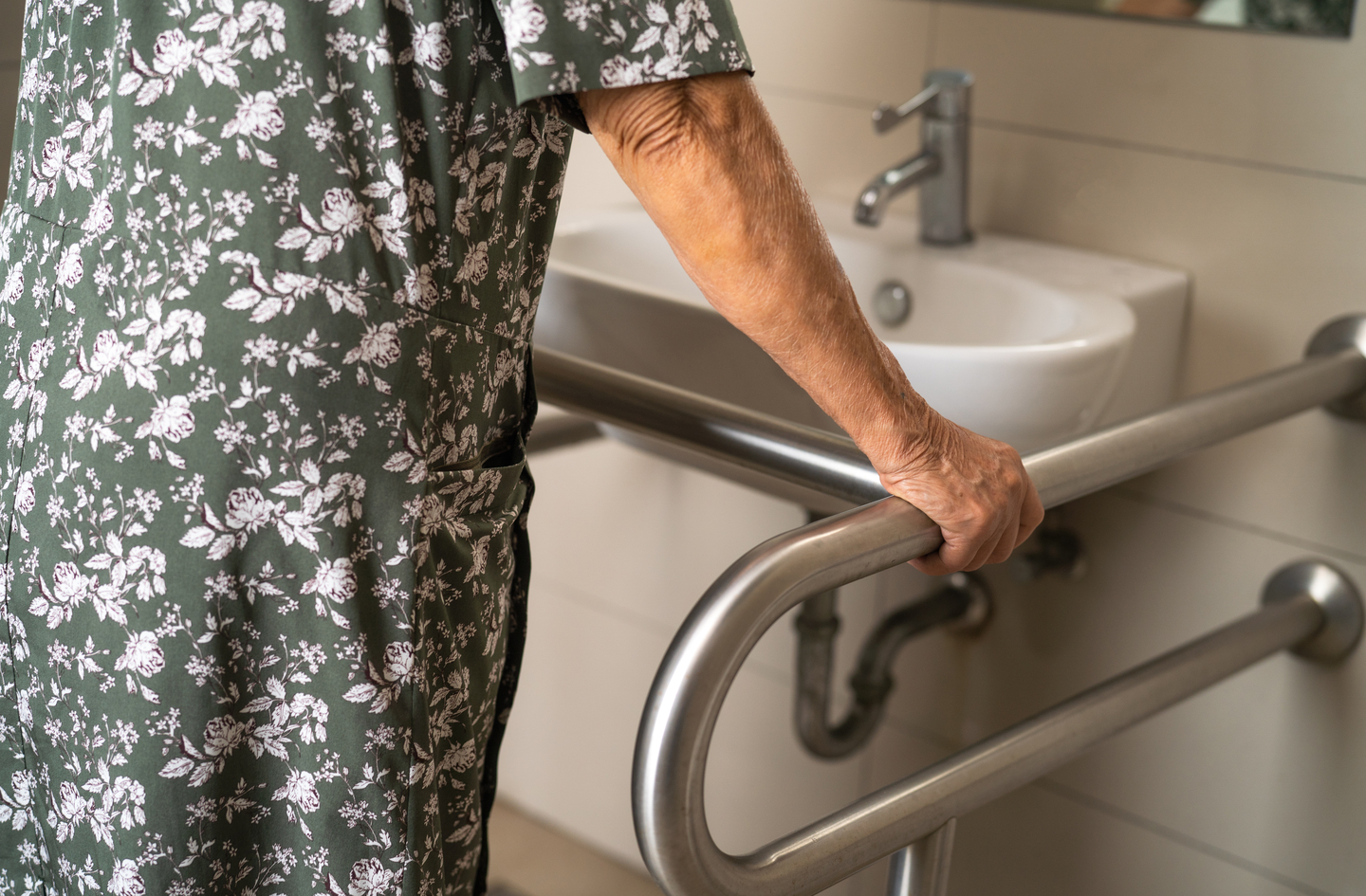
Step 4: Evaluate Daily-Use Ergonomics, Not Just Load Specs
A grab bar that meets the 250-pound structural requirement and is properly anchored into studs can still be the wrong product if the grip diameter is too wide, the surface texture is too smooth, or the placement does not match where the user’s hand naturally lands during the movement. Load specs confirm the product will not pull out of the wall. Ergonomics determine whether it will actually be used, and used correctly, every day.
Bar diameter and surface texture
The ADA Accessibility Guidelines specify that grab bars for adults should have an outside diameter of between 1.25 inches and 2 inches.5 This range reflects the grip mechanics of an adult hand. Bars below 1.25 inches are too narrow for a secure wrap grip under load. Bars above 2 inches are too wide for most adults to close their fingers around effectively, particularly under the reduced grip strength common with age-related changes in hand and forearm musculature.
Surface texture is equally important and less often specified on product pages. A bare stainless or chrome tube transmits little friction to a wet hand. Most well-designed bars for bathroom use have a knurled texture, a satin or brushed finish, or a coated grip section in the primary contact zone. Confirm the finish type from the product description before purchase. A bar that looks like a grab bar but grips like a towel rod is a compromise that becomes obvious on the first wet-hand morning.
Placement relative to the body’s movement arc
The most common ergonomic error is placing a grab bar at a height that felt intuitive in planning but does not align with where the user’s hand lands during the actual movement. The bar needs to be reachable without a deliberate reaching motion – it should be where the hand naturally extends during the transfer, not where you have to seek it.
For toilet support, the relevant reach zone is from a seated position, with the elbow at roughly 90 degrees of flexion, progressing upward during the stand. A bar too far forward requires leaning; too far back requires twisting. An occupational therapist can evaluate placement for a specific person’s body proportions and movement patterns – the correct professional for this decision.
Non-slip flooring and the DCOF standard
Slip-resistant flooring is one of the most effective and underrated bathroom safety modifications, partly because it requires no visible hardware and fits any home aesthetic when selected carefully. The relevant performance standard for tile and ceramic flooring in wet interior spaces is ANSI A137.1:2022, which requires a Dynamic Coefficient of Friction (DCOF) of at least 0.42 for tile products intended to be walked upon when wet.7 DCOF measures the friction of a tile surface under a moving foot – the relevant condition during a bathroom walk, not a static stand.
When selecting tile for a bathroom wet zone, ask for the product’s DCOF rating in the specification sheet. Tiles rated below 0.42 DCOF were not certified for wet interior walking surfaces. Many polished tiles fall into this category; a honed or textured finish on the same material typically tests higher. This specification choice cannot be corrected without replacing the tile after installation.
Step 5: Run a Short Pre-Purchase Quality Check
Before committing to any senior bathroom safety product, a five-point check covers the criteria that separate products worth installing from products that look similar but behave differently under real use. This check takes less than five minutes and applies to grab bars, shower seats, toilet safety rails, and non-slip flooring products.
The five-point pre-purchase check
1. Load rating stated as a number, not an adjective. The product listing should state a specific weight or force capacity, ideally with language indicating it applies to any point on the bar, seat, or mounting hardware. “Holds up to 300 lbs” without specifying at which point and under which mounting conditions is not a complete specification. Prefer products that explicitly cite ANSI A117.1, ADA compliance, or a specific pound rating at any mounting point.
2. Anchoring method clearly specified. The product packaging or listing should name the fastener type, the number of fasteners, and what wall materials the rating was tested against. Products that state “suitable for most bathroom walls” without specifying what that means are not giving you the information you need to assess whether your wall qualifies.
3. Bar diameter between 1.25 and 2 inches. Confirm the outer diameter is listed and falls in the ADA-specified range for adult grips. This is a specification field that is often absent from low-cost products; its absence is itself a signal.
4. Surface texture on the grip zone. Confirm the finish is described as textured, knurled, satin, or brushed – or has a grip coating in the hand contact zone. “Polished chrome” and “mirror finish” are smooth-surface descriptors and suggest a bar that was designed for appearance rather than grip.
5. Finish material, not finish appearance. Stainless steel, powder-coated steel, and aircraft-grade aluminum are durable finishes for bathroom environments. “Chrome” is both a genuine metal plating and a chrome-look plastic coating used on cheaper products. Confirm the core material in the specifications rather than relying on the appearance of the product in photos.
A note on the planning-to-action gap
In 2024, AARP found that 43% of adults age 50 and older plan to modify their homes for future physical limitations, and 72% of those planners are targeting bathroom upgrades including grab bars and no-slip tile.6 The planning instinct is present. The product-selection framework is often what is missing – specifically, the habit of asking for the load rating and anchoring spec before the finish color. This five-point check is one attempt to close that gap.
Common Mistakes When Choosing Senior Bathroom Safety Products
Most product-selection errors in this category fall into a small number of patterns. The most common is buying by appearance and price rather than specs. A bar that looks exactly like a compliant grab bar can be an unrated decorative accessory marketed in the same category. The appearance is indistinguishable to the eye. The load capacity and mounting hardware are not.
Treating suction bars as primary support
Suction-cup grab bars are appropriate as temporary supplemental support in low-risk zones. They are not appropriate as primary support in shower entry zones or toilet transfer zones, where surface conditions and dynamic load patterns make them unreliable when support matters most.
Installing into drywall without reaching framing
This is the single most common installation error and the one most likely to result in failure under load. Drywall anchors can hold a towel ring. They cannot reliably hold a human body load applied at a dynamic jerk angle. If the studs are not in the right location for ideal bar placement, a blocking solution – a solid plate secured to the studs, then tiled over – is the correct structural approach.
Focusing only on the shower zone and skipping the toilet
Transfer injuries at the toilet account for a meaningful share of bathroom injuries, and that share rises substantially among older adults. A plan that addresses the shower completely while leaving the toilet zone unsupported misses a significant risk. Safety rails and raised seats in this zone are among the lower-cost interventions in the category and among the most frequently overlooked.
Choosing placement by convenience, not by movement arc
Grab bar placement is often driven by stud location and aesthetics rather than by where the user’s hand lands during the target movement. Stud-finding informs anchoring; movement analysis drives placement. When the two conflict, a blocking solution in the wall before tiling resolves the conflict permanently.
What Quality Senior Bathroom Safety Products Look Like
A quality senior bathroom safety product is not necessarily the most expensive one in the category. It is the one that meets a set of verifiable specifications, is installed in a wall assembly that can support those specifications, and is placed where it actually supports the movement it is meant to help.
For grab bars: a structural load rating to 250 pounds at any mounting point, stainless steel or powder-coated steel construction, a bar diameter between 1.25 and 2 inches, a textured or satin grip surface, and flanged ends with at minimum 1.5 inches of wall clearance between the bar and the wall (per ADA guidance on clearance for the gripping hand). Installation reaching structural framing, not drywall only.
For shower seats: a structural load rating to 250 pounds, fold-down or fixed wall-mount design reaching structural framing, a seat surface with drainage holes or non-porous material that does not retain water, and a seat depth that allows the user to sit fully back rather than perching at the edge. Installation by a licensed contractor in any wall with uncertain framing location.
For non-slip tile: a DCOF of 0.42 or higher confirmed in the product specification sheet, applied in the full wet zone (not just under a bath mat). An occupational therapist can provide guidance on the full bathroom layout; a licensed contractor handles the installation.
Limitations and Edge Cases
- This guide covers standard residential bathroom configurations. Prefabricated bathrooms, fiberglass tub surrounds, and composite panel systems have their own anchoring requirements; contact the manufacturer directly before installing grab bars in those surfaces.
- The 250-pound structural load specification applies to accessible design standards. A specific user’s needs may require higher-rated hardware; an occupational therapist or accessibility specialist can assess the specific person and situation.
- The bathroom injury location data cited here (CDC MMWR, 2011) is drawn from 2008 emergency department surveillance data. It is the most specific federal government dataset available on this question; no equivalent federally-published breakdown for a more recent year was found in research for this article.
- The flooring DCOF standard (ANSI A137.1:2022) applies to tile and ceramic products. Different slip-resistance standards apply to other flooring materials; consult the product specification sheet and the relevant industry standard for non-tile surfaces.
Frequently Asked Questions
What is the minimum weight capacity for a bathroom grab bar?
Under ANSI A117.1 and ADA standards, a compliant grab bar must withstand a vertical or horizontal force of at least 250 pounds applied at any single point on the bar, fastener, mounting device, or supporting structure.4 This is a structural integrity requirement, not a user-weight limit; the installation – bar, hardware, and wall assembly together – must meet the threshold, not just the bar material itself.
Can I use a suction-cup grab bar as my main bathroom support?
Suction-cup grab bars do not meet the 250-pound structural load requirement in ANSI A117.1 and are not suitable as primary support in high-demand zones like shower entry or toilet transfers. They can serve as supplemental grip points in low-risk areas. For primary support, a flanged wall-mounted bar anchored into structural framing is the standard recommendation from accessibility guidelines.4
Where in the bathroom are seniors most likely to be injured?
More than 65% of nonfatal bathroom injuries among adults occur in or near the tub and shower zone, according to the CDC’s analysis of 2008 emergency department data.3 Toilet transfers account for approximately 14% of bathroom injuries overall; among adults age 65 and older, that share rises to between 19% and 37%. Planning should address both zones, not only the shower.
What diameter grab bar is recommended for seniors?
The ADA Accessibility Guidelines specify an outer diameter of 1.25 to 2 inches for grab bars used by adults.5 This range supports a secure wrap grip for most adult hand sizes. Bars outside this range – too narrow to grip firmly, or too wide to close the fingers around effectively – are not compliant with accessibility design standards and typically provide less functional support.
What slip-resistance rating should bathroom tile meet?
ANSI A137.1:2022, published by the Tile Council of North America, requires tile intended for use on level interior surfaces that will be walked upon when wet to have a Dynamic Coefficient of Friction (DCOF) of at least 0.42.7 DCOF measures friction under a moving foot, which is the relevant condition in a bathroom walk. Confirm this rating in the product specification sheet before selecting tile for a shower floor or bathroom wet zone.
References
- National Council on Aging (NCOA) – Get the Facts on Falls Prevention. NCOA, 2024.
- CDC National Center for Health Statistics – Unintentional Fall Deaths Among Adults Aged 65 and Older: United States, 2023. NCHS Data Brief No. 532, June 2025.
- CDC Morbidity and Mortality Weekly Report (MMWR) – Nonfatal Bathroom Injuries Among Persons Aged 15 Years and Older, United States, 2008. June 10, 2011.
- United States Access Board – ADA Accessibility Guidelines, Chapter 6: Toilet Rooms. Cites ANSI A117.1, Section 609.8 Structural Strength. Accessed July 2026.
- United States Access Board – ADA Accessibility Guidelines, Chapter 6: Bathing Rooms. Sections 609 (Grab Bars) and 610 (Seats). Accessed July 2026.
- AARP Public Policy Institute – 2024 Home and Community Preferences Survey. AARP, 2024.
- Tile Council of North America (TCNA) – ANSI A137.1:2022 American National Standard Specifications for Ceramic Tile. TCNA, 2022.
Conclusion
Choosing senior bathroom safety products by load rating, wall anchoring, movement fit, and daily-use ergonomics produces installations that hold because they are built to hold, not because they look like they should. The 250-pound structural load requirement is the starting line, not a ceiling. Matching anchoring to the actual wall type ensures the spec survives installation. Matching the product to the specific movement removes the gap between a product that looks right and one that works right every morning.
For a broader view of how bathroom products fit within the larger context of safer access, see the Bathroom Safety Planning overview for how the full system fits together.